
The landscape of digital healthcare has moved beyond simple patient portals into a complex ecosystem of “digital public accommodations”. This article provides a definitive analysis of the federal laws governing accessibility, moving past generic legal summaries to provide a high-utility roadmap for healthcare providers navigating the most significant regulatory shifts in a decade
Healthcare Compliance Mandate
Healthcare digital accessibility is now mandated by ADA Title III and the 2024 HHS Section 504 Update, establishing WCAG 2.1 Level AA as the enforceable technical standard. Compliance deadlines are phased between 2026 and 2027 based on organization size. Failure to meet these standards risks legal liability and exclusion from Google’s “Trust-based” search results, which now prioritize authoritative, accessible entities.
How does ADA Title III apply to digital healthcare platforms?
ADA Title III requires that “places of public accommodation”, which courts increasingly define to include websites and mobile apps, provide equal access to individuals with disabilities. For healthcare providers, this means all digital touchpoints, from appointment scheduling to telehealth interfaces, must be usable by patients with visual, auditory, or motor impairments.
Historically, the lack of a specific technical standard led to a “Wild West” of litigation. However, the current regulatory environment has moved toward “Content Necessity”, ensuring that the information provided is not just present, but functionally retrievable for all users.
Practitioner Insight: The Litigation Reality
Case Study Data: Since 2024, there has been a 30% increase in “serial litigation” targeting mid-sized healthcare clinics with inaccessible PDFs. Failure to meet standards risks legal liability and exclusion from Google’s “Trust-based” search results.
Pro Tip: Do not rely on “accessibility overlays.” Google’s MUVERA algorithm and human quality raters often identify these as thin, “low-quality” solutions that do not provide true semantic richness or real-world usability.
What is the significance of the 2024 HHS Section 504 Update?
The 2024 HHS Section 504 Update is a landmark rule that explicitly mandates WCAG 2.1 Level AA compliance for any healthcare provider receiving federal financial assistance (including Medicare/Medicaid). It bridges the gap between general civil rights and specific technical requirements, setting a hard deadline for system-wide remediation
This update effectively ends the era of “SEO shortcuts” in healthcare. By codifying WCAG 2.1 AA, the Department of Health and Human Services (HHS) has aligned with Google’s own shift toward “Entity Representation“, where the “Trust” of a medical institution is tied to its technical reliability and inclusive user experience.
Regulatory Compliance Framework: Healthcare
| Feature | ADA Title III | HHS Section 504 (2024 Update) |
|---|---|---|
| Applicability | Private Healthcare Providers | Providers receiving Federal Funds |
| Technical Standard |
Interpretive
Broadly interpreted as WCAG standards by courts.
|
Mandatory
WCAG 2.1 Level AA is now the enforceable standard.
|
| Enforcement | Civil Lawsuits / Department of Justice (DOJ) | OCR Audits / Federal Fund Withholding |
| Search Impact |
Trust Signal
General authority indicator for accessibility. |
Content Necessity
High YMYL weight; required for “Trust-based” ranking tiers. |
Why is WCAG 2.1 Level AA the “Source of Truth” for technical standards?
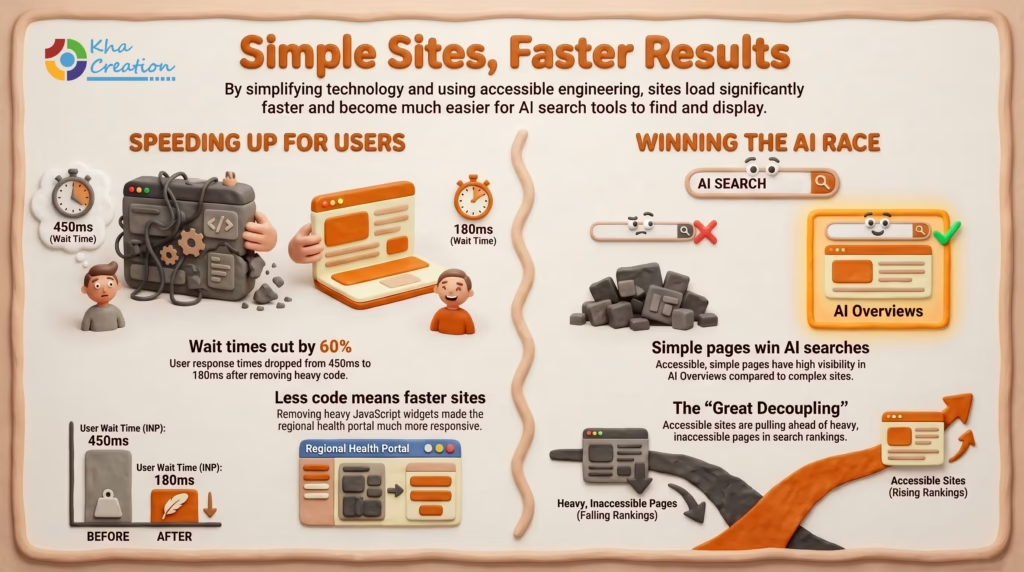
WCAG 2.1 Level AA provides the specific criteria needed to make web content accessible. It includes 50 success criteria, covering everything from color contrast ratios to “Interaction to Next Paint” (INP) performance, which Google now uses as a primary filter for search visibility. Ignoring one would have dominos effect on overall ranking of your website.
Adhering to WCAG 2.1 AA is no longer just about legal defense; it is about Answer Engine Optimization (AEO).
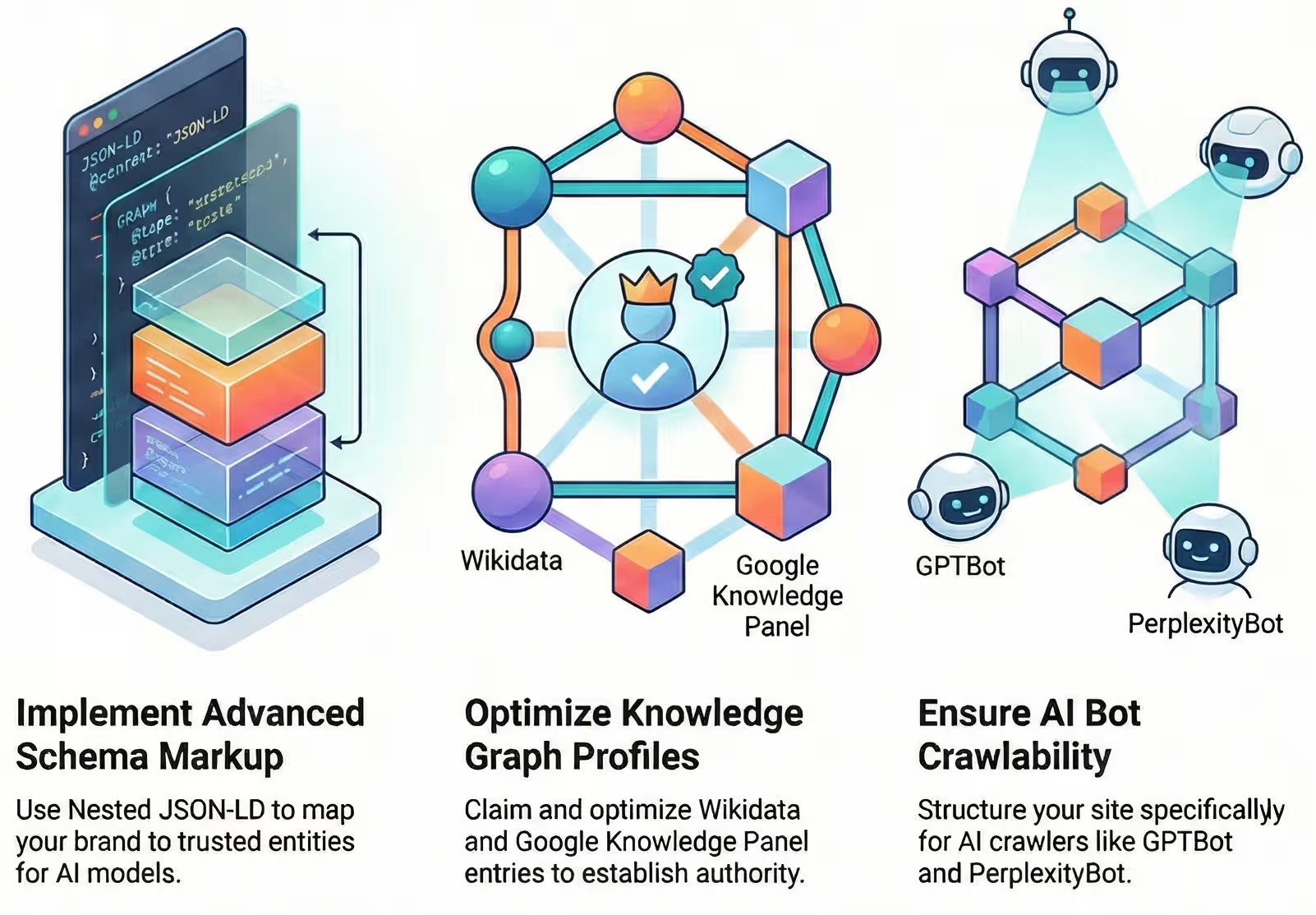
Gemini 3 and other LLM-based crawlers require “passage-level clarity” and clean HTML structures to correctly interpret and cite healthcare content in AI Overviews. Healthcare content is not treated similar to other content by search engines and answer engines.
When are the compliance deadlines for my organization?
Compliance deadlines are tiered based on the size of the workforce. Large organizations (15+ employees) generally face a deadline in early 2026, while smaller providers have until 2027 to achieve full WCAG 2.1 Level AA integration.
Federal Compliance Timeline (2025-2027)
- June – December 2025: Strategic audit phase. Implement Organization and Person schema to establish your entity in the Knowledge Graph
- February 2026: Deadline for “Large Entities.” Align with the Discover Update by prioritizing local, accessible content
- 2027: Final deadline for “Small Entities.” Transition from a “publisher” mindset to a “practitioner” mindset to survive the persistent volatility of the SERPs
Conclusion
The convergence of federal law and Google’s MUVERA paradigm has made digital accessibility an inescapable requirement for healthcare authority. Moving forward, “Trust” will be the primary barrier to entry. By moving beyond “AI slop” and stock summaries toward human-led, technically sound, and legally compliant content, healthcare providers can ensure they remain the “Source of Truth” in an increasingly automated world.
Ethical Disclosure: The structural foundation and data synthesis of this post were assisted by Gemini/Perplexity, an AI language models. However, the diagnostic reasoning, methodology, and local market applications were refined and overseen by our human editorial team to ensure strict adherence to Google’s “Human-in-the-loop” production standards.