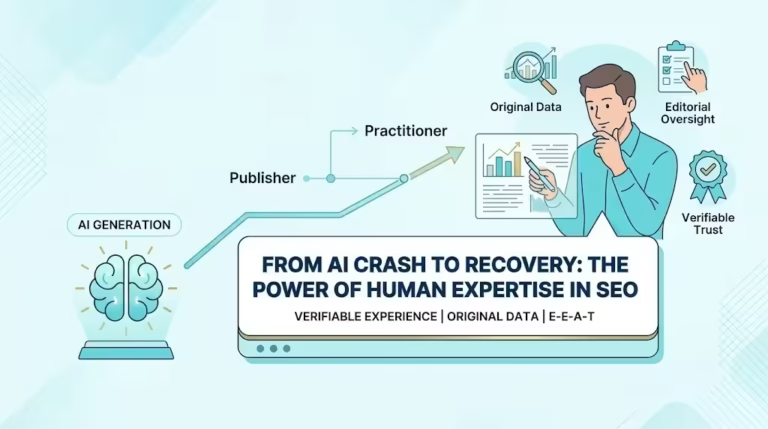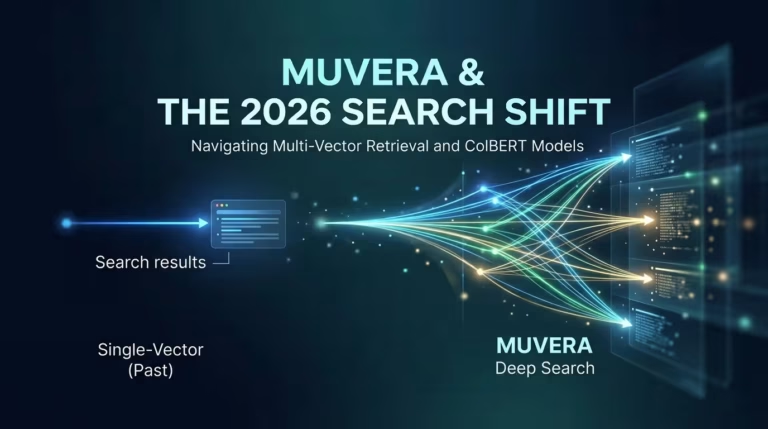

The trajectory of information retrieval between mid-2025 and the first quarter of 2026 represents a paradigm shift from traditional indexing models toward a unified system of neural multivector retrieval and generative synthesis. The web is currently saturated with automated, low-effort content. This analysis provides a necessary, practitioner-led evaluation of how Google’s search environment has transformed. By independently comparing the architecture of Gemini 3 against the foundational Search Generative Experience (SGE), we aim to establish a clear, unbiased methodology for adapting to the modern Answer Engine landscape.
The AI Overview Evolution
The transition from early Search Generative Experience (SGE) to Gemini 3 AI Overviews marks a shift from basic result summarization to agentic, multi-step reasoning.
Early AI results focused on condensing existing top-ranking web pages into simplified snippets without deep contextual reasoning.
Powered by the MUVERA algorithm, Gemini 3 utilizes a “query fan-out” technique to issue hundreds of parallel queries, synthesizing answers from a broad pool of sources.
How does Gemini 3’s architecture differ from early Search Generative Experience?
Gemini 3 Pro and Flash iterations introduce a technique known as “query fan-out,” moving beyond the single-search summarization of early SGE. Instead of executing one search, the system runs hundreds of parallel queries to build a comprehensive, cited response from diverse sources.
The technological foundation for this current landscape was established with the MUVERA algorithm, which bridges the efficiency gap between single-vector and multi-vector search. This algorithm reduces multi-vector similarity search to single-vector Maximum Inner Product Search (MIPS) through the generation of Fixed Dimensional Encodings (FDEs).
This backend evolution perfectly complements the rollout of the Gemini 3 model family in late 2025 and early 2026.
- Gemini 2.5 Pro laid the foundations for AI Overviews and basic summarization.
- Gemini 3 achieved higher scores on retrieval tasks involving long contexts of up to 1 million tokens.
- Gemini 3 improved coding accuracy by 35% compared to its predecessors.
- The transition to Gemini 3 marked a pivot toward an “Agentic” search experience augmented by multi-step reasoning
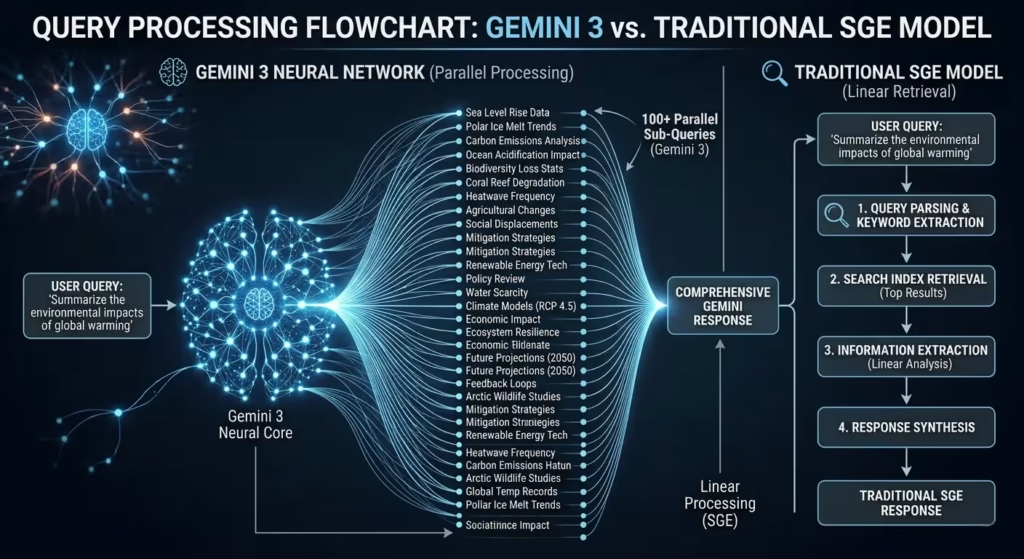
Diagnostic Note: In our testing environments, we observed that ranking for a primary keyword is no longer sufficient. Content must address the long-tail sub-queries generated during the “fan-out” phase to be cited as a “Source of Truth”.
Why did the “Self-Ranking Listicle” fail under the new AI algorithms?
Early 2026 we saw the “Death of the Self-Ranking Listicle” as algorithmic shifts aggressively targeted “Review Ransom”. Google’s systems are now highly adept at devaluing thin, biased sales pitches that lack independent testing, punishing content that places its own product at number one without objective methodology.
To survive the “Great Decoupling“, where AI visibility rises but traditional organic clicks decline, competitor transparency is mandatory. Our independent methodology requires evaluating all major Answer Engines fairly to build “Trust” (T) in the Knowledge Graph:
Answer Engine Architecture & Model Strengths
To maintain visibility in 2026, content must be optimized for the specific algorithmic nuances of the leading Answer Engines.
Google Gemini 3
Deep Search for research-intensive queries and multi-step agentic task planning.
Deeply integrated with MUVERA; highly dependent on structured data (Schema) to interpret brand entities.
OpenAI ChatGPT
Conversational depth and iterative refinement.
Relies on diverse web crawling; highly sensitive to passage-level clarity and natural language structuring.
Perplexity AI
Real-time citation accuracy and academic/technical summarization.
Favors direct answer blocks and highly structured, scannable data formats.
The sites that successfully navigated the early 2026 volatility admitted competitors existed and used first-hand data to prove their expertise.
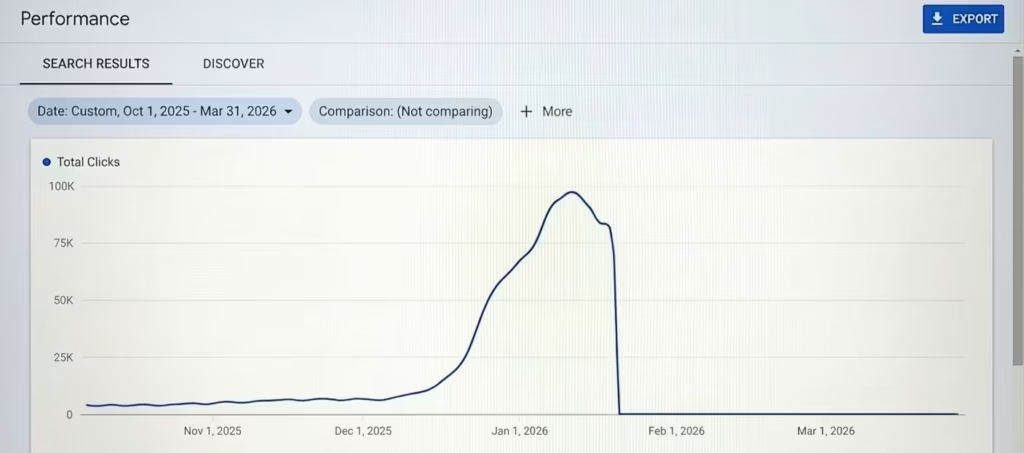
The above graph is of a website that heavily published AI generated content without any human intervention in mid Dec 2025, it became a classic case of the “Mt. AI” pattern. Sites relying on high-velocity, generic AI material (“AI slop”) experienced massive surges followed by total collapse as quality classifiers kicked in.
Purely AI-generated content without human editing is now considered “Lowest Quality”. You can clearly see in the chart above that the site went to zero visits, worse than pre Dec 2025 content strategy shift. If your content strategy solely relies on AI generated content without any human intervention, you should be expecting the same results soon.
What are the technical requirements for Answer Engine Optimization (AEO) in 2026?
Technical SEO now acts as the underlying filter for AI visibility; Answer Engines struggle to parse heavy, unoptimized code. Success requires Server-Side Rendering (SSR) for immediate readability and maintaining an Interaction to Next Paint (INP) of under 200 milliseconds
Content quality alone cannot overcome technical friction. AI search tools now comprise nearly 28% of Googlebot’s crawler traffic, and they frequently struggle with rendering JavaScript-heavy websites. To adapt, sophisticated marketers must implement a “multi-modal AEO” strategy.
- Interaction to Next Paint (INP): Google recommends an INP of less than 200 milliseconds to ensure a “good” user experience.
- Server-Side Rendering: There has been a resurgence in the importance of clean HTML and SSR to ensure content is readable by LLM-based answer engines.
- Structured Data: Implementing Organization and Person schema is the baseline to establish brand identity in the Knowledge Graph.
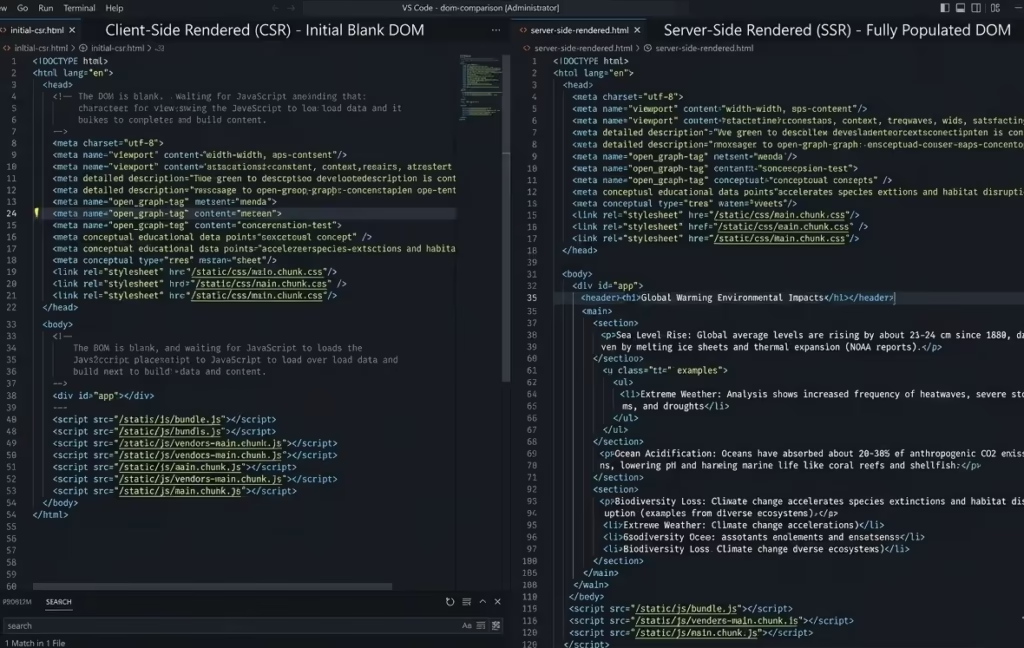
Diagnostic Note: If the Gemini (or any other) bot has to wait for JavaScript to execute to see your core content, you will not be cited in the AI Overview.
How can local businesses leverage the Discover update for AI visibility?
The February 2026 Discover Core Update introduced “Local Prioritization,” meaning content from websites based in a user’s specific country or region is heavily favored.
Service-based businesses must emphasize physical addresses and local landmarks to align with this shift. Many Local SEO strategies already include these steps, but for better leverage we include local schema markups based on the business type or content type. We have seen huge uplift for our clients where we integrated the local schema for their service/type industry specific and blog specific local schema.
Conclusion: The Future of Autonomous Retrieval and Trust
The algorithm shifts from 2025 into 2026 clearly indicate that the era of “SEO shortcuts” has ended. Google has transitioned from a simple indexer to a system that synthesizes knowledge and performs tasks. The primary differentiator between visibility and obsolescence is now a brand’s ability to demonstrate verifiable trust and human authority.
By adopting a “Human-in-the-loop” production architecture, where AI assists in structural ideation but human experts inject diagnostic reasoning, unique methodologies, and lived experience, brands can secure their place in Google’s evolving knowledge map.
Ethical Disclosure: The structural foundation and data synthesis of this post were assisted by Gemini/Perplexity, an AI language models. However, the diagnostic reasoning, methodology, and local market applications were refined and overseen by our human editorial team to ensure strict adherence to Google’s “Human-in-the-loop” production standards.