
The Transition from Retrieval to Synthesis
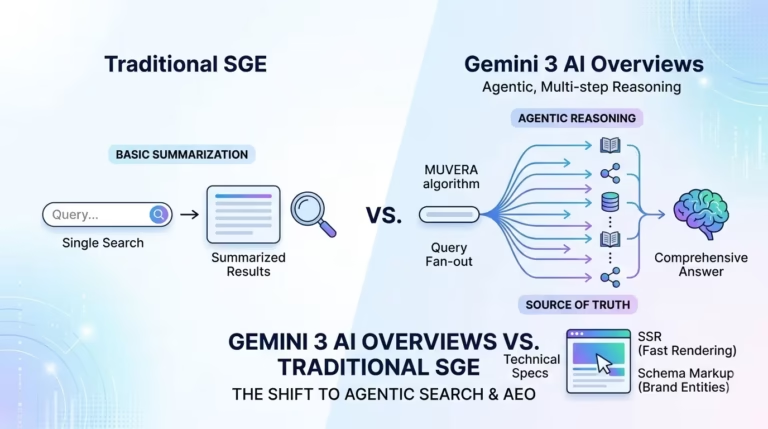
The digital information ecosystem is currently undergoing a structural metamorphosis that rivals the invention of the hyperlink in its magnitude. For the past twenty-five years, the fundamental unit of internet discovery has been the “document retrieval” model: a user inputs a keyword, and a search engine returns a ranked list of URLs. This paradigm, optimized through Search Engine Optimization (SEO), is now being superseded by the “synthesis” model. In this new era, propelled by Large Language Models (LLMs) and Generative Engines (GEs) such as Google’s AI Overviews (formerly SGE), Perplexity AI, and OpenAI’s SearchGPT, the engine does not merely retrieve information; it reads, comprehends, and synthesizes a direct answer.
This report provides an exhaustive analysis of Generative Engine Optimization (GEO), a novel framework defined by researchers at Princeton University, Georgia Tech, and the Allen Institute for AI.1 Unlike traditional SEO, which focuses on ranking position, GEO focuses on inclusion in the “consideration set” of an AI model and the subsequent citation in its generated response. The implications for content creators, agencies, and brands are profound: visibility is no longer about “ranking” #1; it is about becoming a foundational node of truth in the AI’s latent space.
The following analysis dissects the theoretical underpinnings of GEO, the technical requirements for entity optimization, and the specific content engineering tactics required to thrive in the “Citation Economy.” Furthermore, it provides a comprehensive blueprint for commercializing this shift, including full-text deliverables for a GEO Service Page and a GEO-Optimized Blog Post, designed to demonstrate these principles in action.
1: The Macro-Environmental Shift
To understand the necessity of GEO, one must first appreciate the collapse of the traditional “ten blue links” model. The rise of Generative Engines is not merely a feature update; it is a fundamental change in the contract between the search engine and the user.
1.1 The Mechanics of Generative Engines vs. Search Engines
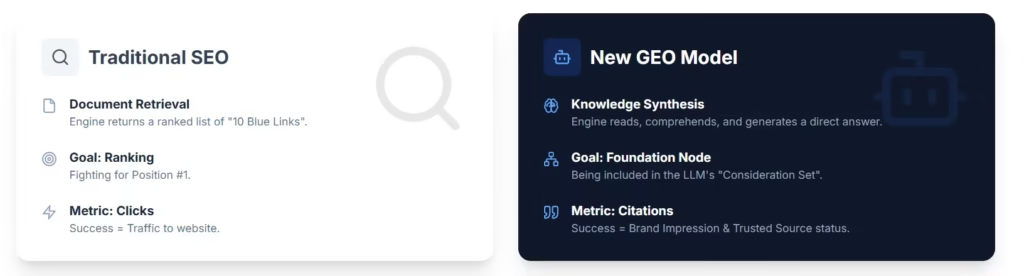
Traditional search engines operate on an index-and-retrieve basis. They crawl the web, build an inverted index, and rank documents based on relevance signals (keywords) and authority signals (backlinks). The burden of synthesis—reading five different articles to answer a complex question—is placed on the user.
Generative Engines, however, operate on a Retrieval-Augmented Generation (RAG) architecture.2 When a query is received, the system performs two distinct functions:
- Retrieval: The system acts as a search engine to fetch relevant, high-quality documents from its index or real-time web access.
- Generation: The system feeds these retrieved documents into the context window of a Large Language Model (LLM). The LLM then “reads” these documents and generates a natural language response, citing the sources that provided the specific facts used in the synthesis.3
This shift moves the goalpost for content creators. In SEO, the goal is to be relevant enough to be listed. In GEO, the goal is to be authoritative enough to be synthesized. If a piece of content is retrieved but contains low “fact density” or poor structure, the LLM will discard it from the final generation, resulting in zero visibility.4
1.2 The Rise of the Zero-Click Economy
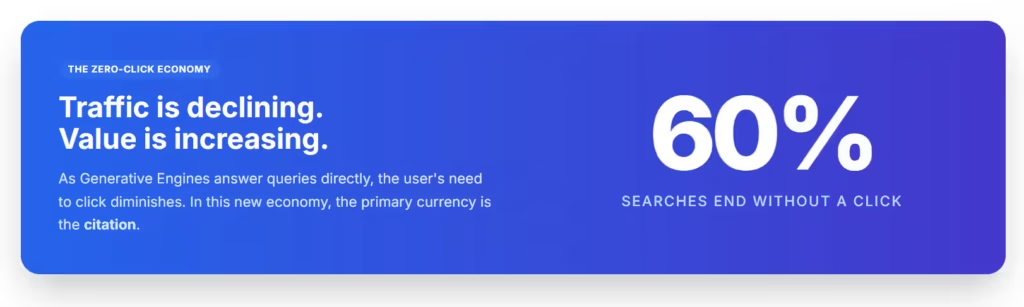
The most immediate commercial impact of this shift is the acceleration of “Zero-Click” searches. As Generative Engines provide comprehensive answers directly on the results page, the user’s need to click through to a website diminishes. Industry data from 2024 and projections for 2025 indicate that over 60% of Google searches now end without a click.5
This creates a paradox: Traffic is declining, but the value of remaining visibility is increasing. This new dynamic is termed the “Citation Economy”.7 In this economy, the primary currency is not the click, but the brand impression and the citation. Being cited by an AI engine acts as a high-level endorsement, signaling to the user that the brand is a trusted source of truth. Furthermore, while volume decreases, the intent of the users who do click on citations is significantly higher, as they are often seeking deep verification or transactional capabilities that the AI cannot provide.8
1.3 The GEO Research Baseline
The foundational legitimacy of GEO stems from the research paper “GEO: Generative Engine Optimization,” authored by Aggarwal et al. (2023). This study introduced GEO-Bench, a rigorous testing framework comprising 10,000 queries across diverse domains (Science, History, Facts, Debates).1
The study’s findings destroy the notion that SEO and GEO are identical. While they share a foundation (crawlability, authority), the specific tactics that move the needle in GEO are distinct. The researchers found that utilizing GEO strategies could improve visibility by up to 40% in generative outputs.1 Most critically, the study revealed that GEO tactics effectively “flatten” the authority curve—allowing lower-ranked sites with superior content structure to displace legacy incumbents in AI answers.9
2: The Science of Visibility – Deconstructing the Tactics
The core of the GEO strategy relies on understanding what LLMs value during the ingestion and synthesis process. The Princeton research provides a hierarchy of efficacy for various optimization tactics. This data allows us to prioritize resources effectively.
2.1 The Hierarchy of GEO Tactics
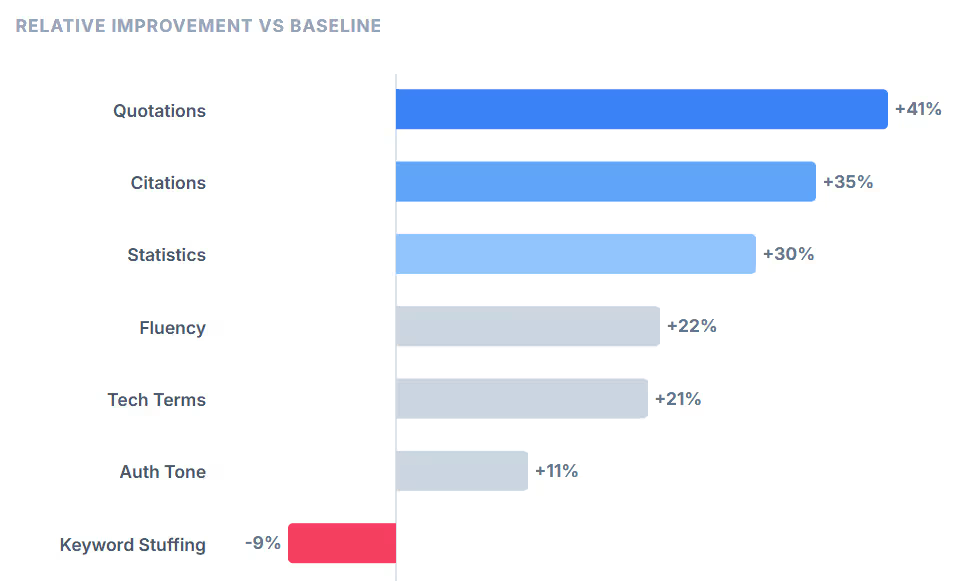
The following table synthesizes the performance of different optimization methods as measured in the GEO-Bench study. It compares the relative improvement in visibility against a baseline of unoptimized content.
| Optimization Tactic | Relative Improvement | Mechanism of Action | Best Use Case |
| Quotation Addition | +41% | LLMs are trained on human discourse and value “Expertise” (E-E-A-T). A quote acts as a semantic anchor of authority. | Content requiring subjective validation or expert opinion. |
| Cite Sources | +30-40% | External links function as verification nodes. The model assigns higher probability to content that is “grounded” in other known truths. | “Your Money Your Life” (YMYL) topics; technical/medical content. |
| Statistics Addition | +30% | LLMs prioritize “Fact Density.” Quantitative data provides concrete tokens for the model to retrieve and synthesize. | B2B content, news, comparative reviews. |
| Fluency Optimization | +22% | Complex syntax increases computational “perplexity.” Smoother text is easier for the model to ingest and summarize without error. | General informational queries; avoiding jargon in consumer content. |
| Technical Terms | +21% | Correct usage of domain-specific lexicon signals “Expert” distribution adherence in the training data. | Niche B2B, scientific, or developer-focused content. |
| Authoritative Tone | +11% | Confidence in language (declarative vs. passive) correlates with truthfulness in the model’s training set. | Historical, debate, or definitive guide content. |
| Keyword Stuffing | -9% (Negative) | Over-optimization triggers “spam” classifiers within the model’s safety and quality filters. | Avoid completely. |
Data Sources: 1
2.2 Deep Dive: The Power of Authority and Citations
The statistic that stands out most prominently is the efficacy of Quotes (+41%) and Citations (+30-40%). In traditional SEO, linking out was often discouraged (“don’t bleed PageRank”). In GEO, it is mandatory. This is because Generative Engines function as probability machines. When an engine encounters a claim, it attempts to verify it. If that claim is immediately followed by a citation to a high-authority node (like a government study, an academic paper, or a major news outlet), the probability of that claim being “true” increases, making it more likely to be included in the final answer.3
Furthermore, the “Authoritative Tone” finding suggests that the style of writing matters. Content that hedges—using words like “maybe,” “could,” “might”—is less likely to be selected as the definitive answer than content that uses declarative sentences. The AI seeks to provide the user with a solution, not a list of possibilities.3
3: Technical Architecture – The Knowledge Graph & Schema
While content is the interface, technical structure is the delivery mechanism. If the AI cannot parse the entity relationships within the content, the text remains unstructured data. Technical GEO focuses on Entity Optimization.
3.1 Entity-First Optimization
Search engines and LLMs no longer think in “keywords”; they think in “Entities”—distinct objects, people, concepts, or corporations with defined relationships. The Google Knowledge Graph is the largest repository of these entities. To rank in GEO, a brand must be a clearly defined entity.13
Key Strategies for Entity Establishment:
- Wikidata & Wikipedia: These are the primary training sets for almost all LLMs. A presence here is the “Gold Standard” for entity recognition. If a Wikipedia page is not possible, a robust Wikidata entry is essential.15
- Google Knowledge Panel: Claiming and populating the Knowledge Panel ensures that Google understands the brand’s official “Source of Truth.”
- Consistent N.A.P.W. (Name, Address, Phone, Website): Discrepancies across platforms (LinkedIn, Crunchbase, G2) cause entity fragmentation. The AI needs to see a unified pattern to assign a high confidence score to the entity.15
3.2 Advanced Schema Strategy (JSON-LD)
Schema markup is the language of entities. For GEO, basic schema is insufficient. We must utilize Nested JSON-LD to explicitly map the relationships between the content, the author, and the brand.16
Table 4: Essential Schema Properties for GEO
| Schema Type | Critical Property | GEO Function | Implementation Note |
| Organization | sameAs | Disambiguation | List all official profiles (LinkedIn, X, Crunchbase, YouTube). |
| Article | mentions | Contextual Mapping | Link to Wikipedia pages of the concepts discussed in the article. |
| FAQPage | mainEntity | Q&A Retrieval | Structure content specifically for “Question/Answer” pairs. |
| Person | jobTitle, alumniOf | E-E-A-T Validation | Establish the author’s credentials to pass “Expertise” filters. |
| ItemList | itemListElement | List Extraction | For “Top 10” posts, helps AI parse the specific items and rankings. |
The “Mentions” Tactic:
A highly effective, under-utilized tactic is using the mentions property within Article schema. By explicitly linking the article to the Wikipedia URL of the topic being discussed (e.g., linking a post about “CRM” to en.wikipedia.org/wiki/Customer_relationship_management), you anchor your content to a known high-authority entity in the Knowledge Graph.17
4: Platform-Specific Optimization Nuances
Not all Generative Engines behave identically. A nuanced strategy requires tailoring content for the specific “personality” of each engine.
4.1 Google AI Overviews (SGE)
- Behavior: SGE is risk-averse and heavily reliant on Google’s existing core ranking factors + the Knowledge Graph. It tends to trigger heavily for informational (“How to”, “What is”) queries.19
- Optimization: Focus on the “Inverted Pyramid” structure. The answer to the user’s query should be in the first 50 words of the content. Use structured HTML (<h2>, <ul>, <table>) as SGE often extracts these elements directly for its “snapshot”.20
4.2 Perplexity AI
- Behavior: Perplexity acts as an “Answer Engine” or research assistant. It values recency and academic citation. It explicitly cites its sources with footnotes.22
- Optimization: Update content frequently (modify the dateModified schema). Include citations to other high-authority domains within your text. Perplexity also heavily indexes YouTube transcripts, so embedding video summaries is a high-leverage tactic.23
4.3 SearchGPT (OpenAI)
- Behavior: SearchGPT is conversational and publisher-focused. It engages in multi-turn dialogue. It values “Publisher Partners” and natural language that reads well when synthesized.2
- Optimization: Structure content with logical “follow-up” headers (e.g., “History of X” followed by “Future of X”). This anticipation of the conversational flow encourages the model to keep the user within your content’s context window for longer.25
Conclusion
Conclusion: The Era of the Foundation Node
The transition from traditional search to Generative Engine Optimization (GEO) represents a structural metamorphosis that rivals the invention of the hyperlink. We have moved beyond the “document retrieval” model, where success was defined by a ranking position, into the era of “synthesis,” where the engine reads, comprehends, and generates direct answers for the user.
Ultimately, GEO is not merely a feature update; it is a fundamental change in the contract between the engine and the user. Those who adapt to become a “foundation node” of data will secure valid endorsements from AI models; those who remain attached to the legacy “ten blue links” model risk becoming invisible in the zero-click future.
Frequently Asked Questions
1. What is Generative Engine Optimization (GEO) and how does it differ from SEO?
While traditional SEO focuses on “Document Retrieval”—optimizing keywords to rank a URL in a list—GEO focuses on “Synthesis”. In GEO, the goal is not to rank #1, but to be included in the AI’s “consideration set” and cited as a foundational node of truth in the generated answer. SEO measures success by clicks, whereas GEO measures success by citations and brand impressions.
2. What are the most effective tactics to improve visibility in Generative Engines?
According to research by Princeton University and others, the most effective tactics differ significantly from SEO. The hierarchy of efficacy includes:
- Quotations (+41%): Adding relevant quotes acts as a semantic anchor of authority.
- Citations (+30-40%): Linking to external high-authority sources helps “ground” the content in verifiable truth.
- Statistics (+30%): Providing quantitative data increases “fact density,” which LLMs prioritize.
- Fluency (+22%): Using simple, smooth syntax makes text easier for models to ingest.
- Note: Keyword stuffing negatively impacts visibility by -9%.
3. What is the “Zero-Click Economy” and how does it impact traffic?
The Zero-Click Economy refers to the trend where users get their answers directly on the results page without visiting a website. Currently, over 60% of Google searches end without a click. While this causes a decline in overall traffic volume, the users who do click often have significantly higher intent. In this economy, the primary currency shifts from the click to the citation, which acts as a high-level endorsement of the brand.
4. Why is “Entity Optimization” crucial for GEO?
Generative Engines and LLMs understand the web through “Entities” (people, concepts, corporations) rather than just keywords. For a brand to be cited, it must be a clearly defined entity within the Google Knowledge Graph. To achieve this, brands must ensure consistency across data sources (N.A.P.W.), maintain a presence on Wikidata/Wikipedia, and claim their Knowledge Panel.
5. How should I use Schema Markup for GEO?
Basic schema is insufficient for GEO; you must use Nested JSON-LD to explicitly map relationships between the content, the author, and the brand. Critical strategies include:
- Organization Schema: Using the sameAs property to list all official profiles for disambiguation.
- Article Schema: Using the mentions property to link concepts in your text to their Wikipedia URLs, anchoring your content to high-authority entities.
- FAQPage Schema: Structuring content specifically for question/answer retrieval.
6. How do optimization strategies differ between Google AI Overviews, Perplexity, and SearchGPT?
- Google AI Overviews (SGE): Use an “Inverted Pyramid” structure, placing the direct answer in the first 50 words, and utilize structured HTML (lists, tables).
- Perplexity AI: Focus on recency and academic citations. It also heavily indexes YouTube transcripts, making video summaries a high-leverage tactic.
- SearchGPT: Structure content with logical “follow-up” headers to anticipate a conversational flow, as this engine values multi-turn dialogue.
References/Works cited
- Generative Engine Optimization: GEO, accessed on December 2, 2025
- We put SearchGPT to the test. Here’s what it means for SaaS marketing | Insight Partners, accessed on December 2, 2025
- GEO: Generative Engine Optimization – arXiv, accessed on December 2, 2025
- How to Structure Your Content for SGE (Search Generative Experience) – TheDevGarden, accessed on December 2, 2025
- Top 19 Generative Engine Optimization (GEO) Service Companies – mvpGrow, accessed on December 2, 2025
- 2025 Organic Traffic Crisis: Zero-Click & AI Impact Analysis Report – The Digital Bloom, accessed on December 2, 2025
- Generative Engine Optimization Explained: Citation Economy, AI Authority, and Zero-Click Search | by Makarenko Roman | Medium, accessed on December 2, 2025
- SEO vs. GEO: 5 Key Differences Despite the Similarities – Ahrefs, accessed on December 2, 2025
- GEO in SEO: How to Get Found in The Age of Generative AI Search Engines – Direction Inc, accessed on December 2, 2025
- What is generative engine optimization (GEO)?, accessed on December 2, 2025
- Generative Engine Optimization (GEO): Legit strategy or short-lived hack? : r/GrowthHacking, accessed on December 2, 2025
- What is Generative Engine Optimization (GEO)? Complete Guide 2025 – Frase AI, accessed on December 2, 2025
- Google Knowledge Graph and SEO: A Beginner’s Guide, accessed on December 2, 2025
- Brand Entity SEO Guide: Build Search Authority & Rankings, accessed on December 2, 2025
- Entity SEO: Building Your Brand’s Knowledge Graph – HigherVisibility, accessed on December 2, 2025
- Enhancing SEO with Nested JSON-LD Schema Examples – WHO Digital Strategy, accessed on December 2, 2025
- Top JSON-LD Schema for SEO Patterns Driving AI Search Visibility – GrowthNatives, accessed on December 2, 2025
- A beginners guide to JSON-LD Schema for SEOs – SALT.agency, accessed on December 2, 2025
- Semrush AI Overviews Study: What 2025 SEO Data Tells Us About Google’s Search Shift, accessed on December 2, 2025
- How to Optimize Content for Google AI Overviews (SGE) – eSEOspace, accessed on December 2, 2025
- Content for the SGE Era: Writing for Google’s AI-Powered Search Results – emfluence, accessed on December 2, 2025
- 5 Ways to Optimize Content for Perplexity AI – Semrush, accessed on December 2, 2025
- AI Search Optimization: SEO for Perplexity, ChatGPT and more – Marketing Aid, accessed on December 2, 2025
- What is SearchGPT? Complete Optimisation Guide – StudioHawk, accessed on December 2, 2025
- SEO for SearchGPT: A Comprehensive Guide – Torro Media, accessed on December 2, 2025
- GEO: Generative Engine Optimization – arXiv, accessed on December 2, 2025
- SearchGPT vs. Google vs. Bing: Search Results Review – Search Engine Journal, accessed on December 2, 2025
- GEO vs. SEO: Key Differences and Importance in Digital Marketing, accessed on December 2, 2025
- We Studied the Impact of AI Search on SEO Traffic | Our Findings – Semrush, accessed on December 2, 2025
- Perplexity AI Usage & Revenue Statistics for 2025 – Famewall, accessed on December 2, 2025