
Local Grants You Didn’t Know Existed
The Convergence of Digital Rights and Local Economic Development
In the shifting economic landscape of Antioch, California, a profound transformation is reshaping the responsibilities of the small business community. For decades, the primary regulatory focus for local enterprises—from the historic storefronts of the Rivertown District to the industrial hubs along the San Joaquin River—centered on physical compliance: structural integrity, fire codes, and physical access ramps. However, the rapid digitization of commerce, accelerated by the post-pandemic economy, has expanded the legal definition of “public accommodation” to include the digital realm. Today, a business’s website is not merely a marketing tool; it is a legally regulated infrastructure component subject to the rigorous standards of the Americans with Disabilities Act (ADA) and California’s Unruh Civil Rights Act.
This report provides an exhaustive analysis of the digital accessibility landscape facing Antioch businesses. It argues that the threat of high-cost ADA litigation—driven by California’s unique damages provisions—requires an immediate strategic pivot from reactive defense to proactive infrastructure investment. Crucially, this analysis uncovers and details the underutilized financial mechanisms available within the City of Antioch and Contra Costa County that can subsidize this transition. By synthesizing data from the City’s 2020-2025 Consolidated Plan, the operational directives of the newly formed Antioch Business Collaborative (ABC), and the technical auditing standards of the Web Content Accessibility Guidelines (WCAG) 2.1, we demonstrate how local businesses can reframe “compliance costs” as “capital improvements” eligible for public funding.
The findings indicate that while direct “website grants” are nominally rare, the City of Antioch’s prioritization of “Accessibility and Public Facilities improvements” in its federal Community Development Block Grant (CDBG) allocation creates a valid, yet often overlooked, pathway for funding digital remediation.1 Furthermore, the network of Community Development Financial Institutions (CDFIs) partnering with the city—specifically ESO Ventures and Pacific Community Ventures—offers specialized capital products designed to absorb operational improvements that enhance equity and access.2 This report serves as a definitive guide for Antioch stakeholders to navigate this complex legal, technical, and financial terrain.
1. The Legal & Economic Imperative for Antioch Enterprises
1.1 The California Context: A Unique Liability Landscape
To understand the urgency of digital accessibility in Antioch, one must first isolate the specific legal conditions of California that make it the epicenter of ADA litigation in the United States. While the Americans with Disabilities Act of 1990 is a federal civil rights law, its enforcement mechanism in the digital space is heavily influenced by state-level legislation.
The Unruh Civil Rights Act Amplifier
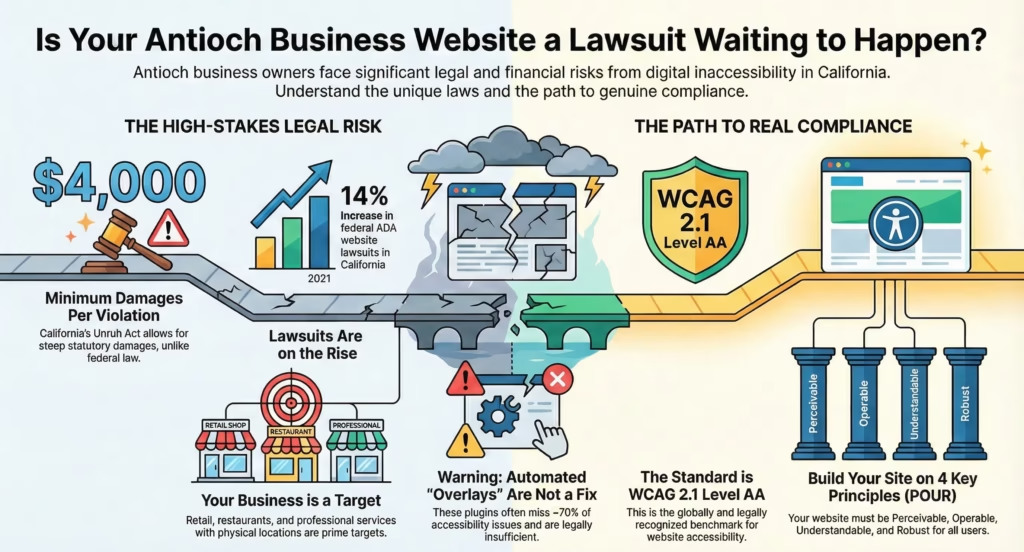
Under federal Title III of the ADA, a plaintiff who successfully sues a business for an inaccessible website is typically entitled only to injunctive relief—a court order forcing the business to fix the website—and the recovery of attorney’s fees. There is no federal provision for monetary damages to the plaintiff. However, California’s Unruh Civil Rights Act (California Civil Code Section 51) dramatically alters this calculus. The Unruh Act incorporates the ADA, meaning that any violation of the federal ADA constitutes a violation of the Unruh Act. Crucially, the Unruh Act allows for the recovery of statutory damages, currently set at a minimum of $4,000 per violation.4
This statutory damage provision has created a powerful economic incentive for what defense attorneys often term “serial litigation.” Plaintiffs’ firms can utilize automated scanning tools to identify thousands of websites with technical WCAG failures—such as missing alternative text on images or improper heading structures—and file mass complaints. In 2021 alone, federal ADA website accessibility lawsuits in California increased by 14%, cementing the state’s status as the second-busiest jurisdiction for such filings in the nation.4 For a small family-owned business in Antioch, a single demand letter often presents a settlement demand of $20,000 to $30,000, a figure calculated to be slightly less than the cost of a full legal defense, thereby forcing a settlement.5
The “Nexus” Theory and Local Geography
The legal theory governing these lawsuits in the Ninth Circuit (which includes California) often relies on the “nexus” theory. This legal doctrine suggests that for a website to be subject to the ADA, there must be a connection, or nexus, between the online barrier and the plaintiff’s ability to access the goods and services of a physical location.
For Antioch’s diverse business mix, this has specific implications:
- Retail and Restaurants (e.g., Somersville Road corridor): These businesses have a clear nexus. If a screen reader user cannot read the online menu or access the digital reservation system, they are effectively barred from the physical service. This makes these businesses prime targets for litigation.6
- Professional Services (e.g., Lone Tree Way): Law firms, dental offices, and consultancies often believe they are immune. However, if their intake forms or appointment schedulers are inaccessible, they are equally liable.
- Purely Digital Enterprises: While the nexus theory historically protected online-only businesses in the 9th Circuit, the legal tides are shifting. The global trend, and the requirements of the California Unruh Act, are increasingly interpreting the internet itself as a place of public accommodation, independent of a brick-and-mortar tether.7
1.2 The Standard of Compliance: WCAG 2.1 AA
The metric by which “accessibility” is judged in court and by grant-making bodies is the Web Content Accessibility Guidelines (WCAG), developed by the World Wide Web Consortium (W3C).
Understanding the Tiers
- WCAG 2.0 vs. 2.1: While 2.0 was the long-standing standard, 2.1 is now the de facto requirement for modern compliance as it addresses mobile accessibility—a critical factor for low-income populations who often rely solely on smartphones for internet access.
- Level A, AA, AAA:
- Level A is the bare minimum and typically insufficient for legal defense.
- Level AA is the global standard referenced in Department of Justice settlements and California state requirements.8
- Level AAA is the gold standard, often reserved for specialized government or disability-focused sites.
For an Antioch business seeking CDBG funding, the target metric is WCAG 2.1 Level AA. This alignment is explicitly cited in Contra Costa County’s own digital accessibility design guidelines 8, signaling that local government bodies view this as the benchmark for “accessible public facilities.”
The Four Principles (POUR)
To secure funding, business owners must articulate their website upgrades not as “bug fixes” but as alignment with the four foundational principles of civil rights access:
- Perceivable: Information must not be invisible to any sense. (e.g., providing text alternatives for images so a blind user can “read” a photo of a product).
- Operable: The interface cannot require interaction that a user cannot perform. (e.g., ensuring all navigation can be done via keyboard for users with motor impairments who cannot use a mouse).9
- Understandable: Information and operation must be clear. (e.g., avoiding jargon and ensuring error messages on forms explain how to fix the error).
- Robust: Content must be compatible with current and future user tools. (e.g., ensuring code is clean enough to be parsed by the latest screen readers).
1.3 The Myth of the “Overlay” Solution
A critical “trap” for small businesses—and a point of differentiation in grant applications—is the reliance on automated accessibility overlays. These are low-cost plugins that add a widget to a website, promising instant compliance.
However, research and legal precedent indicate these are insufficient. Automated tools generally detect only ~30% of WCAG violations.10 They cannot interpret the meaning of an image or the logic of a navigation flow. Furthermore, the European Accessibility Act (EAA), which sets global trends, and upcoming US regulations are moving toward requiring manual audits.11
Strategic Insight: In applying for Antioch business grants, an applicant should explicitly request funding for a “Manual Accessibility Audit and Remediation,” citing the insufficiency of automated tools. This demonstrates a sophistication and commitment to genuine equity that aligns with the high standards of public funding review committees.12
2. The Antioch Grant Ecosystem – Unlocking Public Capital
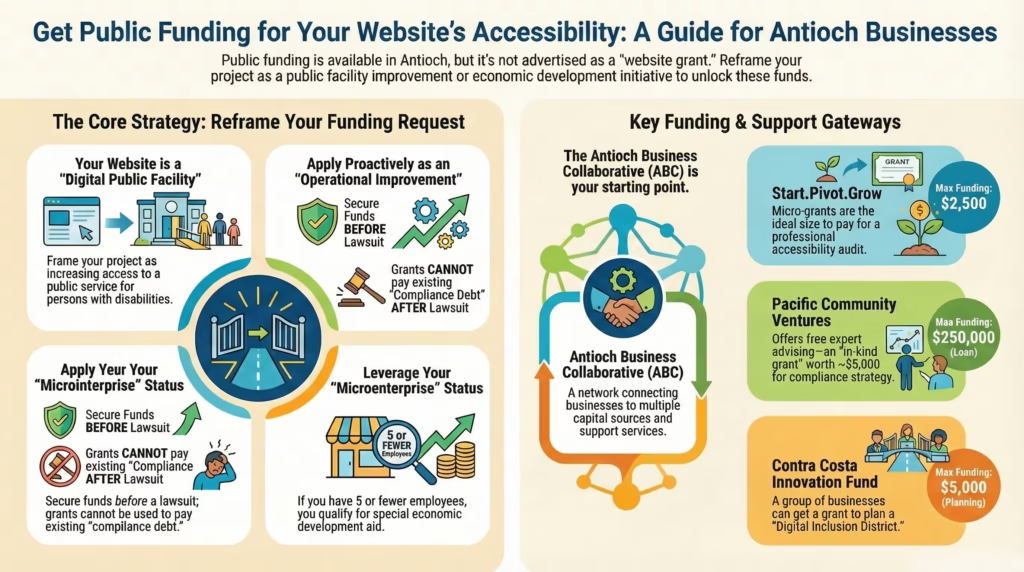
The narrative that “there are no grants for small business websites” is a misconception derived from looking for the wrong keywords. Public funding is allocated based on policy priorities, not technical line items. In Antioch, the relevant policy priority is “Public Facility Accessibility” and “Economic Resilience.”
2.1 The Strategic Anchor: The Consolidated Plan (2020-2025)
The City of Antioch operates its own entitlement program for Community Development Block Grant (CDBG) funds, distinct from the broader Contra Costa County consortium for these specific dollars.14 The spending of these funds is dictated by a 5-year strategy document known as the Consolidated Plan.
The “High Priority” Need
The current Consolidated Plan (FY 2020-2025) explicitly categorizes the following as a “High Priority” for funding:
“Infrastructure, Accessibility and Public Facilities improvements – Increasing access to public facilities for persons with disabilities”.1
Historically, this funding stream paid for curb cuts, wheelchair ramps, and automatic doors. However, Department of Justice guidance and recent case law have firmly established that websites are “public facilities” or services.
The Funding Argument:
When applying for CDBG-backed assistance or sub-grants through local nonprofits, Antioch businesses should frame their website remediation project as a Digital Infrastructure Improvement. The narrative should argue:
- The website is the primary point of public interface.
- Inaccessibility constitutes a barrier to a public facility.
- Remediation directly serves the “most vulnerable residents” (a key CDBG metric), specifically the disabled and elderly populations prioritized in the Consolidated Plan.1
Economic Development Priorities
A secondary, but equally valid, priority in the Consolidated Plan is “Economic Development – Assistance to microenterprises to support small businesses”.1
- Definition: A microenterprise is typically defined as a business with 5 or fewer employees, including the owner.
- Application: If an Antioch business falls into this category, they are eligible for direct technical assistance funded by CDBG. This assistance often takes the form of “professional services” grants, which can pay for the specialized labor of a web accessibility auditor.
2.2 The Antioch Business Collaborative (ABC)
Recognizing the fragmentation of support services, the City of Antioch launched the Antioch Business Collaborative (ABC), a coordinated network of service providers funded largely by American Rescue Plan Act (ARPA) allocations.15 The ABC is not a single grant; it is a gateway to multiple capital sources, each with specific eligibility rules regarding compliance and operational improvements.
Table 1: The Antioch Business Collaborative Ecosystem
| Partner Organization | Capital Product | Max Funding | Key Eligibility / Constraint | Strategic Use for ADA |
| ESO Ventures | Capital in the Community Fund (CICF) | $100,000 | Must complete ESO Incubator; No “compliance debt” allowed 2 | Use for “Operational Improvement” (Web Rebuild) before a lawsuit. |
| Pacific Community Ventures | Small Business Loans & Grants | $250,000 | Profitable, 1+ year in business, 1+ employee 17 | Bundle loan with Free Advising 3 to offset audit costs. |
| Working Solutions | Start-up Loans | $100,000 | Open to pre-revenue start-ups 17 | financing for “Day 1” compliance architecture. |
| Start.Pivot.Grow | Micro-Grants | $2,500 | Growth-focused businesses 18 | Ideal size for covering a Manual WCAG Audit. |
| City of Antioch | CDBG Sub-Grants | Varies | 501(c)3 Nonprofits (Fiscal Agents) 1 | Chambers/Associations can apply to fix district websites. |
2.3 Deep Dive: ESO Ventures Capital in the Community Fund (CICF)
ESO Ventures is a central pillar of the ABC, offering a unique product that blends the mechanics of a loan with the support structure of a grant.
The “Compliance Debt” Restriction
A critical nuance in the ESO funding guidelines is the prohibition on using funds to “repay state, city, county, or federal debt such as to pay a tax bill, compliance, or renewal purposes”.2
- Risk: If a business has already been sued for an ADA violation and owes a settlement or a court-mandated fine, CICF funds cannot be used to pay this. It is classified as “compliance debt.”
- Opportunity: However, the guidelines explicitly allow funds for “Operational Improvement Expenses” and “Safety Expenses”.19
- Strategy: Business owners must apply proactively. The application narrative should emphasize that the funds are for “modernizing operational infrastructure to ensure safety and access for disabled customers.” By framing the website rebuild as an operational upgrade rather than a debt repayment, the project remains eligible.
2.4 Pacific Community Ventures (PCV): The “Good Jobs” Strategy
Pacific Community Ventures offers a “Good Jobs, Good Business” model. While they provide loans, their most valuable asset for ADA compliance is their Business Advising Program, which is free.3
- The “Shadow Grant” Value: A professional ADA audit and compliance roadmap consulting engagement can cost between $3,000 and $5,000. PCV leverages pro-bono experts. By securing a PCV advisor with expertise in risk management or digital operations, an Antioch business effectively receives a $5,000 in-kind grant.
- Advising Scope: Advisors can help draft the Accessibility Statement, a critical legal document that must be posted on the website to demonstrate good faith efforts toward compliance.8
2.5 Contra Costa County Innovation Fund
Beyond the city limits, Contra Costa County administers the Innovation Fund, a $2 million allocation from Measure X sales tax revenue.20
- Target: This fund seeks “innovative public service projects” that “remove structural barriers that cause inequities”.21
- Relevance: Digital exclusion is a structural barrier. A coalition of Antioch businesses (perhaps organized by the Chamber or a Rivertown merchant group) could apply for a Phase 1 Planning Grant ($5,000) to design a “Digital Inclusion District.”
- Phase 1 Mechanics: These smaller grants are designed to fund the development of a larger proposal. The $5,000 can be used to hire a digital accessibility consultant to survey the websites of participating businesses and create a master plan for remediation—effectively conducting the audits at no cost to the individual merchants.21
3. The Role of the East Bay SBDC
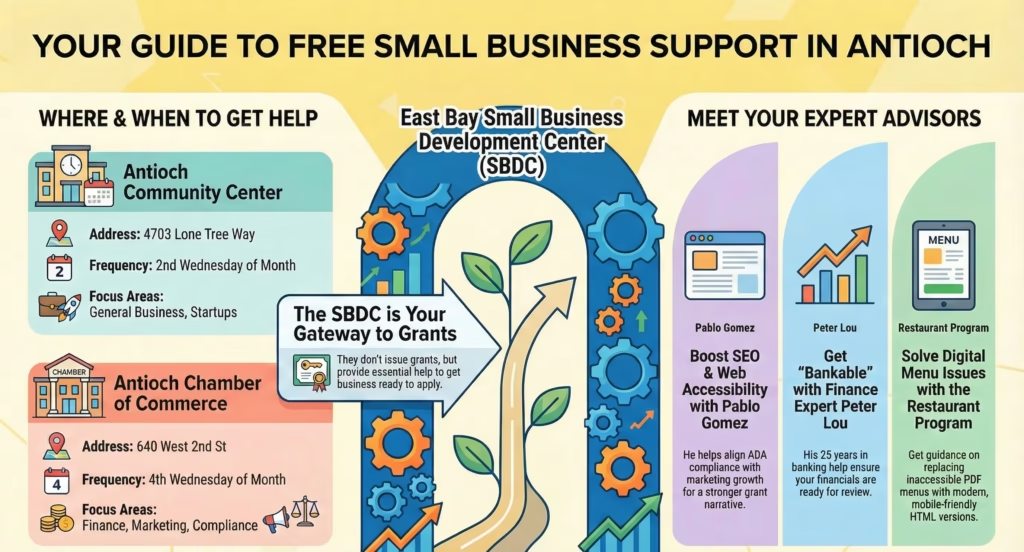
The East Bay Small Business Development Center (SBDC) acts as the technical assistance arm of the Antioch grant ecosystem. They do not issue grants directly, but they are the gatekeepers who prepare businesses to successfully apply for them.
3.1 Local Advising Infrastructure
In 2025, the SBDC has established a robust physical presence in Antioch to facilitate these exact types of complex regulatory navigations. They operate out of two key locations with specific schedules.
Table 2: 2025 SBDC In-Person Advising Schedule (Antioch)
| Location | Address | Frequency | 2025 Dates (Selected) | Focus Areas |
| Antioch Community Center | 4703 Lone Tree Way | 2nd Wednesday | Jan 8, Feb 12, Mar 12, Apr 9 | General Business, Startups |
| Antioch Chamber of Commerce | 640 West 2nd St | 4th Wednesday | Jan 22, Feb 26, Mar 26, Apr 23 | Finance, Marketing, Compliance |
(Note: Appointments are 30 minutes and must be confirmed by the Friday prior to the session.22)
3.2 Key Advisors for ADA Strategy
The SBDC assigns specific advisors with distinct skill sets. Knowing who to ask for is crucial for the ADA conversation.
- Pablo Gomez (Marketing & SEO):
- Relevance: Web accessibility and Search Engine Optimization (SEO) are technically intertwined. Google’s algorithms favor sites with proper headings, alt text, and clear navigation—the exact same requirements for ADA compliance.
- Strategy: Schedule with Pablo to discuss an “SEO and Digital Modernization” plan. Use his guidance to structure a scope of work that achieves compliance under the guise of marketing growth, which makes for a compelling grant narrative.22
- Peter Lou (Finance & Banking):
- Relevance: Peter’s background includes 25 years in banking (Wells Fargo, Union Bank).22 He is the expert on “bankability.” If you are applying to ESO Ventures or PCV, Peter can review your financials to ensure you meet the “debt service coverage” ratios, even if the “debt” is for a website fix.
3.3 The Restaurant Program
Antioch has a vibrant culinary scene, from the chain restaurants on Lone Tree to independent eateries in the older districts. The SBDC’s Restaurant Program offers specialized consulting for this sector.23
- Menu Accessibility: A common ADA lawsuit trigger for restaurants is the PDF menu. Screen readers often cannot read PDFs that are scanned images. The Restaurant Program advisors can guide owners toward HTML-based menu systems that are natively accessible and mobile-friendly, solving both the legal risk and the customer experience issue.
4. Technical Implementation – A Masterclass in Compliance
Securing the funding is only the first half of the equation. Spending it correctly to achieve genuine, defensible compliance is the second. This section details the technical execution required.
4.1 The inadequacy of Automated Audits
As established, relying on automated tools is a liability. Snippets regarding “manual audits” in the context of high-stakes verification (like elections or financial reporting) 25 metaphorically underscore a truth in the digital accessibility world: machines miss context.
A Manual WCAG Audit involves a human tester performing the following checks:
- Keyboard-Only Navigation: Attempting to use the entire website without a mouse. (Can you tab through the menu? Can you submit the contact form?)
- Screen Reader Verification: Using tools like NVDA (NonVisual Desktop Access) or JAWS to “listen” to the website. This reveals if the “Order Now” button is announced as “Button” (useless) or “Button: Order Chicken Sandwich” (useful).
- Zoom/Reflow Testing: Scaling the browser to 200% text size to ensure text doesn’t overlap or disappear, a requirement for low-vision users.9
4.2 The “Hybrid” Remediation Roadmap
For Antioch businesses operating on tight margins, a hybrid approach balances cost and risk:
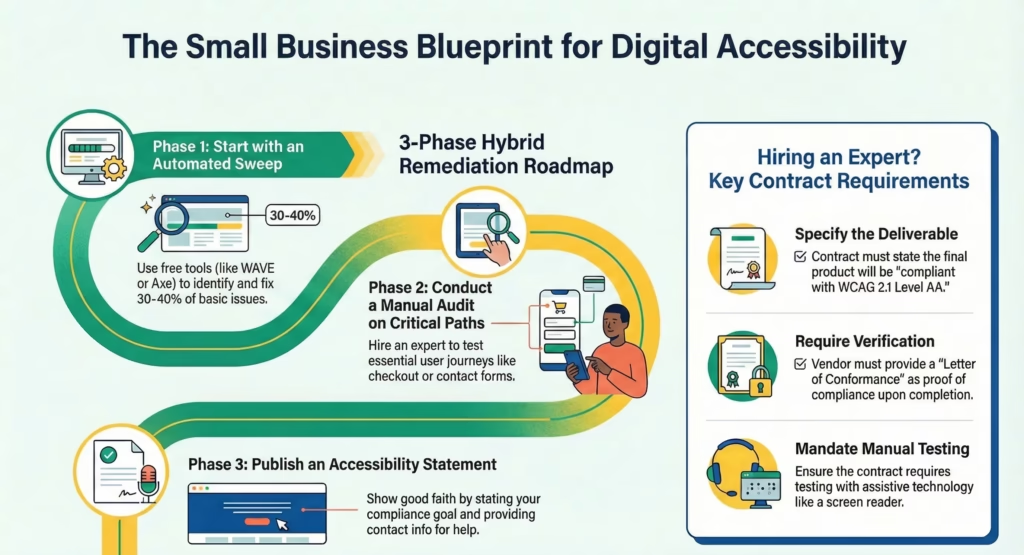
- Phase 1: The Automated Sweep (Cost: Low/Free). Use free browser extensions like WAVE or Axe to identify and fix 30-40% of issues (broken links, missing language tags).
- Phase 2: The Critical Path Manual Audit (Cost: Grant Funded). Use grant funds to hire an expert to audit only the critical paths.
- Retail: Homepage -> Product Page -> Cart -> Checkout.
- Service: Homepage -> Service Description -> Contact Form.
- Phase 3: The Accessibility Statement (Cost: Administrative). Publish a statement in the footer.
- Content: Must state the target standard (WCAG 2.1 AA), the known limitations, and a phone number or email for users to get immediate help.8
- Legal Value: While not a shield, it shows “good faith” and provides a frustrated user an alternative to suing.
4.3 Vendor Selection Criteria
When using grant money to hire a web developer, the Request for Proposal (RFP) must be specific. A “website redesign” is not enough. The contract must stipulate:
- Deliverable: “Website compliant with WCAG 2.1 Level AA.”
- Verification: “Vendor will provide a Letter of Conformance upon completion.”
- Testing: “Vendor will conduct manual testing with at least one screen reader.”
5. Digital Inclusion & The Future of Smart Antioch
The conversation around ADA compliance is rapidly merging with the broader concept of “Digital Inclusion.” Antioch is actively positioning itself as a leader in this space, creating future opportunities for businesses that align with this vision.
5.1 The “Smart City” Convergence
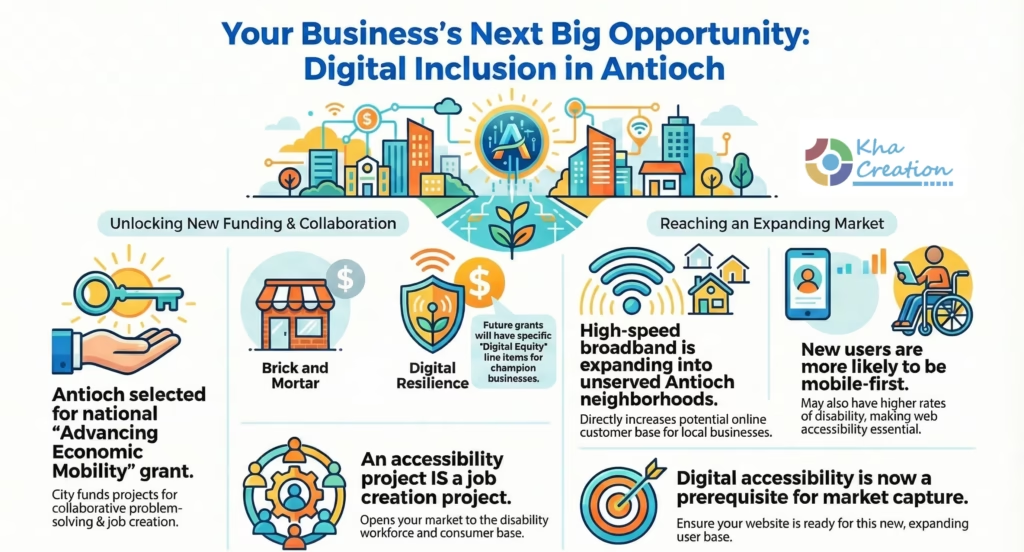
Antioch was recently selected as one of 12 cities nationwide for the National League of Cities’ Advancing Economic Mobility Rapid Grant ($20,000).29 This grant aims to launch the Work Together Fund, a pilot program for collaborative problem-solving.
- Implication: The City is looking for projects that “foster collaborative problem-solving toward job creation.”
- Opportunity: A digital accessibility project is inherently a job creation project—it opens the market to the disability workforce and consumer base. Businesses that propose collaborative digital upskilling projects will be well-positioned for this new wave of funding.
5.2 Broadband and Infrastructure
The California Public Utilities Commission (CPUC) and regional consortia are actively mapping “unserved” areas for broadband investment.30 As high-speed internet reaches more low-income neighborhoods in Antioch, the user base for local business websites expands. This new user base is statistically more likely to rely on mobile devices and may have higher rates of disability. Thus, accessibility becomes a prerequisite for capturing this expanding market share.
5.3 Technical Assistance Trends
The trend in CDBG and municipal funding is moving away from “brick and mortar” toward “digital resilience.” Snippets from similar municipalities (like Lake County and Nashville) 31 show a clear trajectory: grants for “Digital Inclusion Visionaries” and “Connected Services.” Antioch’s participation in similar national cohorts suggests that future grant cycles will have specific “Digital Equity” line items. Businesses that have already begun their ADA journey will be prime candidates for these “champion” grants.
6. Strategic Recommendations for Antioch Business Owners
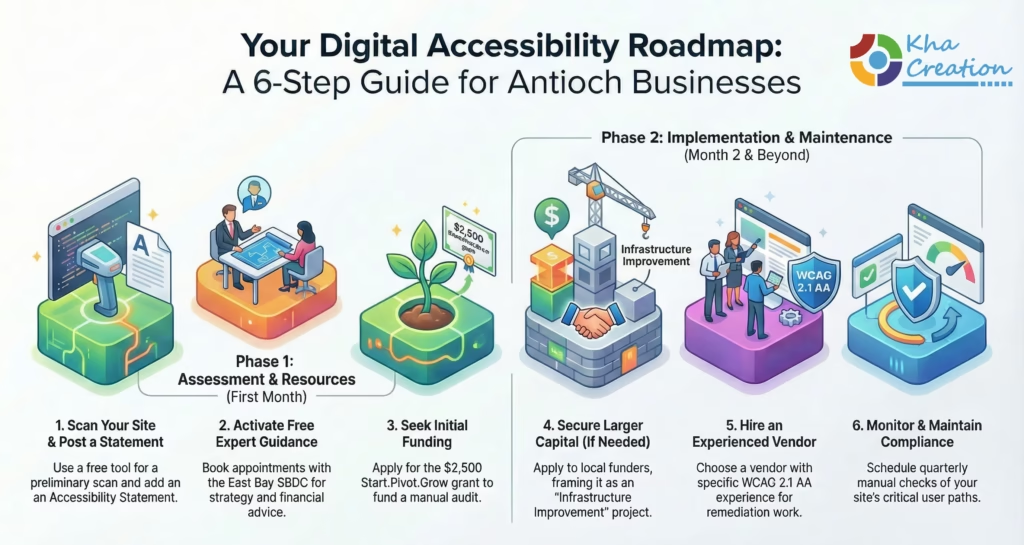
Based on the synthesis of legal, financial, and technical data, the following strategic roadmap is recommended for Antioch business owners in 2025:
Step 1: Diagnosis & Documentation (Week 1-2)
- Action: Conduct a preliminary automated scan of your website using a free tool.
- Action: Draft an Accessibility Statement using the Contra Costa County model 8 and post it to your site footer immediately. This signals awareness and provides a contact method for users.
Step 2: Resource Activation (Week 3-4)
- Action: Book an appointment with the East Bay SBDC at the Antioch Chamber (4th Wednesday). Request Pablo Gomez for a digital strategy review and Peter Lou for financial readiness.22
- Action: Evaluate eligibility for the Start.Pivot.Grow $2,500 micro-grant. If eligible, draft a proposal specifically to fund a “Manual Accessibility Audit”.18
Step 3: Capital Application (Month 2)
- Action: If deeper remediation is needed, apply to ESO Ventures (if willing to incubate) or Pacific Community Ventures (if established).
- Narrative Strategy: Frame the request as “Infrastructure Improvement for Public Facility Access,” citing the City of Antioch Consolidated Plan priority.1
Step 4: Execution & Monitoring (Ongoing)
- Action: Hire a vendor with specific WCAG 2.1 AA experience.
- Action: Schedule a quarterly “manual check” of critical paths (checkout, contact forms) to ensure new content hasn’t broken accessibility.
FAQ: Navigating Compliance and Funding in Antioch
Q1: Can I use CDBG grant money to pay for a lawsuit settlement I already received?
A: No. Federal and local grant guidelines generally prohibit using funds to pay for fines, penalties, or legal settlements. This is explicitly stated in the ESO Ventures guidelines as “compliance debt”.2 You must use the funds for forward-looking improvements, such as the technical work required to fix the website.
Q2: What is the difference between an “automated audit” and a “manual audit,” and which one do grants cover?
A: An automated audit is a software scan that catches basic code errors (about 30% of issues). A manual audit involves a human using assistive technology to test the site. Grants are more likely to cover manual audits because they are considered “professional technical assistance,” whereas automated tools are often seen as low-cost software subscriptions. The manual audit is also the only way to ensure true legal compliance.11
Q3: I run a home-based business in Antioch. Am I eligible for these funds?
A: Generally, yes. The CDBG “Microenterprise” definition usually includes businesses with 5 or fewer employees, regardless of physical storefront status. Working Solutions and ESO Ventures specifically target early-stage and home-based entrepreneurs.16
Q4: My web developer says they made my site “ADA Ready.” Is that enough?
A: “ADA Ready” is a marketing term, not a legal one. You need to ask for a “Letter of Conformance to WCAG 2.1 Level AA.” If they cannot provide that or explain what “manual testing” they did, your business remains at risk.
Q5: Who protects me if I am targeted by a “serial filer” lawsuit?
A: While the City cannot provide legal defense, the Contra Costa County District Attorney’s Consumer Protection Unit reviews complaints of unfair business practices. If you suspect a lawsuit is fraudulent or predatory, you can report it to the DA’s office.34 However, the best defense is a compliant website.
Q6: What specific dates should I look out for in 2025 for grant applications?
A: The City of Antioch typically opens its CDBG community grant cycle in late October/November, with applications due in early December for funding that starts the following July.1 However, the ABC partner organizations (ESO, PCV) often accept applications on a rolling basis or have quarterly cohorts.
Data Tables & Reference
Table 3: Antioch CDBG Consolidated Plan Priorities (2020-2025)
Source: City of Antioch Consolidated Plan 1
| Priority Category | Description | Relevance to Digital ADA |
| Infrastructure & Accessibility | Increasing access to public facilities for persons with disabilities. | High. Courts increasingly view websites as public facilities. This is the primary “hook” for grant narratives. |
| Economic Development | Assistance to microenterprises to support small businesses. | High. Can fund “Technical Assistance” (TA) which includes specialized audits. |
| General Public Services | Access to technology/computers and assistance. | Medium. Supports “Digital Inclusion” programs that may involve website upgrades. |
Table 4: Key Contacts for Antioch Business Support
| Organization | Contact Info | Primary Function |
| Antioch Business Collaborative | (https://www.antiochca.gov/1067/Antioch-Business-Collaborative) | Central Hub for Resources |
| East Bay SBDC | 510-885-4801 / eastbaysbdc.org | Free Advising & Loan Prep |
| Contra Costa DA Consumer Unit | 925-957-8608 | Fraud/Scam Reporting |
| City of Antioch CDBG | (https://www.antiochca.gov/993/Community-Grants) | Grant Administration |
Disclaimer: This report is for informational purposes only and does not constitute legal advice. Business owners should consult with a qualified attorney regarding specific ADA liability.
References/Works cited
- Community Grants | Antioch, CA, accessed on December 31, 2025
- General 6 – ESO Ventures, accessed on December 31, 2025
- Get Started Archive — Pacific Community Ventures, accessed on December 31, 2025
- How Can Small and Solo Firms Comply with ADA Website Requirements Without Breaking the Bank, accessed on December 31, 2025
- Digital accessibility lawsuits are on the rise: Is your website AwDA compliant? – CDA, accessed on December 31, 2025
- How Small Businesses are Targeted with Abusive ADA Lawsuits – Institute for Legal Reform, accessed on December 31, 2025
- Supreme Court Allows Suit Over Website Accessibility – Wood Smith Henning & Berman LLP, accessed on December 31, 2025
- Website Accessibility – Contra Costa County, accessed on December 31, 2025
- Web Content Accessibility | California Office of the Small Business Advocate (CalOSBA), accessed on December 31, 2025
- How to Conduct a Web Accessibility Audit | QAwerk, accessed on December 31, 2025
- What is the European Accessibility Act? Answers for US Companies, accessed on December 31, 2025
- EXECUTIVE SUMMARY – Nashville.gov, accessed on December 31, 2025
- Accessibility statement | Sport England, accessed on December 31, 2025
- Community Development Block Grant | Contra Costa County, CA Official Website, accessed on December 31, 2025
- City of Antioch launches small business support program, accessed on December 31, 2025
- Participation Necessary — ESO Ventures, accessed on December 31, 2025
- Antioch Business Collaborative, accessed on December 31, 2025
- Small business grants you can apply for in February 2024 – Start.Pivot.Grow., accessed on December 31, 2025
- City of Antioch Small Business Grant Program, accessed on December 31, 2025
- About the Innovation Fund | Contra Costa County, CA Official Website, accessed on December 31, 2025
- Contra Costa County Announces Innovation Fund Grant Program, accessed on December 31, 2025
- Antioch In-Person advising – East Bay SBDC, accessed on December 31, 2025
- SBDC Services – East Bay SBDC, accessed on December 31, 2025
- East Bay SBDC – Northern California Region, accessed on December 31, 2025
- Performance Oversight Report Fiscal Year 2019 – 2020 | DC Council, accessed on December 31, 2025
- Board of Governors – Alameda Alliance for Health, accessed on December 31, 2025
- 2022-10-18 Agenda and Backup – COD – Denton, TX, accessed on December 31, 2025
- ADA Accessibility | Contra Costa County, CA Official Website, accessed on December 31, 2025
- Antioch Awarded Grant by National League of Cities to Promote Local Economic Mobility Efforts – Contra Costa News, accessed on December 31, 2025
- Exhibit DTC-69 2022 CASF Annual Report, accessed on December 31, 2025
- Early voting begins for February 25 Consolidated Primary, Addressing critical stormwater issues, Dunn Museum to expand and More – GovDelivery, accessed on December 31, 2025
- Metro Nashville Awarded $1.9M Digital Inclusion Grant from State of Tennessee, accessed on December 31, 2025
- WCAG Compliance Auditing – A11Y Pros, accessed on December 31, 2025
- Consumer Protection (Civil) Unit | Contra Costa County, CA Official Website, accessed on December 31, 2025