
Dominating the Era of Generative and Agentic Commerce
Executive Summary
The digital commerce landscape of 2026 bears little resemblance to the search ecosystems of the early 2020s. We have transitioned from an era defined by information retrieval—optimizing for a list of ten blue links—to an era of information synthesis and autonomous action. The rapid maturity of Large Language Models (LLMs), the deployment of multimodal AI (text, voice, video), and the emergence of “Agentic Commerce” have fundamentally rewritten the rules of visibility and conversion.1
For e-commerce executives and SEO practitioners, this shift is existential. The traditional search engine result page (SERP), once a directory of possibilities, has transformed into an “Answer Engine” where AI Overviews (AIO) and chatbots provide direct, synthesized responses, often satisfying user intent without a click-through.3 Data from late 2025 indicates that “zero-click” searches now account for nearly 60% of all Google queries, and the traffic that remains is increasingly fought for in a “winner-takes-all” environment where AI citations drive the vast majority of visibility.2
This comprehensive report analyzes the strategic pivot from traditional Search Engine Optimization (SEO) to Generative Engine Optimization (GEO). It details the technical architectures required to satisfy “robot shoppers” (AI agents), the semantic data structures necessary to build robust Knowledge Graphs, and the content strategies that leverage “Experience” and “Authority” to secure visibility in a post-keyword world. The analysis suggests that success in 2026 relies on three pillars: Entity-First Strategy, Multimodal Optimization, and Technical Fluidity centered on interaction metrics like Interaction to Next Paint (INP).
1. The Paradigm Shift: From Search Engines to Answer Engines
1.1 The Erosion of Traditional Search Traffic
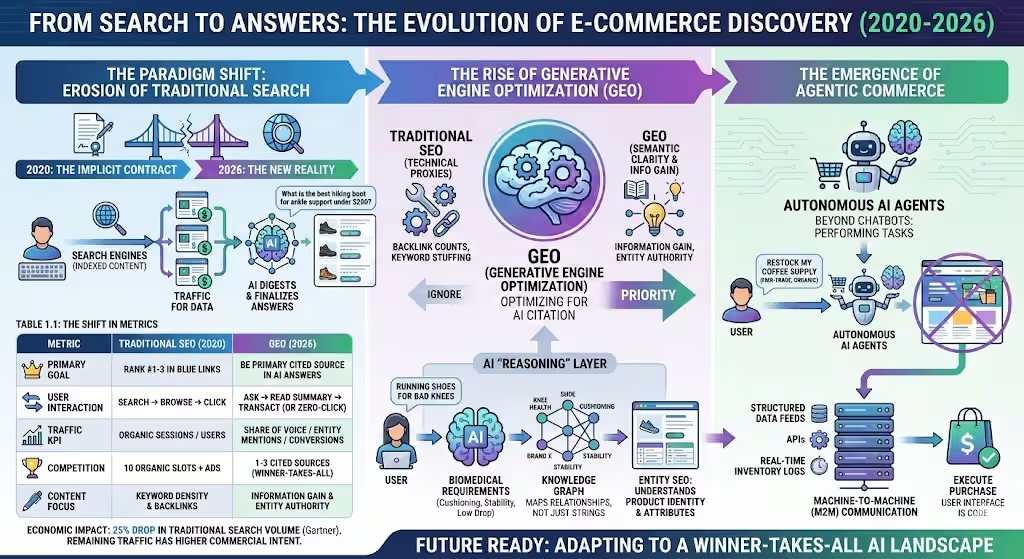
For two decades, the implicit contract of the web was straightforward: search engines indexed content and distributed traffic to publishers and retailers in exchange for data. In 2026, this contract has been irrevocably altered. Generative AI models now act as an intermediary layer, digesting information from across the web and presenting a finalized answer directly to the user.
The implications for e-commerce traffic are profound. Informational queries—historically the top-of-funnel (TOFU) driver for new customer acquisition—are increasingly being cannibalized by AI. When a consumer asks, “What is the best hiking boot for ankle support under $200?”, platforms like Google’s AI Overviews, ChatGPT Search, and Perplexity do not merely list retailers; they synthesize reviews, compare specifications, and present a recommended shortlist directly in the interface.3
Table 1.1: The Shift in Search Metrics (2020 vs. 2026)
| Metric | Traditional SEO (2020) | Generative Engine Optimization (2026) |
| Primary Goal | Rank #1-3 in Blue Links | Be the primary cited source in AI Answers |
| User Interaction | Search -> Browse -> Click | Ask -> Read Summary -> Transact (or Zero-Click) |
| Traffic KPI | Organic Sessions / Users | Share of Voice / Entity Mentions / Conversions |
| Competition | 10 Organic Slots + Ads | 1-3 Cited Sources (Winner-Takes-All) |
| Content Focus | Keyword Density & Backlinks | Information Gain & Entity Authority |
The economic impact of this shift is measurable. Gartner predicted a 25% drop in traditional search volume by 2026, a forecast that has largely materialized as users migrate to conversational interfaces.8 However, the value of the remaining traffic has increased. Users who click through from an AI citation typically demonstrate higher commercial intent, having already been “pre-qualified” by the AI’s summary.9
1.2 The Rise of Generative Engine Optimization (GEO)
Generative Engine Optimization (GEO) is the strategic practice of optimizing content and data to ensure it is selected, summarized, and cited by AI models.1 Unlike traditional SEO, which often relied on technical proxies for quality (such as backlink counts), GEO relies on the semantic clarity and information gain of the content.
The “reasoning” layer of modern search engines does not just match strings of text; it maps relationships between concepts. If a user searches for “running shoes for bad knees,” the AI understands the biomedical requirements (cushioning, stability, low heel-to-toe drop) and looks for products within its Knowledge Graph that possess these attributes, even if the exact keyword phrase is absent from the product page.1 To win in this environment, brands must move beyond keywords and focus on Entity SEO—ensuring that the search engine understands the identity of the product and its attributes within a global context.
1.3 The Emergence of Agentic Commerce
Perhaps the most disruptive trend of 2026 is the rise of Agentic Commerce. We are moving beyond chatbots that simply answer questions to autonomous AI agents that perform tasks. These “robot shoppers” can research, compare, negotiate, and even execute purchases on behalf of human users.11
In an agentic workflow, the “user interface” is code. An AI agent tasked with “restocking my coffee supply with a fair-trade organic roast” does not view a website’s homepage or navigate its menu. Instead, it parses the retailer’s structured data feeds, APIs, and real-time inventory logs to determine availability and pricing.13 Consequently, e-commerce optimization in 2026 is as much about Machine-to-Machine (M2M) communication as it is about Human-Computer Interaction (HCI).
2. Generative Engine Optimization (GEO) Strategy
2.1 Optimizing for Citation Velocity and Visibility
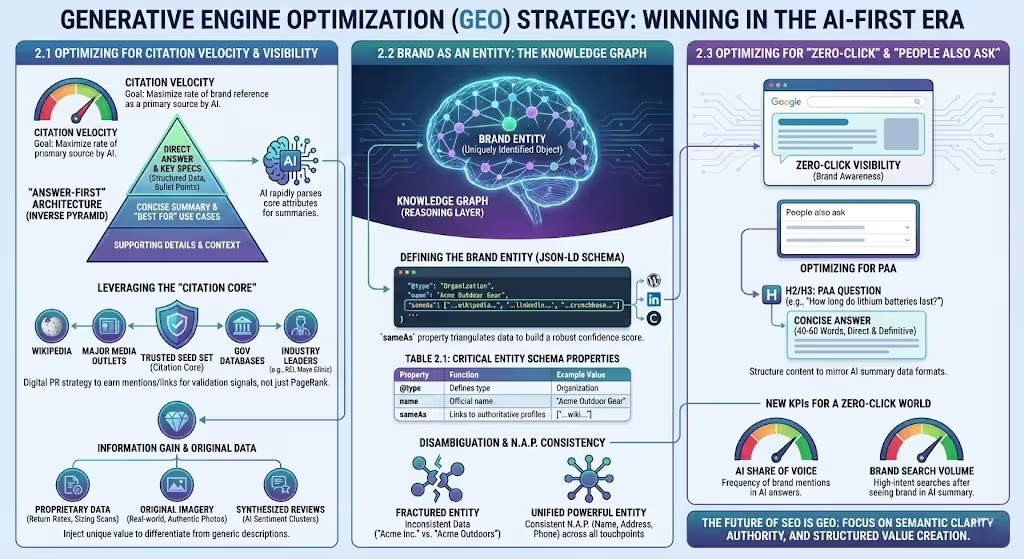
Securing a citation in an AI Overview (formerly SGE) or a ChatGPT response requires a fundamentally different approach to content creation than traditional SEO. AI models are probabilistic engines that prioritize content which appears authoritative, structured, and easy to synthesize. The goal is to maximize Citation Velocity—the rate at which a brand is referenced as a primary source across the AI ecosystem.
The “Answer-First” Content Architecture
AI models digest content in “chunks” or passages. To maximize the probability of extraction, content must be structured to provide immediate value. The “Answer-First” or “Inverse Pyramid” structure is essential. E-commerce guides and product descriptions should begin with a direct, definitive answer to the core user query before expanding into details.15
For example, a product page for a high-end camera should not bury the megapixel count or sensor size in the third paragraph. These specs—along with a concise summary of “Best For” use cases (e.g., “Best for low-light landscape photography”)—should be presented at the very top in a structured format. This allows the AI to quickly parse the entity’s core attributes and generate a summary.17
Leveraging the “Citation Core”
AI models do not treat all sources equally. They heavily weight information derived from a “seed set” of highly trusted domains, often referred to as the Citation Core. These include entities like Wikipedia, major media outlets, government databases, and established industry leaders (e.g., Mayo Clinic for health, REI for outdoor gear).19
For e-commerce brands, this necessitates a Digital PR strategy focused on earning mentions and backlinks from these Citation Core domains. A link from a high-authority news site or a specialized industry association is no longer just a vote of confidence for PageRank; it serves as a verification signal that validates the brand’s existence and legitimacy to the AI’s truth models.21
Information Gain and Original Data
Google and other search entities have increasingly prioritized “Information Gain” in their ranking algorithms. This concept rewards content that adds new information to the overall corpus, rather than simply rehashing existing facts found on competitor sites.
In the context of e-commerce, generic product descriptions provided by manufacturers are toxic to GEO. If 50 retailers publish the exact same description for a Samsung TV, the AI has no reason to cite any specific retailer over the manufacturer. To compete, retailers must inject unique Information Gain:
- Proprietary Data: Publish return rate statistics, customer satisfaction scores, or proprietary sizing data (e.g., “Our 3D scans show this shoe fits 5mm wider than the industry average”).23
- Original Imagery: Use unpolished, real-world photos of the product in use, which signals authenticity and “Experience” (E-E-A-T).23
- Synthesized Reviews: Use AI to aggregate user reviews into specific sentiment clusters (e.g., “Pros: Battery Life; Cons: Heavy Weight”) and publish these summaries as structured content.17
2.2 Brand as an Entity: The Knowledge Graph
In 2026, if a search engine does not recognize a brand as a distinct “Entity” in the Knowledge Graph, that brand is effectively invisible to the reasoning layer of search.10 An entity is a uniquely identified object—a person, corporation, place, or product—with defined relationships to other objects.
Defining the Brand Entity
The foundation of Entity SEO is the Organization schema. Brands must explicitly define their identity using JSON-LD structured data. This includes not just the name and logo, but the sameAs property, which is crucial for disambiguation.
The sameAs property acts as the “glue” of the Knowledge Graph. It tells the search engine that the “Nike” found on nike.com is the exact same entity as the “Nike” found on Wikipedia, LinkedIn, Crunchbase, and the New York Stock Exchange. This triangulation of data builds a robust confidence score for the entity.25
Table 2.1: Critical Entity Schema Properties
| Property | Function | Example Value |
| @type | Defines the entity type. | Organization or OnlineStore |
| name | The official name of the brand. | “Acme Outdoor Gear” |
| legalName | The registered corporate name. | “Acme Holdings, LLC” |
| sameAs | Links to external authoritative profiles. | [“https://en.wikipedia.org/wiki/Acme”, “https://twitter.com/acme”] |
| iso6523Code | Unique global identifier (e.g., DUNS). | “006092088” |
| contactPoint | Customer service details. | {“@type”: “ContactPoint”, “telephone”: “+1-800…”} |
Disambiguation and N.A.P. Consistency
A common failure point in Entity SEO is inconsistent data. If a brand is listed as “Acme Inc.” on one platform and “Acme Outdoors” on another, with varying addresses or phone numbers, the Knowledge Graph may fracture the entity into two separate, weaker nodes. N.A.P. (Name, Address, Phone) consistency must be maintained rigorously across all digital touchpoints to ensure the Knowledge Graph aggregates all authority signals to a single, powerful entity.28
2.3 Optimizing for “Zero-Click” and “People Also Ask”
While zero-click searches result in less direct traffic, they are critical for brand awareness and can drive high-intent searches later in the journey. Optimizing for features like People Also Ask (PAA) and Featured Snippets is the primary method for securing visibility in zero-click scenarios.
Content should be structured to answer PAA questions directly. If the PAA box asks, “How long do lithium batteries last?”, the content should include an H2 or H3 heading with that exact question, followed immediately by a concise (40-60 word) answer. This format mirrors the data structure AI models use to generate summaries.9
Furthermore, e-commerce teams must adopt new KPIs to measure success in a zero-click world. Metrics like “AI Share of Voice” (how often the brand is mentioned in AI answers) and “Brand Search Volume” (users searching for the brand specifically after seeing it in an AI summary) are becoming more relevant than raw organic sessions.31
3. The Knowledge Graph & Structured Data: The Semantic Backbone
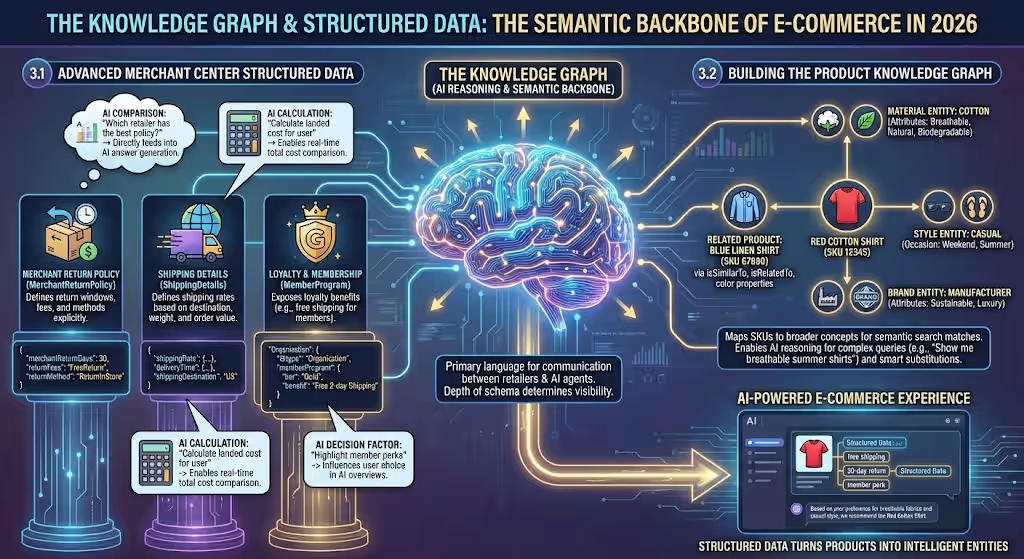
Structured data is no longer an optional “best practice” for e-commerce; it is the primary language of communication between retailers and AI agents. In 2026, the depth and specificity of schema markup determine whether a product is surfaced in a query or ignored.
3.1 Advanced Merchant Center Structured Data
Google and other platforms have significantly expanded the schema capabilities for merchants. It is insufficient to merely implement basic Product schema. Retailers must provide granular details about their operations to compete in the “Shopping Graph.”
Merchant Return Policy (MerchantReturnPolicy)
Return policies are a major decision factor for consumers. The MerchantReturnPolicy schema allows retailers to explicitly define return windows, fees, and methods in a machine-readable format.
- Key Properties: merchantReturnDays (e.g., 30), returnFees (e.g., https://schema.org/FreeReturn), and returnMethod (e.g., https://schema.org/ReturnInStore).
- Strategic Value: This data feeds directly into AI comparisons. When a user asks, “Which laptop retailer has the best return policy?”, the AI compares these structured fields to generate an answer.27
Shipping Details (ShippingDetails)
Similarly, shipping costs and speeds are critical. The ShippingDetails schema allows for the definition of shipping rates based on destination, weight, and order value.
- Key Properties: shippingRate, deliveryTime (using shippingDeliveryTime), and shippingDestination.
- Strategic Value: This allows the AI to calculate the “landed cost” for the user in real-time and surface products that offer free or fast shipping for the user’s specific location.27
Loyalty and Membership (MemberProgram)
With the rise of retention marketing, exposing loyalty benefits via schema is crucial. The MemberProgram schema, nested under Organization, allows brands to highlight tiers and benefits (e.g., “Gold members get free 2-day shipping”). This can be a deciding factor for users comparing retailers in an AI overview.27
3.2 Building the Product Knowledge Graph
A robust Product Knowledge Graph connects specific SKUs to broader concepts, enabling semantic search matches. Instead of treating a product as a standalone item, the graph maps it to attributes, occasions, and related entities.
For example, a “Red Cotton Shirt” should not just be indexed as text. It should be connected in the graph to:
- Material Entity: Cotton (Attributes: Breathable, Natural, Biodegradable).
- Style Entity: Casual (Occasion: Weekend, Summer).
- Brand Entity: Manufacturer Name (Attributes: Sustainable, Luxury).
Implementation: Retailers should use schema properties like isSimilarTo, isRelatedTo, and color to define these relationships explicitly. This helps AI recommendation engines perform “reasoning” tasks, such as suggesting substitutions (“If this shirt is out of stock, suggest this similar one based on material and style”) or answering complex queries (“Show me breathable summer shirts”).36
4. Technical Architecture for 2026: Speed and Fluidity
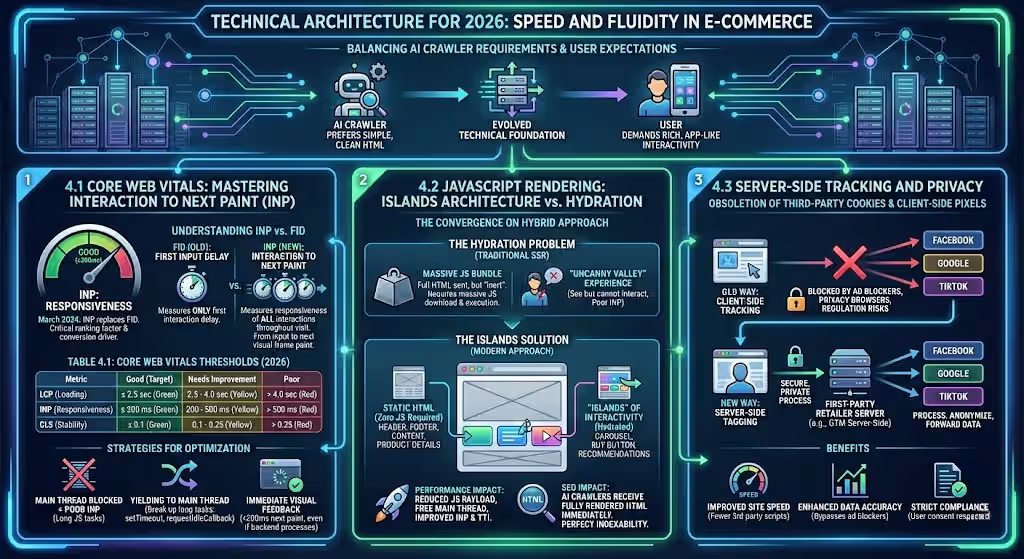
The technical foundation of e-commerce has evolved to meet the dual demands of AI crawlers (which prefer simple, clean HTML) and users (who demand rich, app-like interactivity).
4.1 Core Web Vitals: Mastering Interaction to Next Paint (INP)
In March 2024, Google replaced First Input Delay (FID) with Interaction to Next Paint (INP) as a Core Web Vital. By 2026, INP has solidified its position as a critical ranking factor and a primary driver of conversion rates.38
Understanding INP:
Unlike FID, which only measured the delay in the first interaction, INP measures the responsiveness of the page to all user interactions (clicks, taps, key presses) throughout the entire lifespan of the visit. It captures the time from the user’s input until the browser is able to paint the next frame of visual feedback.39
Table 4.1: Core Web Vitals Thresholds (2026)
| Metric | Good (Target) | Needs Improvement | Poor |
| LCP (Loading) | ≤ 2.5 sec | 2.5 – 4.0 sec | > 4.0 sec |
| INP (Responsiveness) | ≤ 200 ms | 200 – 500 ms | > 500 ms |
| CLS (Stability) | ≤ 0.1 | 0.1 – 0.25 | > 0.25 |
Strategies for Optimization:
A poor INP score is often caused by long-running JavaScript tasks on the main thread. When the main thread is blocked by a complex script (e.g., re-rendering a large product list), the browser cannot respond to the user’s click.
- Yielding to the Main Thread: Developers must break up long tasks using setTimeout or requestIdleCallback. This pauses the script execution briefly to allow the browser to handle user inputs and render updates.38
- Visual Feedback: For actions that require server processing (like “Add to Cart”), immediate visual feedback (e.g., a button state change) must be rendered in the next frame (<200ms), even if the backend process takes longer.40
4.2 JavaScript Rendering: Islands Architecture vs. Hydration
The architectural debate between Client-Side Rendering (CSR) and Server-Side Rendering (SSR) has converged on a hybrid approach known as Islands Architecture (popularized by frameworks like Astro and Fresh).
The Hydration Problem:
Traditional SSR sends a full HTML page to the browser, but the page is effectively “inert” until a massive JavaScript bundle is downloaded and executed—a process known as “hydration.” This creates a disconnect where the user can see the content but cannot interact with it, leading to poor INP scores and “uncanny valley” experiences.42
The Islands Solution:
Islands Architecture renders the vast majority of the page (header, footer, blog text, product details) as static HTML, which requires zero JavaScript to display. Only specific “islands” of interactivity—such as the image carousel, the “Buy Now” button, or the personalized recommendation widget—are hydrated.
- Performance Impact: This drastically reduces the JavaScript payload, freeing up the main thread and significantly improving INP and TTI (Time to Interactive).
- SEO Impact: AI crawlers and search bots receive fully rendered HTML immediately, ensuring perfect indexability without the complexity of executing JavaScript.44
4.3 Server-Side Tracking and Privacy
The deprecation of third-party cookies and the tightening of privacy regulations (GDPR, CCPA, DMA) have rendered traditional client-side tracking pixels obsolete and risky. In response, 2026 has seen a mass migration to Server-Side Tagging.
Mechanism:
Instead of the user’s browser sending data directly to Facebook, Google, or TikTok (which can be blocked by ad blockers or privacy browsers), the data is sent to a secure, first-party server owned by the retailer (e.g., a Google Tag Manager Server-Side container). This server then processes, anonymizes, and forwards the data to the marketing platforms.
- Benefits: This approach improves site speed (fewer third-party scripts running on the client), enhances data accuracy (bypassing ad blockers), and ensures strict compliance with user consent choices.46
5. Visual & Multimodal Search Optimization
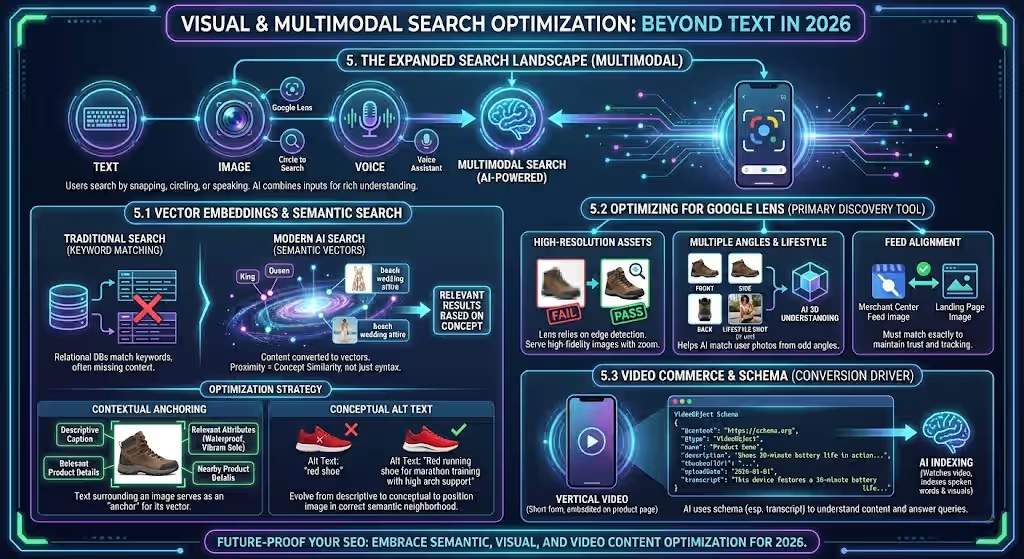
By 2026, the concept of “search” has expanded beyond text input. It is increasingly multimodal—combining text, images, and voice. Users search by snapping a photo with Google Lens (“Where can I buy this chair?”), by circling an item in a video (“Circle to Search”), or by having a conversation with a voice assistant.48
5.1 Vector Embeddings and Semantic Search
To understand how visual search works, one must understand Vector Embeddings. Traditional search engines stored data in relational databases and matched keywords. Modern AI search engines convert text and images into “vectors”—lists of numbers that represent the semantic meaning of the content in a multi-dimensional space.
In this vector space, the mathematical representation of “King” is close to “Queen,” and the vector for an image of a “floral summer dress” is located near the text vector for “beach wedding attire,” even if the keywords do not overlap. This proximity allows the search engine to return relevant results based on concept rather than just syntax.50
Optimization Strategy:
- Contextual Anchoring: To optimize for vector search, the text immediately surrounding an image is critical. It serves as an “anchor” for the image’s vector. E-commerce sites must ensure that descriptive captions, alt text, and relevant product attributes are placed adjacent to product images.52
- Conceptual Alt Text: Alt text should evolve from purely descriptive (“red shoe”) to conceptual (“Red running shoe for marathon training with high arch support”). This helps the vector algorithm position the image in the correct semantic neighborhood.52
5.2 Optimizing for Google Lens
Google Lens usage has exploded, particularly among Gen Z consumers, who use it as a primary discovery tool. Optimizing for Lens is distinct from traditional image SEO.
- High-Resolution Assets: Lens relies on edge detection and feature matching. Low-resolution or blurry images fail the recognition threshold. Retailers must serve high-fidelity images, ideally with zoom capabilities.52
- Multiple Angles: Providing standard views (front, side, back) as well as lifestyle shots helps the AI build a 3D understanding of the object. This improves the algorithm’s ability to match user photos taken from odd angles.52
- Feed Alignment: A common failure point is a discrepancy between the image in the Merchant Center feed and the image on the landing page. These must match exactly to maintain trust and tracking continuity.48
5.3 Video Commerce and Schema
Video has become a primary conversion driver. AI models like Gemini are capable of “watching” video content to index spoken words and visual entities.
- Vertical Video: Short-form, vertical videos (reminiscent of TikTok or YouTube Shorts) should be embedded directly onto product pages.
- VideoObject Schema: These videos must be wrapped in VideoObject schema. Critical properties include transcript (text of the audio), thumbnailUrl, uploadDate, and description. This allows the AI to index the video’s content—such as a spoken mention of “30-minute battery life”—and use it to answer queries.23
6. E-E-A-T, Trust, and Privacy
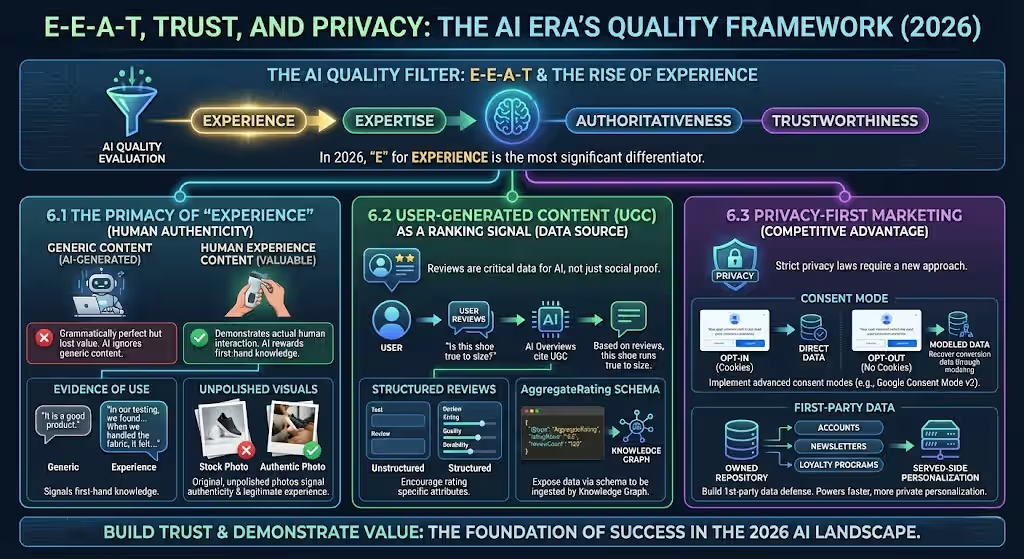
Google’s E-E-A-T (Experience, Expertise, Authoritativeness, Trustworthiness) framework remains the primary filter through which AI evaluates content quality. In 2026, the “E” for Experience has become the most significant differentiator.
6.1 The Primacy of “Experience”
Generative AI can write a grammatically perfect product description in seconds. As a result, generic content has lost almost all value. Search engines now heavily reward content that demonstrates actual human experience with the product.53
Tactics for Demonstrating Experience:
- Evidence of Use: Content must provide proof of physical interaction. Phrases like “In our testing, we found…” or “When we handled the fabric, it felt…” signal first-hand knowledge.
- Unpolished Visuals: Paradoxically, “perfect” stock photos are often ignored by AI as generic. Original, unpolished photos that show the product being used, held, or tested signal authenticity and legitimate experience.23
6.2 User-Generated Content (UGC) as a Ranking Signal
Reviews are no longer just social proof for humans; they are a critical data source for AI. AI Overviews frequently cite user reviews to answer specific queries like “Is this shoe true to size?” or “Does this blender crush ice well?”.17
- Structured Reviews: Retailers should encourage “structured” reviews where users rate specific attributes (e.g., Sizing, Quality, Durability) rather than just leaving a text block.
- AggregateRating Schema: This data must be exposed via AggregateRating schema to ensure it is ingested by the Knowledge Graph.21
6.3 Privacy-First Marketing
With the enforcement of strict privacy laws, a “Privacy-First” approach is a competitive advantage.
- Consent Mode: Implementing advanced consent modes (like Google’s Consent Mode v2) allows retailers to recover conversion data through modeling even when users opt out of cookies.
- First-Party Data: Building a repository of first-party data (via accounts, newsletters, loyalty programs) is the only defense against the loss of third-party signals. This data can be used to power server-side personalization, which is faster and more private than client-side alternatives.46
7. Platform-Specific Strategies: Beyond Google
While Google remains dominant, the search landscape is fragmented. Strategies must be tailored for different “Answer Engines.”
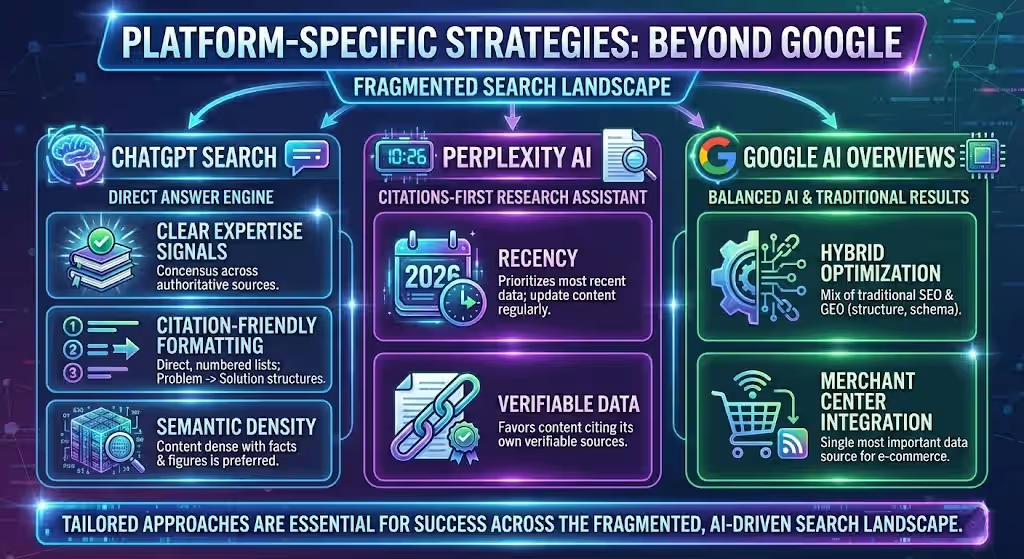
7.1 ChatGPT Search
ChatGPT acts as a direct answer engine. It values:
- Clear Expertise Signals: It looks for consensus across authoritative sources.
- Citation-Friendly Formatting: It prefers direct, numbered lists and clear “Problem -> Solution” structures.
- Semantic Density: Content that is dense with facts and figures is more likely to be synthesized.56
7.2 Perplexity AI
Perplexity is an “citations-first” engine that functions like a real-time research assistant.
- Recency: It heavily prioritizes the most recent data. Updating content with the current year’s statistics or recent news is vital.
- Verifiable Data: It favors content that cites its own sources (e.g., a blog post that links to a scientific study), as this allows the AI to verify the chain of trust.56
7.3 Google AI Overviews
Google balances AI answers with traditional search results.
- Hybrid Optimization: It requires a mix of traditional SEO (keywords, backlinks) and GEO (structure, schema).
- Merchant Center Integration: For e-commerce, the Merchant Center feed is the single most important data source for AI Overviews.29
8. Strategic Implementation Roadmap
To transition from traditional SEO to GEO, organizations need a phased approach that prioritizes foundational structure before advanced optimization.
Table 8.1: The 2026 E-Commerce SEO Implementation Roadmap
| Phase | Timeline | Key Actions |
| Phase 1: Foundation | Q1 2026 | Audit Core Web Vitals (INP focus). Implement Organization & Product Schema. Claim Knowledge Panel. |
| Phase 2: Semantic Layer | Q2 2026 | Build “Citation Core” content strategy. Add MerchantReturnPolicy & ShippingDetails schema. Implement Islands Architecture. |
| Phase 3: Multimodal | Q3 2026 | Optimize images for Vector Search. Implement Video Commerce (VideoObject schema). Enrich Product Feeds for Agentic Commerce. |
| Phase 4: Agentic | Q4 2026 | Test API-based purchasing for agents. Optimize specifically for Voice & Conversational queries using Speakable schema. |
9. Industry-Specific Trends
Different verticals require nuanced applications of these strategies.
- Fashion & Apparel: Visual search is dominant. “Shop the Look” and reverse image search drive over 40% of discovery. Return policy schema (MerchantReturnPolicy) is a critical conversion factor due to high return rates in this sector.49
- Consumer Electronics: Technical specifications and compatibility data are key. “Comparison” queries (e.g., “PS6 vs Xbox Next”) are the primary battleground. Structured data must be exhaustive to allow AI to perform side-by-side spec comparisons.58
- B2B E-Commerce: Entity authority is paramount. B2B buyers use AI to vet supplier reliability. Detailed “About Us” pages, certifications, and case studies (demonstrating Experience) are the main drivers of ranking and trust.59
FAQ: E-Commerce SEO in 2026
Q: Is traditional SEO dead in 2026?
A: No, but the “ten blue links” model is in steep decline. It has evolved into Generative Engine Optimization (GEO). The goal is no longer just to rank on a list but to be the source of the answer provided by an AI. While overall traffic volume may decrease due to zero-click searches, the intent of the remaining traffic is typically higher.1
Q: What is the most important technical metric in 2026?
A: Interaction to Next Paint (INP). It measures the responsiveness of your site to user inputs. A poor INP score (>200ms) frustrates users and is a negative ranking factor. Optimization involves reducing main-thread blocking JavaScript.38
Q: Should I use Client-Side Rendering (CSR) or Server-Side Rendering (SSR)?
A: The gold standard is now Islands Architecture (a hybrid). You render the page shell statically (HTML) for speed and SEO, and only hydrate specific interactive elements (buttons, filters) with JavaScript. This offers the best balance of performance and crawlability.44
Q: How does Schema Markup help with AI?
A: Schema (JSON-LD) is the machine-readable code that translates your content for AI. By using schemas like MerchantReturnPolicy, ShippingDetails, and Product, you provide the AI with raw, structured facts. Without schema, the AI must “guess” based on unstructured text, which significantly lowers your probability of being cited.27
Q: Can I use AI to write my product descriptions?
A: You can use AI for drafting or scaling, but do not publish raw AI content. AI content is often generic and lacks “Information Gain.” Google’s algorithms detect and devalue unoriginal content. You must inject human “Experience” (E-E-A-T)—unique insights, testing notes, or proprietary data—to rank.23
Q: How do I get my products into Google Lens results?
A: Use high-resolution, clear images with multiple angles. Ensure your product feed images match your landing page images exactly. Use descriptive file names and alt text that describe visual attributes (e.g., “vintage floral midi dress”) to help Vector Search algorithms match your image to user intent.52
Q: What is “Agentic Commerce”?
A: It refers to autonomous AI agents (bots) shopping on behalf of humans. To optimize for this, ensure your product data (price, stock, specs) is accessible via structured feeds and APIs, not just locked in visual HTML pages. Agents prioritize accessible, real-time data.11
Conclusion: The Era of the Verified Entity
As we navigate through 2026, the brands that will dominate e-commerce are not those with the highest keyword density, but those that have established themselves as Verified Entities within the global Knowledge Graph. The “search engine” as a simple directory is gone, replaced by a “reasoning engine” that seeks to answer, advise, and transact.
Success in this new era requires a rigorous commitment to data integrity. Structured data must be flawless and comprehensive. Technical infrastructure must be fluid and responsive (low INP). Content must exude human experience and provide genuine information gain. By aligning strategy with the principles of Generative Engine Optimization (GEO)—Entity Authority, Semantic Clarity, and Technical Fluidity—brands can position themselves not just to be found, but to be the answer.
Reference Data & Statistics
Table 11.1: Global E-Commerce & AI Statistics (2025-2026)
| Metric | Value | Source |
| Zero-Click Searches | ~60% of all Google Searches | 2 |
| Mobile Commerce Share | 60% of Total E-Commerce | 19 |
| Voice Assistant Users (US) | ~157.1 Million | 61 |
| Visual Search Usage (Gen Z) | 22% use regularly | 62 |
| AI Overview Reach | 2 Billion Monthly Users | 5 |
| Global E-Commerce Sales (2026) | ~$6.88 Trillion | 63 |
| Amazon US Market Share | 40.9% | 19 |
References/ Works cited
- Generative Engine Optimization (GEO) for Businesses: Redefining Growth in 2026, accessed on December 30, 2025
- SEO Trends 2026: Win Google AI Overviews & ChatGPT Citations, accessed on December 30, 2025
- How will Google’s AI Overviews affect my website traffic in 2026? – ROI Growth Agency, accessed on December 30, 2025
- Generative Engine Optimization (GEO): The New SEO Frontier | by Vivek Malhan | Nov, 2025, accessed on December 30, 2025
- 26 AI SEO Statistics for 2026 + Insights They Reveal – Semrush, accessed on December 30, 2025
- 26 AI SEO Statistics for 2026 & Insights They Reveal – Elementor, accessed on December 30, 2025
- Ecommerce GEO in 2025 (Optimize for AI-Powered Search), accessed on December 30, 2025
- How To Do Generative Engine Optimization (GEO) for Ecommerce – Salsify, accessed on December 30, 2025
- 2026 Google Search Statistics – What Every Marketer Must Know – Eco York, accessed on December 30, 2025
- How to get your Brand into Google & OpenAI Knowledge Graph? 2026 – ClickRank AI, accessed on December 30, 2025
- 15 SEO predictions for 2026: The shift to Search Everywhere Optimization – Envisionit, accessed on December 30, 2025
- Ecommerce Trends 2026: Bold Predictions for the Future of Ecommerce | Triple Whale, accessed on December 30, 2025
- When AI Shops for Consumers. Why AI Agents Are the New Customer…, accessed on December 30, 2025
- The Rise of AI Search in Retail: 2026 Trends | Agentic AI – Finch, accessed on December 30, 2025
- How to Optimize Content for AI Search and Discovery | Digital Marketing Institute, accessed on December 30, 2025
- How to Optimize Content for AI Search Engines in 2026 – Elementor, accessed on December 30, 2025
- Ecommerce SEO Trends in 2026: How Search Behavior Is Changing for Online Stores, accessed on December 30, 2025
- AI FAQs & Generative Search: Boost Visibility – LSEO, accessed on December 30, 2025
- 36 Up-To-Date Ecommerce Statistics for 2026 – Backlinko, accessed on December 30, 2025
- Generative Engine Optimization Strategies and Tracking?, accessed on December 30, 2025
- The 2026 Guide to Building EEAT for eCommerce & AI Search Visibility – ClickSlice, accessed on December 30, 2025
- How to plan for GEO in 2026 and evolve your search strategy – Search Engine Land, accessed on December 30, 2025
- eCommerce SEO in 2026 – 5 Things to have an eye on – Legiit, accessed on December 30, 2025
- From Website to Knowledge Graph – Hill Web Creations: Digital Marketing, SEM, SEO, accessed on December 30, 2025
- How to Set Up sameAs Schema for Better E-E-A-T | Weekend Growth, accessed on December 30, 2025
- 7 sameAs Schema Best Practices – Aubrey Yung, accessed on December 30, 2025
- Organization Schema Markup | Google Search Central …, accessed on December 30, 2025
- Why Brands Must Have A Knowledge Graph to Master AI Visibility in 2026 | Yext, accessed on December 30, 2025
- AI Overviews and Zero-Click Searches: Adapting Your SEO Strategy for 2026 – ALM Corp, accessed on December 30, 2025
- From People Also Ask to AI Search — Reading the Signals That Matter | Mark Williams-Cook, accessed on December 30, 2025
- The Top 10 Digital Marketing Trends For 2026 – Search Engine Journal, accessed on December 30, 2025
- Beyond SERP visibility: 7 success criteria for organic search in 2026 – Search Engine Land, accessed on December 30, 2025
- New Ways to Add Shipping & Return Policies in Google Search: What Merchants Need to Know (November 2025 Update) – PEMAVOR, accessed on December 30, 2025
- Google Search Console Lets You Add Shipping/Return Details Without Merchant Center Account, accessed on December 30, 2025
- Merchant Shipping Policy Structured Data (ShippingService) | Google Search Central | Documentation, accessed on December 30, 2025
- 7 Knowledge Graph Examples of 2026, accessed on December 30, 2025
- E-Commerce SEO: Grow Visibility with a Product Knowledge Graph – iPullRank, accessed on December 30, 2025
- How important are Core Web Vitals for SEO in 2026? – White Label Coders, accessed on December 30, 2025
- Introducing INP to Core Web Vitals | Google Search Central Blog …, accessed on December 30, 2025
- Core Web Vitals 2026: The Ultimate Power Guide to Fast, Stable SEO – ClickRank AI, accessed on December 30, 2025
- Core Web Vitals 2026: Technical SEO That Actually Moves the Needle – ALM Corp, accessed on December 30, 2025
- Is JavaScript SEO the Powerful Key to Top Rankings in 2026?, accessed on December 30, 2025
- JavaScript SEO in 2026: Rendering Strategies for Modern Frameworks – Jasmine Directory, accessed on December 30, 2025
- Islands Architecture – Patterns.dev, accessed on December 30, 2025
- Island Architecture in Astro: A Example with an Interactive Pricing Calculator – Medium, accessed on December 30, 2025
- Data Privacy Trends 2026: Essential Guide for Business Leaders, accessed on December 30, 2025
- Server-side Tracking Report 2026 – JENTIS, accessed on December 30, 2025
- Google’s Old Search Era Is Over – Here’s What 2026 SEO Will Really Look Like, accessed on December 30, 2025
- Image Search Techniques 2026: The Complete SEO Strategy Guide – ClickRank AI, accessed on December 30, 2025
- The Best Open-Source Embedding Models in 2026 – BentoML, accessed on December 30, 2025
- Vector Search – OpenSearch, accessed on December 30, 2025
- Visual Search Optimization for E-commerce Websites in 2026 – Cloudi5, accessed on December 30, 2025
- 2026 Guide to E E A T and Google SGE for Better Search Visibility – Cubic Digital, accessed on December 30, 2025
- The E-E-A-T Playbook for 2026: Beyond On-Page SEO — Building Trust and Authority | by Rizwan Haider Razi | Dec, 2025 | Medium, accessed on December 30, 2025
- Top Digital Marketing Trends 2026: The Complete Guide to Future-Proofing Your Strategy, accessed on December 30, 2025
- Generative engine optimization: What we know so far about …, accessed on December 30, 2025
- The Ultimate Guide to Visual Search in Ecommerce – Coveo, accessed on December 30, 2025
- eCommerce Conversion Rate by Industry (2026 Update) – Convertcart, accessed on December 30, 2025
- How is your SEO strategy changing in 2026? : r/b2bmarketing – Reddit, accessed on December 30, 2025
- Tips to Optimize Your Ecommerce Store with AI – Salesforce, accessed on December 30, 2025
- 51 Voice Search Statistics 2025: New Global Trends – DemandSage, accessed on December 30, 2025
- Visual Search and the New Rules of Retail Discovery in 2026 – Imagga Blog, accessed on December 30, 2025
- What is Global Ecommerce? Trends and How to Expand Your …, accessed on December 30, 2025