
Why Your SaaS Must Be EAA Compliant by 2026
Executive Summary
The technological hegemony of Silicon Valley, centered in San Jose, has historically operated on a model of aggressive innovation where speed to market often supersedes regulatory foresight. This paradigm, encapsulated by the ethos of “move fast and break things,” is now colliding with a rigid, non-negotiable regulatory wall emanating from across the Atlantic: The European Accessibility Act (EAA), Directive (EU) 2019/882.1 As of June 28, 2025, this directive will fundamentally alter the market access requirements for digital products and services sold within the European Union, affecting everything from e-commerce platforms to consumer banking services and operating systems.1
For the Software-as-a-Service (SaaS) sector in San Jose, the implications are profound. The EAA is not merely a set of guidelines like the Web Content Accessibility Guidelines (WCAG) often treated as voluntary best practices in the United States; it is a legal mandate enforced by “market surveillance” mechanisms capable of banning non-compliant products.4 With California exporting over $28 billion in goods to the EU annually—a significant portion being computer and electronic products—the economic exposure is immense.6 The “Brussels Effect”—the ability of the EU to unilaterally set global standards through its market power—means that San Jose firms face a binary choice: harmonize their global product lines to meet European standards or forfeit access to the world’s largest single market.2
This report provides an exhaustive analysis of the EAA’s impact on San Jose’s tech ecosystem. It dissects the legal nuances of the Directive versus the US Americans with Disabilities Act (ADA), explores the technical rigors of the EN 301 549 standard, and outlines the severe penalties for non-compliance, which range from fines of €250,000 in France to imprisonment in Ireland.9 It serves as a strategic roadmap for C-suite executives, product managers, and legal counsel in Silicon Valley to navigate this regulatory shift before the 2025 deadline.
1: The Geopolitical Shift – When Code Meets Policy
1.1 The Mechanics of the Brussels Effect
The “Brussels Effect,” a phenomenon extensively documented in regulatory studies, describes the process by which the European Union externalizes its laws.2 Unlike the United States, which often relies on market mechanisms or reactive litigation to shape corporate behavior, the EU utilizes its sheer market size—450 million affluent consumers—as leverage to enforce proactive compliance. When the EU sets a strict standard, multinational corporations based in San Jose typically find it economically inefficient to maintain separate product lines—one compliant for Europe and one non-compliant for the rest of the world. Consequently, they adopt the EU standard globally. This was evident with the General Data Protection Regulation (GDPR), which forced Silicon Valley to overhaul data privacy practices worldwide, and it is now recurring with digital accessibility via the EAA.8
For a San Jose SaaS company, the Brussels Effect signifies a loss of regulatory autonomy. The product requirements are no longer solely defined by user feedback or local US law but are dictated by bureaucrats in Brussels. The EAA aims to harmonize accessibility standards across all 27 member states to facilitate cross-border trade, but in doing so, it sets a high bar that foreign importers must clear.1 The directive effectively acts as a non-tariff trade barrier; products that do not meet the accessibility criteria are legally defective and cannot be placed on the market.9
This regulatory export is not accidental. EU policymakers view the EAA as a tool to ensure “digital sovereignty” and to promote “human-centric” technology, contrasting with the profit-centric/surveillance-capitalism models often associated with US tech giants.8 By mandating accessibility, the EU is forcing San Jose to code distinct social values—inclusivity, transparency, and robustness—into their software architectures.
1.2 The End of Voluntary Compliance
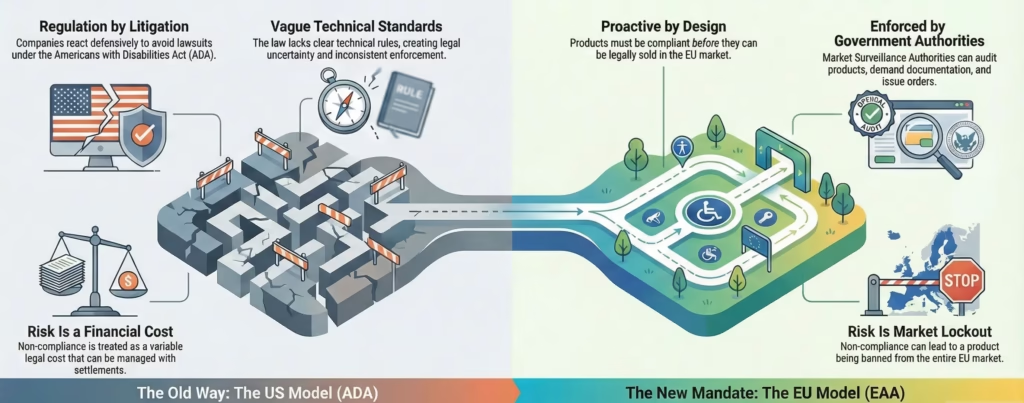
In the United States, digital accessibility has largely been driven by the threat of civil litigation under Title III of the Americans with Disabilities Act (ADA). This “regulation by litigation” creates a defensive posture where companies do the minimum necessary to avoid a lawsuit or settle quickly when sued.13 The ADA does not provide clear technical standards for websites, leaving courts to interpret compliance, often using WCAG as a de facto benchmark but without statutory certainty.15
The EAA upends this model entirely. It is not based on civil liability but on administrative law.
- Proactive vs. Reactive: Under the EAA, you do not wait to be sued. You must demonstrate compliance before or during the sale of the service.
- Market Surveillance: Member states designate Market Surveillance Authorities (MSAs) aimed at policing the market. These government bodies have the power to audit products, demand technical documentation, and order product withdrawals.4
- No Settlements: You cannot “settle” with a Market Surveillance Authority to keep a non-compliant product on the market. If a product is found to be non-compliant, the remedy is correction or removal, not just a monetary payout.5
This shift requires a fundamental change in mindset for San Jose executives. The risk is no longer a variable legal cost; it is an existential operational risk. A “product withdrawal” order in Germany could cascade across the entire EU via the Information and Communication System for Market Surveillance (ICSMS), effectively locking a SaaS platform out of the entire continent.5
1.3 The Broader Techlash Context
The EAA must be viewed within the broader context of the EU’s assertive digital strategy, which includes the Digital Services Act (DSA), the Digital Markets Act (DMA), and the AI Act.2 These regulations collectively target the dominance of Silicon Valley “gatekeepers.” The EAA intersects with these by attacking “lock-in” mechanisms. If a dominant cloud provider or SaaS platform in San Jose is non-compliant with the EAA, it gives European enterprise clients a regulatory justification to terminate long-term contracts, claiming the service is legally unfit.19 Furthermore, as the US and China pursue divergent technological paths, Europe is carving out a “third way” focused on fundamental rights.8 For San Jose firms, this means that “compliance” is no longer just a legal checklist—it is a condition of geopolitical market entry. The EAA is the tip of the spear in a new era where access to the EU market is conditional on adhering to European values of inclusivity.
Download Saas Accessibility Guide
2: The San Jose Ecosystem – Exposure and Opportunity
2.1 The Economic Stakes: San Jose’s Export Engine
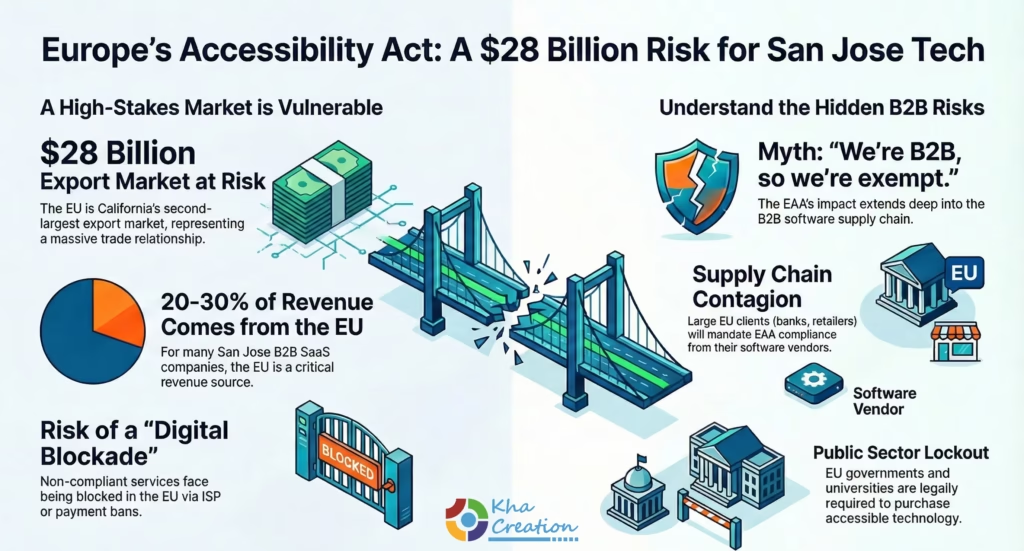
San Jose is not just the capital of Silicon Valley; it is a critical node in the global trade network. In 2024, California’s exports to the European Union totaled $28.02 billion, making the EU the second-largest export market for the state.6 The composition of these exports is heavily skewed towards the very sectors targeted by the EAA: “Computer and Electronic Products” accounted for $47.9 billion of California’s total global exports, with a significant portion destined for Europe.7
The interdependence is stark. European Union countries purchase approximately 15.3% of all California exports.6 For many B2B SaaS companies in San Jose, the EU represents 20-30% of their revenue base. The “San Jose Chamber of Commerce” and other local trade bodies like the “Northern California World Trade Center” actively facilitate this trade, recognizing that the economic vitality of the South Bay is inextricably linked to open access to European markets.20
However, this trade flow is vulnerable. The EAA applies to “manufacturers,” “importers,” and “distributors”.22 A San Jose SaaS company selling directly to EU consumers is considered a manufacturer/importer under the directive. If the service is non-compliant, it can be stopped at the “digital border” via ISP blocking or payment processing bans ordered by MSAs.9 The $28 billion trade relationship is predicated on regulatory alignment; as that alignment fractures due to the EAA’s new high standards, San Jose’s export revenue is at risk.
2.2 The B2B Supply Chain Contagion
A dangerous misconception pervasive in San Jose is the belief that “We are B2B, so this doesn’t apply to us”.23 While the EAA focuses on consumer products, the definition of “consumer” and the interconnected nature of the SaaS supply chain effectively drag B2B firms into scope.
- Public Procurement: European public sector bodies are bound by the Web Accessibility Directive (WAD) and public procurement rules that mandate the purchase of accessible technology. If a San Jose B2B firm wants to sell to the French government or a German university, their product must meet EN 301 549 standards. The EAA reinforces this by harmonizing the standards used in procurement.24
- Enterprise Mandates: Large EU corporations (banks, telcos, retailers) are directly subject to the EAA. They cannot use non-compliant third-party tools (e.g., a chatbot, a billing system, a CRM) that interact with their customers. Consequently, they will push EAA compliance requirements down to their vendors. A San Jose SaaS platform that powers a European bank’s customer portal must be compliant, or the bank will be fined.26
- Employee Usage: National laws in several EU states (e.g., France, Italy) extend accessibility rights to employees. Therefore, software used internally by employees (B2E) is often subject to similar requirements, meaning “internal tools” sold by San Jose firms must also be accessible.27
2.3 The Role of Local Trade Organizations
Organizations like the San Jose Chamber of Commerce (101 W. Santa Clara St) 28 and the U.S. Commercial Service San Jose (55 South Market Street) 29 play a pivotal role in bridging this gap. They offer export counseling and webinars on EU regulations.30 However, the specific urgency of the EAA—with its 2025 hard deadline—requires a more aggressive mobilization. The Chamber’s focus on “economic vitality” and “business-friendly environments” 31 now involves ensuring that member businesses are not blindsided by non-tariff barriers.
Local legal firms in Silicon Valley, such as Silicon Valley Law Group and offices of Morgan Lewis and Greenberg Traurig, are increasingly fielding inquiries about EAA compliance, shifting from defensive ADA litigation support to proactive regulatory advisory.32 This signals a maturing of the local ecosystem’s approach to accessibility, moving from risk avoidance to market readiness.
3: The Legal Machinery – Directive 2019/882
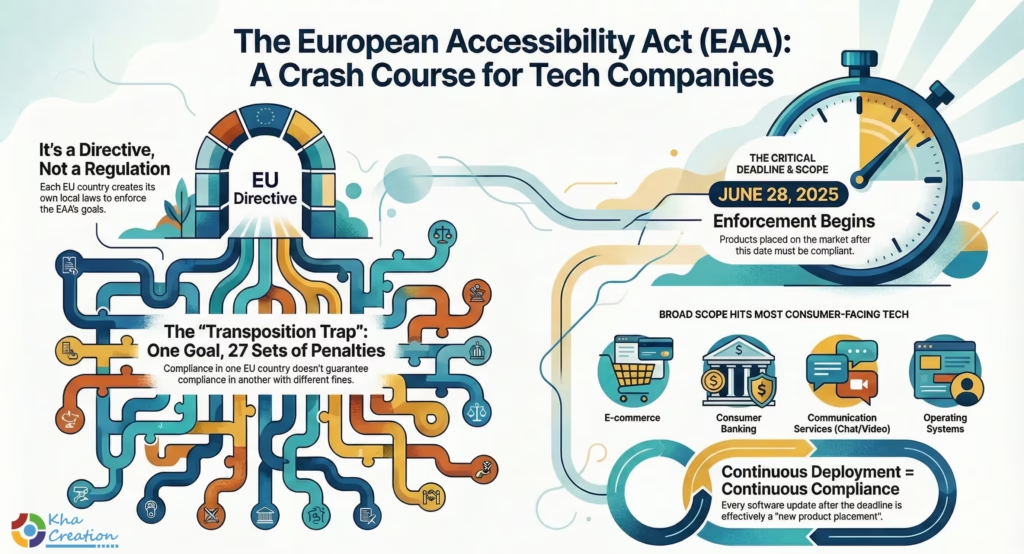
3.1 Directive vs. Regulation: The “Transposition” Trap
To navigate the EAA, San Jose legal teams must understand the instrument itself. The EAA is a Directive, not a Regulation.1
- Regulation (e.g., GDPR): A single law that applies identically across the EU.
- Directive (e.g., EAA): A legislative act that sets a goal that all EU countries must achieve. However, it is up to the individual countries to devise their own laws on how to reach these goals. This process is called “transposition”.1
This distinction is critical because it creates a fragmented enforcement landscape. While the requirements (what the software must do) are harmonized, the penalties and procedures (what happens if you fail) vary by country. A San Jose SaaS company is not just complying with “The EAA”; it is complying with the Barrierefreiheitsstärkungsgesetz (BFSG) in Germany, the Code de la Consommation in France, and the European Union (Accessibility Requirements of Products and Services) Regulations 2023 in Ireland.36
This variation creates the “Transposition Trap.” A compliance strategy that works for Ireland might be insufficient for France, where specific administrative fines and public shaming protocols exist.9
3.2 The Critical Timeline
The timeline for the EAA is rigid, with no indication of extensions.
- June 27, 2019: EAA entered into force.
- June 28, 2022: Deadline for member states to publish national laws (Transposition).3
- June 28, 2025: Enforcement Date. The laws become applicable. Products placed on the market after this date must be compliant.1
- Transitional Measures: Some service contracts concluded before June 2025 may continue unchanged until June 2030, but this generally applies to the contract, not the product. New features or significant updates typically trigger immediate compliance obligations.1
For a SaaS company operating on continuous deployment (CI/CD), every update pushed after June 28, 2025, is effectively a “new product placement” and must be compliant.
Download Saas Accessibility Guide
3.3 Scope of Applicability
The EAA applies to a specific list of products and services, but the definitions are broad enough to capture most consumer-facing SaaS 22:
- E-commerce Services: Defined as services provided via websites and mobile devices that allow consumers to conclude a contract. This covers almost any SaaS with a subscription model or a checkout flow.37
- Consumer Banking Services: Including identification methods, mobile banking apps, and online portals. This hits the Fintech sector of San Jose hard.37
- Electronic Communications Services: Email, video chat, instant messaging. This covers platforms like Zoom, Slack, or WhatsApp equivalents.38
- Operating Systems: Including mobile OS and desktop OS.
- Access to Audiovisual Media Services: The UI for streaming services (Netflix, YouTube, etc.).39
Exemptions: Micro-enterprises (companies with fewer than 10 employees and an annual turnover or balance sheet under €2 million) are exempt from the services requirements.37 However, most venture-backed startups in San Jose quickly exceed this threshold. Furthermore, if a micro-enterprise sells a product (hardware), the exemption does not apply in the same way.
4: The Technical Standard – EN 301 549 vs. ADA
4.1 The Delta Between WCAG and EN 301 549
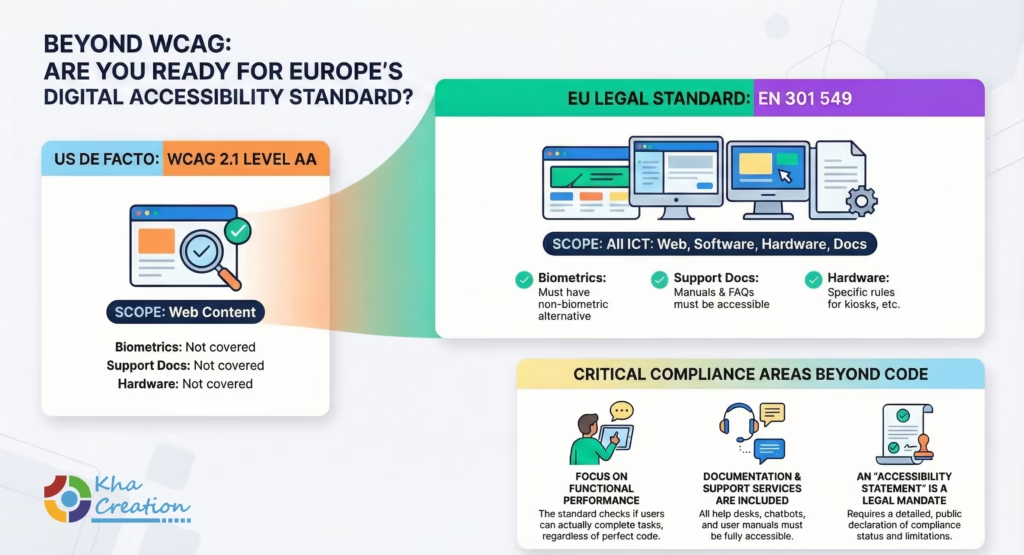
The EAA does not list technical specifications in the legal text. Instead, it references “Harmonized Standards.” The standard for digital accessibility in Europe is EN 301 549.25
San Jose developers are likely familiar with the Web Content Accessibility Guidelines (WCAG) 2.1 Level AA. While EN 301 549 incorporates WCAG 2.1 AA, it is not identical. It is a superset.
Table 1: Technical Standards Comparison
| Feature | WCAG 2.1 Level AA (US De Facto Standard) | EN 301 549 V3.2.1 (EU Legal Standard) |
| Scope | Web Content | ICT Products & Services (Web, Software, Hardware, Docs) |
| Biometrics | Not explicitly covered in detail | Clause 5.1.4: Must provide alternative to biometric ID 41 |
| Real-Time Text (RTT) | Not required | Clause 6.2: Mandatory for communication services 38 |
| Documentation | Not covered | Clause 12: Product docs & support must be accessible 42 |
| Functional Performance | Implicit | Clause 4: Explicit “Functional Performance Statements” (Safety net) |
| Kiosks/Hardware | Not covered | Clause 8: Specific hardware accessibility requirements |
Insight: A SaaS platform might be 100% WCAG compliant but fail EN 301 549 because its documentation (PDF manuals) is inaccessible, or because its support chat does not support Real-Time Text, or because it relies solely on FaceID for login without a robust alternative.41
4.2 Functional Performance Statements (Clause 4)
Clause 4 of EN 301 549 is the “safety net” of the standard. It shifts the focus from “did you code this tag correctly?” to “can a user actually use this?”.25
- Usage without vision: Can the entire SaaS be operated with a screen reader?
- Usage with limited manipulation: Can it be used without fine motor control (no drag-and-drop only interfaces)?
- Usage with limited cognition: Is the interface consistent and predictable?
For San Jose’s “disruptive” UIs—often characterized by minimalist design, gesture-based navigation, and unconventional layouts—Clause 4 is a minefield. Innovation cannot come at the cost of intelligibility. If a user with a cognitive disability cannot understand the authentication flow, the product is non-compliant, regardless of valid HTML.37
4.3 Documentation and Support Services (Clause 12)
This is the most overlooked area. The EAA requires that “support services” be accessible.42
- Help Desks: If you offer telephone support, you must be able to communicate with users via text relay services.
- Chatbots: Automated support bots must be fully accessible (keyboard navigable, screen reader compatible).
- Manuals: User guides, FAQs, and API documentation must meet accessibility standards. Sending a scanned PDF invoice or a non-tagged PDF manual is a violation.22
4.4 The “Accessibility Statement” Requirement
Under the EAA, publishing a detailed Accessibility Statement is mandatory, not optional.43 This statement must:
- Identify the standard applied (EN 301 549).
- List any known limitations (non-compliant areas).
- Provide a feedback mechanism for users to report barriers.
- Link to the enforcement procedure (the MSA).
This differs from the generic “we are committed to accessibility” statements often found on US sites. It is a legal declaration of conformity. Falsifying this statement or failing to update it can trigger fraud penalties in some jurisdictions.44
5: Enforcement & Penalties – The Cost of Non-Compliance
5.1 The Market Surveillance Mechanism
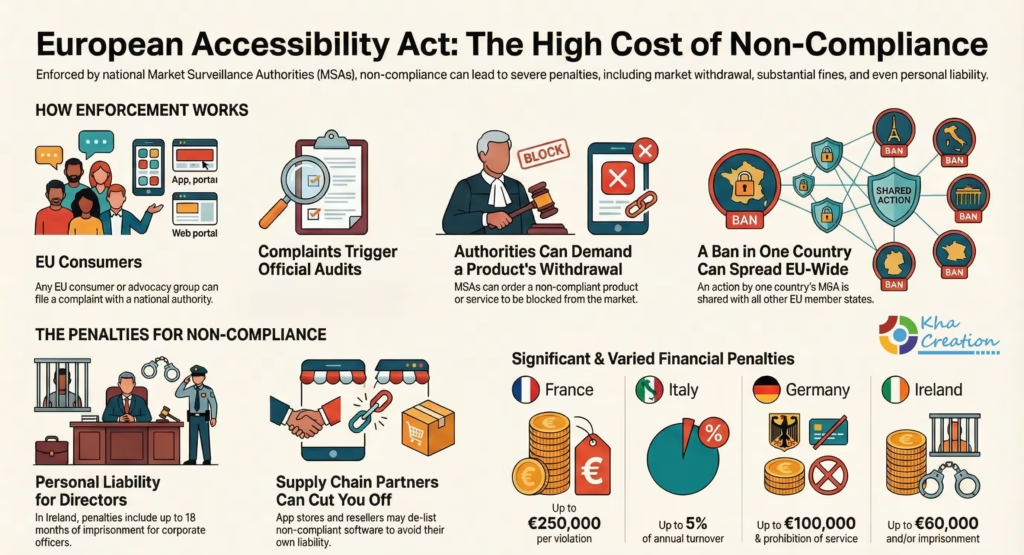
The EAA’s enforcement model relies on Market Surveillance Authorities (MSAs). These are not courts; they are regulatory agencies with police-like powers for products.17
- Consumer Complaints: Any EU consumer can file a complaint with their national MSA if a service is inaccessible.
- NGO Action: Public and private organizations (like disability advocacy groups) can take action on behalf of consumers.3
- The Audit: An MSA can demand your technical documentation (the “Technical File”) which must explain how you achieved compliance. You generally have a short window (e.g., 30 days) to produce this.5
The Nuclear Option: Product Withdrawal
If a product is non-compliant and the company fails to take corrective action, the MSA can order the withdrawal of the product from the market.5
- SaaS Context: “Withdrawal” effectively means an order to Internet Service Providers (ISPs) to block the domain or to payment processors to cease handling transactions for the service in that country.
- Cross-Border Effect: An action taken by one MSA is communicated to all other EU MSAs via the ICSMS system, potentially leading to a pan-European ban.1
5.2 Country-Specific Penalties
Because of the Directive structure, penalties vary significantly. San Jose firms must prepare for the worst-case scenario in each jurisdiction they serve.
Table 2: EAA Penalty Landscape by Member State
| Country | Penalty Mechanism | Maximum Fine / Consequence |
| France | Administrative Fines & Criminal Sanctions | Up to €250,000 per violation; Public “Naming and Shaming” 9 |
| Germany | Administrative Fines | Up to €100,000; Prohibition of service; Fines for missing docs 39 |
| Ireland | Criminal & Civil Liability | Up to €60,000 and/or 18 months imprisonment for directors 9 |
| Italy | Administrative Fines (Turnover based) | Up to 5% of annual turnover (for certain entities); €40,000 standard 36 |
| Austria | Administrative Fines | Up to €80,000 for severe violations 39 |
| Belgium | Operational Sanctions | Suspension of business activities until compliant 45 |
| Sweden | Fines & Corrective Actions | Up to €200,000 45 |
Insight: The Irish penalty is particularly alarming for Silicon Valley. Many US tech firms have their EU headquarters in Dublin (Google, Meta, etc.). The threat of imprisonment for corporate officers in Ireland elevates accessibility compliance to a boardroom-level issue involving personal liability for directors.9
Download Saas Accessibility Guide
5.3 Liability of Importers and Distributors
The EAA places liability on the “importer” and “distributor”.22 If a San Jose SaaS company does not have an EU subsidiary, the entity that facilitates the sale (e.g., a reseller, an app store, or a local partner) is liable.
- App Stores: Apple and Google may be forced to de-list non-compliant apps from their EU storefronts to avoid liability as distributors.
- Resellers: European Value-Added Resellers (VARs) will demand “Declarations of Conformity” from San Jose vendors before carrying their software, effectively acting as private market surveillance agents.
6: Strategic Implications – The Future of SaaS in Europe
6.1 Antitrust and the “Lock-In” Factor
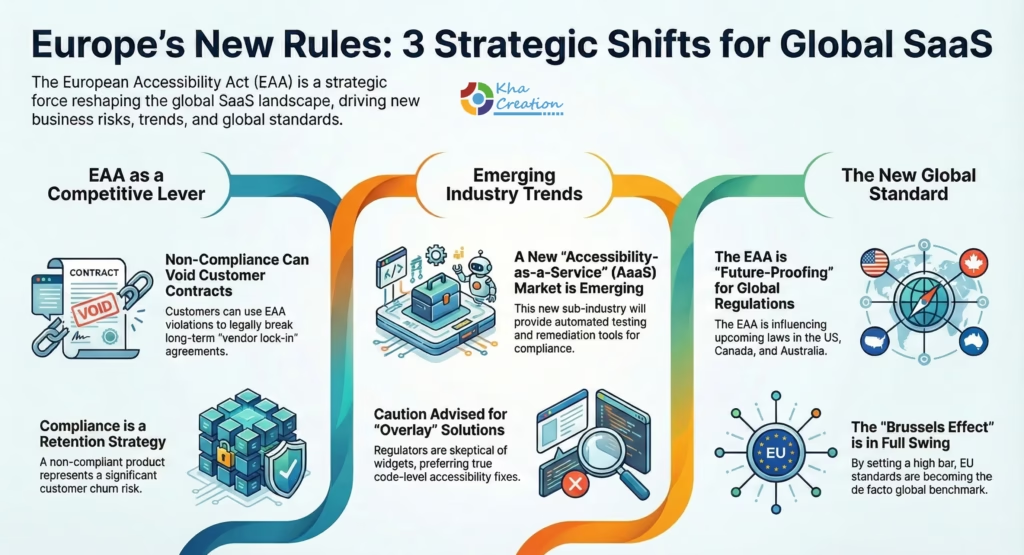
The EAA intersects dangerously with the EU’s antitrust agenda. Regulators are actively investigating “lock-in” practices by major cloud and SaaS providers.19
- The Scenario: A European enterprise wants to switch from a San Jose SaaS provider to a local European competitor. They are locked into a 3-year contract.
- The EAA Lever: The enterprise audits the San Jose SaaS and finds it non-compliant with EN 301 549. They declare the contract void due to the product being legally defective (unfit for market).
- The Result: The EAA becomes a tool for breaking vendor lock-in. Compliance is therefore a retention strategy. A non-compliant product is a contract waiting to be breached.
6.2 The Rise of “AaaS” (Accessibility as a Service)
The strict requirements of the EAA will likely spawn a new sub-industry in Silicon Valley: Accessibility as a Service. Startups that provide automated testing, remediation pipelines, and “compliance watchdogs” will see massive growth. However, reliance on automated “overlays” (widgets that sit on top of a site to “fix” it) is explicitly warned against by experts. Overlays often fail to meet the “robustness” and “functional performance” criteria of the EAA and are viewed skeptically by European regulators.37 True compliance requires code-level remediation.
6.3 The “California Effect” vs. The “Brussels Effect”
While the Brussels Effect drives global standards, California often follows suit. We saw this with GDPR leading to CCPA. It is highly probable that the EAA will influence future updates to the ADA or state-level legislation in California. By complying with the EAA now, San Jose firms are essentially future-proofing themselves for domestic regulations that will likely emerge later in the decade. The EAA standard (EN 301 549) is already being looked at by other nations (Canada, Australia) as a template, solidifying it as the global benchmark.11
7: Operational Roadmap to Compliance
For a San Jose SaaS company, the path to compliance by June 2025 involves four distinct phases.
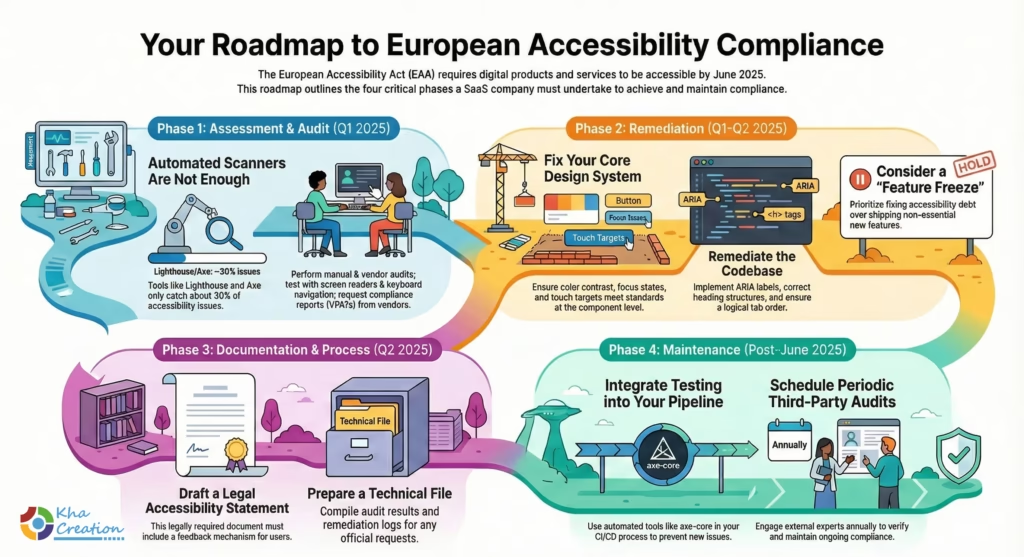
Phase 1: Assessment & Audit (Q1 2025)
- Audit Scope: Identify all digital touchpoints: Marketing site, Web App, Mobile App (iOS/Android), Help Center, PDFs, Customer Emails.
- Gap Analysis: Perform a full audit against EN 301 549 V3.2.1. Crucially, do not rely solely on automated scanners (Lighthouse, Axe). They catch only ~30% of issues. You must perform manual testing with screen readers (NVDA, JAWS, VoiceOver) and keyboard-only navigation.46
- Vendor Audit: Review all third-party integrations (Chatbots, Stripe elements, embedded maps). Contact vendors for their VPATs/Accessibility Conformance Reports.
Phase 2: Remediation (Q1-Q2 2025)
- Design System Update: Fix accessibility at the component level. Ensure color contrast ratios (4.5:1), focus states, and touch targets meet standards in your UI kit/Design System.
- Code Retrofit: Remediate the codebase. Add ARIA labels, fix heading structures, ensure logical tab order.
- Feature Freeze: Consider a feature freeze on non-essential updates to prioritize accessibility debt repayment.
Phase 3: Documentation & Process (Q2 2025)
- Draft Accessibility Statement: Create the legal statement required by the EAA. Include the feedback mechanism.
- Prepare Technical File: Compile the audit results and remediation logs into a “Technical Documentation” file to be ready for an MSA request.
- Training: Train support staff on how to handle accessibility queries and use RTT (Real-Time Text) tools.
Phase 4: Maintenance (Post-June 2025)
- CI/CD Integration: Integrate automated accessibility testing into the build pipeline (e.g., using axe-core in CI).
- Regression Testing: Ensure new features do not break existing accessibility.
- Periodic Audits: Schedule annual third-party audits to ensure continued compliance.
Download Saas Accessibility Guide
Conclusion
The deadline of June 28, 2025, represents a watershed moment for the global digital economy. The era of “move fast and break things” is ending; the era of “move intentionally and include everyone” has begun. The European Accessibility Act is not just a bureaucratic hurdle; it is a market reality that redefines the definition of a “viable product.”
For San Jose SaaS companies, the EAA presents a dual-faced reality. On one side, it is a massive compliance burden carrying the threat of fines, bans, and imprisonment. On the other, it is a strategic opportunity. The “Brussels Effect” ensures that EN 301 549 will become the global gold standard. Companies that embrace this shift—integrating inclusive design into their DNA—will not only secure their access to the lucrative European market but will also build better, more robust products for users worldwide.
The message from Brussels to San Jose is clear: Access is no longer a feature; it is a fundamental right. And in the EU market, rights are non-negotiable.
Frequently Asked Questions (FAQs)
Q1: Does the EAA apply to US companies with no physical presence in the EU?
A: Yes. The EAA applies to any product or service “placed on the market” in the EU. If your SaaS accepts EU customers, processes payments from EU cards, or targets EU users, you are in scope. The location of your HQ is irrelevant to the applicability of the law.22
Q2: We are a B2B company. Are we exempt?
A: Generally, no. While the EAA focuses on consumer services, the supply chain effect pulls B2B into scope. If your customers are EU banks, retailers, or government bodies, they are legally required to buy accessible software. Additionally, software used by employees in countries like France must be accessible under national labor laws.26
Q3: What is the difference between WCAG 2.1 AA and EN 301 549?
A: WCAG is a set of guidelines for web content. EN 301 549 is a comprehensive standard that includes WCAG but adds requirements for hardware, biometrics, real-time text, and documentation. Compliance with WCAG does not guarantee compliance with EN 301 549.25
Q4: Can we use an accessibility overlay to comply?
A: Using overlays is high-risk. They typically do not fix underlying code issues required for full EN 301 549 compliance (like “robustness”) and are often viewed unfavorably by regulators and privacy advocates. They are not a “silver bullet” for EAA compliance.37
Q5: What are the penalties for non-compliance?
A: Penalties are set by each member state. They range from fines (up to €250,000 in France, €100,000 in Germany) to product withdrawal (market bans) and even imprisonment (in Ireland). The most common penalty will likely be administrative fines and orders to fix the issue under threat of ban.5
Q6: Who enforces the EAA?
A: Enforcement is carried out by “Market Surveillance Authorities” (MSAs) in each country. These are government bodies with the power to audit companies, investigate complaints, and issue fines/bans.17
Q7: Is there a grace period?
A: The enforcement deadline is June 28, 2025. While there are transitional measures for existing contracts (potentially until 2030), new products and services sold after June 2025 must be compliant immediately. There is no general “grace period” for new market entries.1
Q8: Where can I get help in San Jose?
A: The U.S. Commercial Service in San Jose and the San Jose Chamber of Commerce can provide export counseling. Legal firms with EU regulatory practices (e.g., Greenberg Traurig, Morgan Lewis) can provide legal advice. Technical audits should be conducted by specialized accessibility firms.29
References/ Works Cited
- An introduction to the European Accessibility Act (EAA) – Deque Systems, accessed on January 5, 2026
- The EU’s Digital Services Act Confronts Silicon Valley | Wilson Center, accessed on January 5, 2026
- European Accessibility Act 2025: Get ready for the June deadline – Siteimprove, accessed on January 5, 2026
- European Accessibility Act 2025 | Key Steps for Compliance – Level Access, accessed on January 5, 2026
- What is the European Accessibility Act and what impact will it have on your business?, accessed on January 5, 2026
- Trade Statistics – Advocacy – California Chamber of Commerce, accessed on January 5, 2026
- California | United States Trade Representative – USTR.gov, accessed on January 5, 2026
- Is There Still a Brussels Effect for Artificial Intelligence? | FSI – Stanford University, accessed on January 5, 2026
- Penalties for non-compliance with the European Accessibility Act (EAA) – Silktide, accessed on January 5, 2026
- European Accessibility Act fines: What you need to know – Iubenda, accessed on January 5, 2026
- The EU AI Act will have global impact, but a limited Brussels Effect – Brookings Institution, accessed on January 5, 2026
- European Accessibility Act 2025 US Enterprise Guide – Kha Creation, accessed on January 5, 2026
- Web Accessibility Compliance: A Guide to the EAA and ADA – Siteimprove, accessed on January 5, 2026
- Digital Accessibility and Legal Updates in 2024: WCAG Accessibility and Beyond – Vispero, accessed on January 5, 2026
- ADA vs EAA Key Differences Explained: A Guide to Digital Accessibility – Pandectes, accessed on January 5, 2026
- Web Content Accessibility Guidelines 2.1 (WCAG 2.1 AA) – Accessibility Assistant, accessed on January 5, 2026
- European Accessibility Act: June 2025 deadline has arrived | Global Policy Watch, accessed on January 5, 2026
- Brussels effect or experimentalism? The EU AI Act and global standard-setting, accessed on January 5, 2026
- California Clouds: If hyperscalers lock-In customers, what’s the harm? | Mogin Law LLP, accessed on January 5, 2026
- California San Jose – International Trade Administration, accessed on January 5, 2026
- Northern California (Sacramento) – World Trade Centers Association, accessed on January 5, 2026
- The European Accessibility Act 2025: Why It Affects Businesses Worldwide – Rouse, accessed on January 5, 2026
- European Accessibility Act B2B guide: Are B2B companies affected? Here’s what the law says – Iubenda, accessed on January 5, 2026
- Does the European Accessibility Act apply to B2B? – Recite Me, accessed on January 5, 2026
- EN 301 549 & EAA Compliance Guide for Web Accessibility – tabnav, accessed on January 5, 2026
- The European Accessibility Act: FAQs – Siteimprove, accessed on January 5, 2026
- The European Accessibility Act and B2B Software: What Internal Platforms Must Comply With – Karl Groves, accessed on January 5, 2026
- San Jose Chamber of Commerce Policy & Advocacy, accessed on January 5, 2026
- San Jose Contact Us – International Trade Administration, accessed on January 5, 2026
- Webinar Library | Global Compact Network USA, accessed on January 5, 2026
- About – San Jose Chamber of Commerce, accessed on January 5, 2026
- ADA and Accessibility Law | Law Firm | Capabilities – Greenberg Traurig, LLP, accessed on January 5, 2026
- Silicon Valley Law Group: Silicon Valley Business Lawyer | San Jose, California Corporate Attorney, accessed on January 5, 2026
- Morgan Lewis Silicon Valley Office | Global Law Firm – Locations, accessed on January 5, 2026
- Directive – 2019/882 – EN – EUR-Lex – European Union, accessed on January 5, 2026
- European Accessibility Act (EAA) Country Compliance Data – Deque Systems, accessed on January 5, 2026
- European Accessibility Act Compliance (EAA 2025) – ALTCHA, accessed on January 5, 2026
- Directive (EU) 2019/ of the European Parliament and of the Council of 17 April 2019 on the accessibility requirements for – EUR-Lex, accessed on January 5, 2026
- Understanding the European Accessibility Act: Risks of non-compliance and key authorities, accessed on January 5, 2026
- EAA vs. ADA: Digital Accessibility Compliance Guide – Skynet Technologies, accessed on January 5, 2026
- EN 301 549 vs. WCAG: What’s the EAA compliance benchmark? – Level Access, accessed on January 5, 2026
- What You Need to Know About EN 301 549 – The A11Y Collective, accessed on January 5, 2026
- EAA vs. ADA | What are the key differences? – Level Access, accessed on January 5, 2026
- EAA Non-compliance Fines and Penalties – Level Access, accessed on January 5, 2026
- European Accessibility Act Fines: Avoid EAA lawsuits – Recite Me, accessed on January 5, 2026
- SaaS EAA Compliance: Meeting European Accessibility Act EN 301 549 Requirements, accessed on January 5, 2026
- How the European Accessibility Act impacts organizations in the United States – Recite Me, accessed on January 5, 2026