
A Comprehensive Strategic Analysis for United States Enterprises
1. Executive Summary: The Geopolitical Shift in Digital Inclusion
The digital economy is approaching a regulatory precipice that will fundamentally reshape the operational landscape for United States enterprises doing business in the European Union (EU). The European Accessibility Act (EAA), formally Directive (EU) 2019/882, represents the most significant extraterritorial expansion of digital accessibility mandates in history. Unlike the American framework, which relies heavily on civil litigation under the Americans with Disabilities Act (ADA) to enforce inclusivity, the EAA establishes a proactive, administrative compliance regime that treats accessibility as a prerequisite for market entry.1
Effective June 28, 2025, the EAA will enforce harmonized accessibility requirements across all 27 EU Member States.3 For US multinationals, technology exporters, and digital service providers, this directive is not merely a legal checkbox; it is a “license to operate.” Failure to comply carries the risk of administrative fines ranging from €60,000 to €500,000 per violation, criminal liability for executives in jurisdictions like Ireland, and, most critically, the suspension of products and services from the world’s largest single market.5
This report provides an exhaustive analysis of the EAA’s implications for US economic operators. It dissects the directive’s scope, contrasts its technical standards (EN 301 549) with the US-centric WCAG guidelines, and provides a country-by-country breakdown of enforcement mechanisms. The analysis posits that the EAA will trigger a “Brussels Effect” in digital design, forcing US companies to adopt EU standards globally to maintain scalable product lines.
2. The Legislative Framework: From Fragmentation to Harmonization
To navigate the EAA, US entities must first understand the legislative instrument itself. The EAA is a Directive, a specific form of EU legislation that sets binding objectives while leaving the method of implementation to individual Member States. This structure creates a complex compliance environment where the goals are uniform, but the penalties and enforcement procedures vary significantly across national borders.8
2.1 The Rationale: Correcting Market Fragmentation
Prior to the EAA, the EU digital market was fragmented. Countries like France and Italy had robust but divergent accessibility laws (e.g., the RGAA in France, the Stanca Law in Italy), while others had little regulation. This regulatory patchwork created barriers to trade; a payment terminal manufactured in California might meet French standards but fail German ones. The EAA aims to remove these barriers by harmonizing the definition of “accessible products and services”.10
For US companies, this harmonization offers a theoretical benefit: a single technical standard (EN 301 549) now grants access to the entire EU market. However, the directive’s implementation phase (2022–2025) has revealed a divergent enforcement landscape. While the what (the product requirements) is harmonized, the or else (the penalties) is not. US legal teams must therefore navigate 27 distinct liability regimes.9
2.2 Extraterritorial Reach: The “Economic Operator” Principle
A pervasive misconception among US corporate leadership is that EU directives apply solely to companies domiciled within the Union. The EAA explicitly rejects this geographic limitation. It applies to any “economic operator” placing products on the market or providing services to consumers within the EU.1
The concept of the “economic operator” encompasses four distinct categories, each with specific obligations:
- Manufacturers: The primary entity producing the hardware or software. US manufacturers are responsible for the conformity assessment, technical documentation, and CE marking.14
- Authorized Representatives: Entities within the EU designated by a non-EU manufacturer to hold compliance documents.
- Importers: Companies bringing non-EU goods into the single market. They bear the responsibility of verifying that the US manufacturer has completed the necessary conformity assessments.15
- Distributors: Retailers or supply chain intermediaries. They must verify that the product bears the CE mark and is accompanied by the required documents.15
For a US-based SaaS provider or e-commerce platform, the “service provider” classification applies. The trigger for compliance is not a physical presence (e.g., an office in Dublin or Berlin) but the provision of the service to EU consumers. If a US website ships to Germany or accepts payments in Euros from French citizens, it falls within the EAA’s scope.1
3. Scope of Application: Defining the “Covered” Economy
The EAA does not cover every digital product. It adopts a functional approach, targeting high-impact sectors where accessibility is critical for societal participation. For US companies, identifying whether their portfolio falls within these categories is the first step in the compliance roadmap.
3.1 Hardware and Integrated Systems
The directive places stringent requirements on specific hardware categories. These products must be “born accessible,” meaning accessibility features must be integrated into the hardware design and the operating system.
| Product Category | Detailed Scope & US Implications |
| Consumer General Purpose Computer Systems | Includes desktops, laptops, tablets, and their Operating Systems (Windows, macOS, Android, iOS). Note: The OS is considered a product component. US hardware OEMs must ensure the pre-installed OS supports accessibility features (screen readers, magnifiers) out of the box.16 |
| Payment Terminals | Point-of-Sale (POS) devices found in retail. This includes the physical keypad (tactile markers), the screen (contrast), and the software interface. US manufacturers of payment hardware must redesign devices to ensure blind users can enter PINS independently.17 |
| Self-Service Terminals (SSTs) | A critical category including ATMs, ticketing machines, check-in kiosks, and interactive information terminals. SSTs represent the intersection of hardware and software. A US airline’s check-in kiosk at Charles de Gaulle Airport must be accessible to a traveler in a wheelchair or with low vision.16 |
| Consumer Terminal Equipment | Smartphones and routers used for electronic communications. This ensures that the devices enabling internet and voice access are themselves accessible.16 |
| E-Readers | Dedicated hardware like Kindle or Kobo. The device and the reading software must support features like text-to-speech and font resizing.16 |
3.2 Digital Services
For the US technology sector, the service provisions are the most far-reaching. The EAA applies to services “provided to consumers,” emphasizing the B2C relationship.
E-Commerce Services:
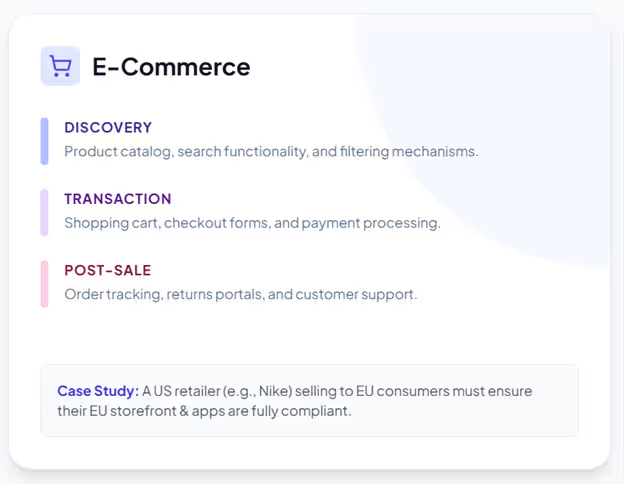
This is the most expensive category. It covers the entire online shopping experience:
- Discovery: The product catalog, search functionality, and filtering mechanisms.
- Transaction: The shopping cart, checkout forms, and payment processing.
- Post-Sale: Order tracking, returns portals, and customer support chat interfaces.8
- Implication: A US retailer like Nike or Gap selling directly to EU consumers must ensure their EU storefronts are fully compliant. This extends beyond the “store” to the mobile app.17
Banking and Financial Services:
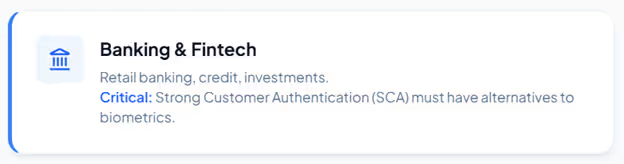
This includes retail banking, online credit agreements, and investment services. The directive mandates that identification methods, electronic signatures, and payment services be perceivable and operable. For US fintech companies operating in Europe, this requires ensuring that strong customer authentication (SCA) methods do not exclude users with disabilities (e.g., offering alternatives to biometric verification).16
Transport Services:

Air, bus, rail, and water transport services are covered. Crucially for US companies, this applies to the digital elements of the service: websites, mobile apps, electronic ticketing services, and real-time travel information. US airlines flying to EU destinations must ensure their booking engines and check-in apps comply.16
Audiovisual Media Services (AVMS):
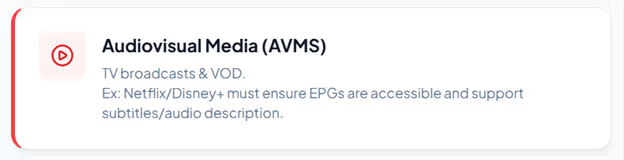
This covers services providing access to TV broadcasts and video-on-demand. US streaming giants (Netflix, Disney+, Amazon Prime) must ensure their user interfaces (EPGs) are accessible and that they support the transmission of accessibility services like subtitles and audio description.16
3.3 The B2B Exemption and the “Dual-Use” Risk
A critical strategic question for US software vendors is the applicability of the EAA to Business-to-Business (B2B) products. The directive explicitly targets consumers. Pure B2B software (e.g., an internal inventory management system used solely by employees) is generally out of scope.19
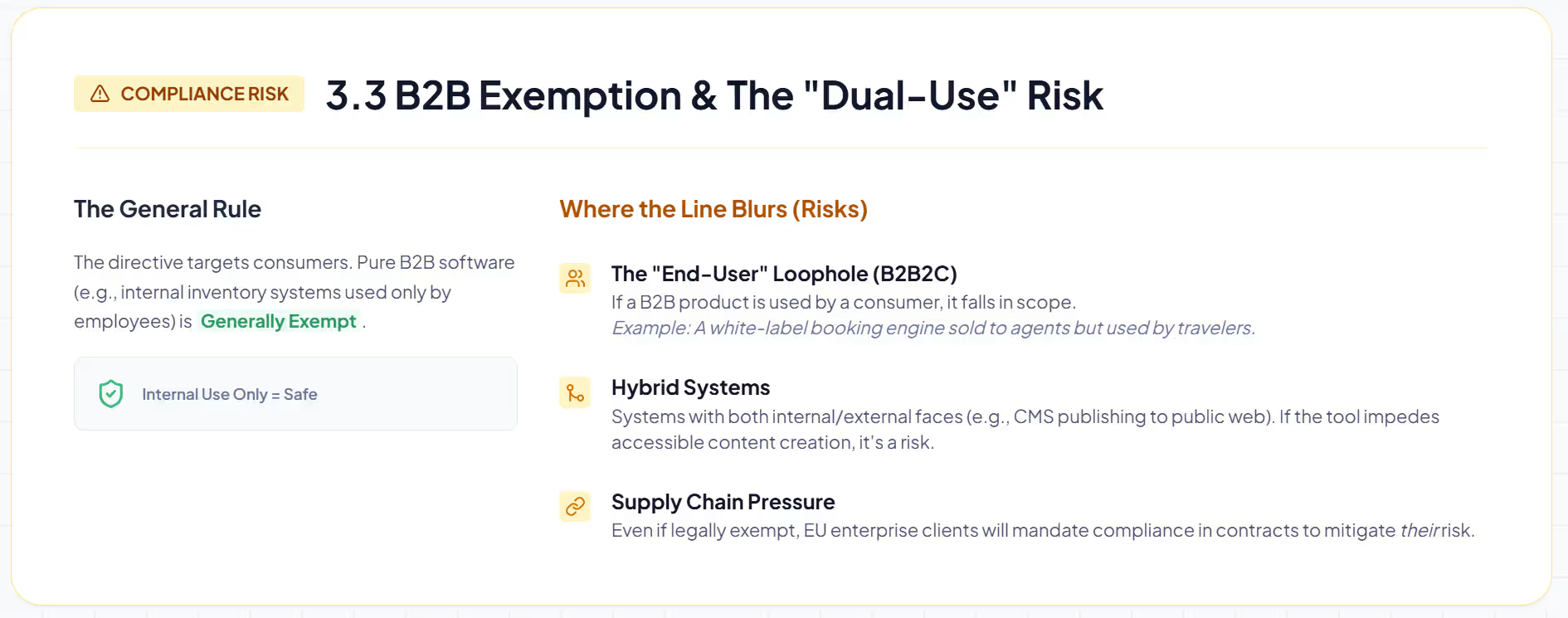
However, the line between B2B and B2C is increasingly blurred, creating a “Dual-Use” risk:
- The “End-User” Loophole: If a B2B product is used by a consumer (e.g., a B2B2C model), it falls in scope. For instance, a US company providing a white-label booking engine to travel agents is a B2B vendor, but the end-user interacting with the interface is a consumer. The engine must be compliant.21
- Hybrid Systems: Systems used for both internal and external purposes, such as a Content Management System (CMS) that publishes to a public website, may be scrutinized if the authoring tool impedes the creation of accessible content.19
- Supply Chain Pressure: Even if a US B2B vendor is legally exempt, their EU enterprise clients (who are subject to the EAA) will increasingly mandate compliance in procurement contracts to mitigate their own risk. US B2B firms will face commercial pressure to comply even where legal obligation is absent.21
4. Technical Standards: The Primacy of EN 301 549
While the EAA sets the legal requirement, it does not contain the technical specifications. Instead, it relies on “Harmonized Standards.” The presumption of conformity is granted to products and services that meet EN 301 549, the European Standard for Accessibility Requirements for ICT Products and Services. Understanding this standard is the single most critical technical task for US engineering teams.11
4.1 Divergence from US Standards (ADA/Section 508)
US companies typically design for the Web Content Accessibility Guidelines (WCAG) to satisfy ADA Title III risks or Section 508 requirements. While EN 301 549 incorporates WCAG, it is significantly broader. Relying solely on a WCAG audit will leave gaps in EAA compliance.
Key Differences:
- Scope of Application: WCAG is designed for web content. EN 301 549 applies to ICT—Information and Communications Technology. It includes specific clauses for hardware, biometrics, and non-web documents that WCAG does not address.11
- Biometrics (Clause 5.3): EN 301 549 explicitly addresses biometric identification. It requires that if a product uses biometrics (e.g., FaceID, fingerprint), it must provide an alternative that does not rely on that specific biological characteristic. This is critical for US fintech and banking apps.24
- Real-Time Text (RTT) (Clause 6.2): For telecommunications services, EN 301 549 mandates support for RTT, allowing text to be transmitted character-by-character in real-time. This is a higher standard than typical instant messaging and is essential for emergency service (112) access.24
- Hardware Requirements (Clause 8): The standard includes physical requirements for reach ranges, tactile indicators on keys, and the connection of assistive technology (e.g., headphone jacks on kiosks). A software-only WCAG audit will miss these physical compliance vectors.25
4.2 The Role of WCAG 2.1 vs. WCAG 2.2
The current version of EN 301 549 (v3.2.1) references WCAG 2.1 Level AA as the baseline for web and software accessibility.26 However, the W3C released WCAG 2.2 in October 2023, introducing new success criteria relevant to cognitive disabilities and mobile device usage (e.g., focus appearance, dragging movements).
Strategic analysis suggests US companies should audit against WCAG 2.2 AA. The European Commission is expected to update the harmonized standards to reference WCAG 2.2 (likely via ISO/IEC 40500:2026).27 Adopting the newer standard now provides a “future-proof” defense and demonstrates a commitment to the state-of-the-art, which is a strong mitigating factor in any enforcement action.27
4.3 Functional Performance Statements (The “POUR” Principles)
The EAA is not just a checklist; it is outcome-based. It relies on the functional performance of the product, categorized by the POUR principles:
- Perceivable: Information must be presented in ways users can perceive (e.g., alt text for images, captions for video).
- Operable: The interface must be navigable (e.g., keyboard-only access, no keyboard traps).
- Understandable: Information and operation must be understandable (e.g., predictable navigation, error prevention).
- Robust: Content must be robust enough to be interpreted by assistive technologies (e.g., screen readers).28
If a specific technical standard in EN 301 549 does not address a new technology (e.g., a Virtual Reality shopping interface), the US company cannot simply claim “no standard exists.” They must revert to these functional performance statements to ensure the product is accessible to the extent possible.16
5. The National Patchwork: Transposition and Enforcement
The most dangerous trap for US multinationals is assuming that “one Europe” means “one law.” Because the EAA is a Directive, it has been transposed into 27 distinct national legal frameworks. While the requirements are harmonized, the enforcement bodies, penalty structures, and litigation risks vary wildly. A strategy that works in France may lead to criminal liability in Ireland.
5.1 Germany: The Barrierefreiheitsstärkungsgesetz (BFSG)
Germany, the EU’s largest economy, has transposed the EAA via the Accessibility Strengthening Act (BFSG).
- Enforcement Authority: Market surveillance is conducted by the federal states (Länder), creating a decentralized audit environment.30
- Penalty Structure: The BFSG imposes administrative fines of up to €100,000 for serious violations, such as placing a non-compliant product on the market. Smaller fines (up to €10,000) apply to administrative errors like missing documentation.31
- The Competitor Risk: The unique danger in Germany lies in the intersection of the BFSG with the Act Against Unfair Competition (UWG). Under German law, a competitor can sue a company for “unfair market conduct” if that company gains a cost advantage by ignoring legal requirements. A US company could find itself sued not by the government, but by a compliant German rival seeking to level the playing field.31
5.2 France: The Authoritarian Approach
France has updated its existing accessibility framework (Law No. 2005-102) to align with the EAA.
- Enforcement Authority: The DGCCRF (General Directorate for Competition Policy, Consumer Affairs and Fraud Control) and ARCOM (Regulatory Authority for Audiovisual and Digital Communication).
- Penalty Structure: Administrative fines can reach €50,000 for the core violation of non-accessibility. Crucially, an additional fine of €25,000 applies for failing to publish the required accessibility statement or the multi-year accessibility plan. These fines are cumulative.7
- “Name and Shame”: French law empowers authorities to publicly list non-compliant entities. In the French market, where corporate social responsibility (CSR) is highly scrutinized, the reputational damage of being “blacklisted” by the government may exceed the financial cost of the fine.34
5.3 Ireland: The Headquarters Liability
Ireland is the European HQ for many US tech giants (Google, Meta, Apple). Its transposition is therefore of disproportionate importance.
- Enforcement Authority: The Competition and Consumer Protection Commission (CCPC) and the Commission for Communications Regulation (ComReg).
- Penalty Structure: Ireland has implemented one of the most severe regimes. Penalties include fines up to €60,000 and/or imprisonment for up to 18 months for company directors found guilty of an offence. While imprisonment is reserved for extreme cases, its existence in the statute elevates accessibility compliance to a personal liability issue for US executives sitting on Irish boards.1
5.4 Italy: The Turnover Model
Italy has integrated EAA requirements into its Stanca Law (Law 4/2004), significantly expanding its scope from the public sector to private companies.
- Enforcement Authority: The Agency for Digital Italy (AgID).
- Penalty Structure: For large entities (previously covered under public procurement rules), fines can reach 5% of annual turnover. for newly covered private entities, fines range from €5,000 to €40,000.5
- Cure Period: The Italian framework emphasizes remediation. Authorities typically issue a warning with a mandated “cure period” (often 90 days) to fix the violation before fines are imposed. This offers US companies a small window for reactive compliance, though relying on it is risky.36
5.5 Table: Comparative Penalties by Jurisdiction
| Member State | Key Statute | Max Financial Penalty | Personal Liability? | Specific Risk Factor |
| Germany | BFSG | €100,000 | No | Competitor lawsuits under UWG |
| France | Law 2005-102 | €75,000 (Cumulative) | No | “Name and Shame” public listing |
| Ireland | SI No. 116/2023 | €60,000 | Yes (18 Months) | Criminal liability for Directors |
| Italy | Stanca Law | €40,000 or 5% Turnover | No | Turnover-based fines for some |
| Sweden | — | €200,000 | No | High administrative fines |
| Austria | — | €80,000 | No | Strict strict liability for Directors |
6. Operational Compliance: A Strategic Roadmap
Achieving compliance with the EAA requires a fundamental shift in operations. It moves accessibility from the legal department (risk defense) to the product and engineering teams (market readiness).
6.1 The Conformity Assessment Procedure
For hardware manufacturers, the EAA mandates a formal “Conformity Assessment.”
- Internal Production Control: The manufacturer must document the design and manufacturing process to demonstrate how the product meets the requirements.
- CE Marking: Once conformity is demonstrated, the CE mark must be affixed to the product. This is a declaration that the product complies with all applicable EU directives, now including the EAA.14
- EU Declaration of Conformity: A legal document typically signed by a VP of Engineering or Quality. It must list EN 301 549 as the applied standard. This document must be translated into the language of every Member State where the product is sold.14
- Record Retention: Technical documentation must be kept for 5 years after the product is placed on the market.14
6.2 The Mandatory Accessibility Statement
For service providers (websites, SaaS, apps), the EAA requires a detailed Accessibility Statement. Unlike the voluntary statements often seen in the US, this is a regulated document.
- Content: It must detail the compliance status (fully, partially, non-compliant), list specific non-accessible content with valid justifications (e.g., disproportionate burden), and provide a feedback mechanism.2
- Placement: It must be available in an accessible format, typically linked from the footer or the terms of service.
- Update Cycle: Member States require regular updates (e.g., annually or upon major release) to reflect the current state of the service.40
6.3 The “Disproportionate Burden” Defense
The EAA allows for an exemption if compliance would impose a “disproportionate burden.” However, US companies must approach this with extreme caution.
- Criteria: The burden is assessed based on the ratio of compliance costs to net turnover, and the estimated benefit to persons with disabilities.2
- Self-Assessment: The company must perform this assessment before claiming the exemption and document it. You cannot claim it retroactively after an enforcement action begins.
- Documentation: The assessment must be provided to market surveillance authorities upon request. Given the resources of major US multinationals, authorities are unlikely to accept “cost” as a valid excuse for non-compliance. It is reserved for truly small players or legacy technologies near end-of-life.19
6.4 The “Microenterprise” Exemption
Microenterprises are exempt from the service requirements of the EAA.
- Definition: A company with fewer than 10 employees AND an annual turnover or balance sheet total of ≤ €2 million.2
- The Trap: This applies to the entire economic operator. A US startup with 15 employees and $3 million in revenue is NOT exempt, even if its sales in the EU are zero. The definition looks at the global entity’s size, not just its EU footprint.19
7. Comparative Litigation Risk: The “Overlay” Trap
A critical distinction for US companies is the difference between ADA compliance strategies and EAA mandates. In the US market, many companies have turned to “accessibility overlays”—automated widgets that modify the code of a webpage in the browser—as a cost-effective shield against ADA lawsuits.
The EAA renders overlays obsolete and dangerous.
- Regulatory Stance: The European Commission and national bodies have indicated that overlays do not meet the requirement of “designed for all.” They often fail to address the underlying code quality required by EN 301 549 (e.g., proper semantic HTML, compatibility with all assistive technologies).19
- The “Separate but Equal” Problem: Overlays create a separate experience for disabled users, which violates the core principle of inclusive design mandated by the Directive.
- Privacy Risks: Many overlays collect user data to detect disability (e.g., detecting a screen reader), which may violate the General Data Protection Regulation (GDPR) regarding the processing of sensitive health data without explicit consent.39
Insight: US companies utilizing overlays on their global sites must remove them for the EU market and invest in native remediation (fixing the source code). Continuing to use an overlay in the EU after June 2025 is a red flag for regulators, signaling that the digital property is not fundamentally accessible.
8. Conclusion: The New Cost of Doing Business
The European Accessibility Act signals the end of the era of voluntary digital inclusion. For US companies, the transition from a litigation-based model (ADA) to a compliance-based model (EAA) requires a strategic pivot. The risks are no longer calculated in settlement dollars but in market access and brand reputation.
The “Brussels Effect” suggests that the EAA standards (EN 301 549) will likely become the global baseline. US companies that proactively adopt these standards will find themselves ahead of the curve not just in Europe, but in emerging regulatory landscapes in Canada (Accessible Canada Act) and beyond. The window for preparation is closing; come June 2025, the digital gates of Europe will only open for those who have built the keys.
Frequently Asked Questions
Q: Does the European Accessibility Act apply to US companies with no offices in the EU?
A: Yes. The EAA applies to any “economic operator” that places products on the EU market or provides services to EU consumers. If you sell to EU customers or your website targets them (e.g., accepts Euros, ships to EU), you must comply, regardless of where your headquarters are located.1
Q: What is the deadline for EAA compliance?
A: The enforcement deadline is June 28, 2025. By this date, new products placed on the market and new services must be compliant. Transitional periods exist for existing service contracts (until 2030) and self-service terminals (until the end of their economic life, max 20 years), but the primary deadline for market readiness is 2025.3
Q: What are the penalties for non-compliance?
A: Penalties are set by individual Member States and vary. They include:
- Germany: Fines up to €100,000 and competitor lawsuits.31
- France: Fines up to €75,000 and public “naming and shaming”.33
- Ireland: Fines up to €60,000 and potential imprisonment for directors.1
- General: Removal of products from the market and suspension of services.6
Q: Is ADA compliance sufficient for the EAA?
A: No. While there is overlap via WCAG, the EAA’s standard (EN 301 549) is broader. It includes requirements for hardware, biometrics, Real-Time Text (RTT), and specific documentation (CE marking, Accessibility Statements) that the ADA does not mandate. An ADA-compliant site may still fail an EAA audit.2
Q: Do B2B companies need to comply?
A: Generally, the EAA targets B2C (Business-to-Consumer) products. However, B2B products used by consumers (e.g., a kiosk sold to a retailer) or “dual-use” software (used by employees and consumers) are in scope. Additionally, EU enterprise clients will likely enforce compliance contractually on their US B2B vendors to minimize their own liability.19
Q: Are small businesses exempt?
A: Only “microenterprises” (fewer than 10 employees AND ≤ €2 million turnover) are exempt from service requirements. This applies to the global entity. A US company with 20 employees is NOT exempt, even if its EU revenue is small.2
References/Works cited
- How the European Accessibility Act impacts organizations in the United States – Recite Me, accessed on December 24, 2025
- EAA vs. ADA | What are the key differences? – Level Access, accessed on December 24, 2025
- European Accessibility Act 2025: Get ready for the June deadline, accessed on December 24, 2025
- The EAA comes into effect in June 2025. Are you ready? – AccessibleEU – European Union, accessed on December 24, 2025
- European Accessibility Act Fines: Avoid EAA lawsuits – Recite Me, accessed on December 24, 2025
- European Accessibility Act: How to Avoid Penalties and Stay Compliant – Allyant, accessed on December 24, 2025
- EAA Non-compliance Fines and Penalties – Level Access, accessed on December 24, 2025
- The European Accessibility Act 2025: It May Apply to Your Website – Kinsta, accessed on December 24, 2025
- The European Accessibility Act: a ‘win-win’ piece of regulation – Taylor Wessing, accessed on December 24, 2025
- European accessibility act, accessed on December 24, 2025
- EN 301 549 Conformance | Accessibility Standards in Europe – WCAG, accessed on December 24, 2025
- Understanding the European Accessibility Act: Risks of non-compliance and key authorities, accessed on December 24, 2025
- Does the EAA Apply to United States Companies? | Accessible.org, accessed on December 24, 2025
- European Accessibility Act Articles – IAAP, accessed on December 24, 2025
- European Accessibility Act Poses New Challenges for US Companies with Customers in the EU | ADA Title III, accessed on December 24, 2025
- Accessibility of products and services | EUR-Lex – European Union, accessed on December 24, 2025
- European Accessibility Act: products and services required to be accessible!, accessed on December 24, 2025
- EAA Scope: What products and services must be accessible?, accessed on December 24, 2025
- European Accessibility Act 20 FAQs – Deque Systems, accessed on December 24, 2025
- European Accessibility Act B2B guide: Are B2B companies affected? Here’s what the law says – Iubenda, accessed on December 24, 2025
- Does the European Accessibility Act apply to B2B? – Recite Me, accessed on December 24, 2025
- What’s the Difference Between WCAG, the EAA, and EN 301 549? – Vispero, accessed on December 24, 2025
- 301549 ways to improve accessibility: EN 301 549 – Deque Systems, accessed on December 24, 2025
- Web accessibility standards – latest changes | Shaping Europe’s digital future, accessed on December 24, 2025
- Critical Info on EN 301 549 | The EU Accessibility Standard – UserWay, accessed on December 24, 2025
- EN 301 549 (V3.2.1) (2021-03) – ETSI, accessed on December 24, 2025
- WCAG 2 Overview | Web Accessibility Initiative (WAI) – W3C, accessed on December 24, 2025
- The European Accessibility Act (EAA): Directive (EU) 2019/882 and Its Implementation in Italy – Centro Diritti Umani, accessed on December 24, 2025
- Germany’s Digital Accessibility Laws, accessed on December 24, 2025
- German Accessibility Improvement Act- BFSG – Cookie Script, accessed on December 24, 2025
- European Accessibility Act transposition in Germany – an overview – Taylor Wessing, accessed on December 24, 2025
- Germany Ready for the EAA European Accessibility Act implementation entering into force on 28 June 2, accessed on December 24, 2025
- Digital accessibility in favour of disabled people in France: years of legislative efforts now enhanced by the transposition of Directive (EU) 2019/882 (EAA), accessed on December 24, 2025
- European Accessibility Act fines: What you need to know – Iubenda, accessed on December 24, 2025
- European Accessibility Act (EAA) Country Compliance Data – Deque Systems, accessed on December 24, 2025
- EAA Enforcement in Europe Following the June 2025 Deadline – Pivotal Accessibility, accessed on December 24, 2025
- CE marking – obtaining the certificate, EU requirements – Your Europe – European Union, accessed on December 24, 2025
- Declaration of Conformity for CE Marking – Authorised Rep Compliance, accessed on December 24, 2025
- European Accessibility Act 2025 | Key Steps for Compliance – Level Access, accessed on December 24, 2025
- EAA | Accessible.org, accessed on December 24, 2025