
Why Keywords Are Dying and Entities Are King
In the rapidly evolving world of Generative Engine Optimization (GEO), the old rules of SEO are crumbling. For decades, we optimized for “strings” of text, keywords that users typed into a search bar. But today, Large Language Models (LLMs) like GPT-4 and Google Gemini don’t just “read” words; they understand concepts.
To survive the shift to AI Search, brands must stop optimizing for keywords and start optimizing for Entities and “Truth”.Here is your technical guide to Entity Engineering, the backbone of modern visibility.
What is an Entity? (And Why LLMs Care)
To a human, a keyword is just a search term. To an AI, a keyword is often just a “string” of text with no inherent meaning. However, an Entity is a distinct object, person, place, or concept that can be uniquely identified in a Knowledge Graph.
Think of it this way:
- Keyword: “Best CRM software” (This is just text).
- Entity: Salesforce (ID: /m/06_77_) (This is a defined node in the Knowledge Graph).
When you ask ChatGPT a question, it doesn’t scan the web for keywords; it traverses an internal map of entities to construct an answer. If your brand isn’t a defined entity on this map with clear relationships (e.g., Brand X -> is a -> Software Company), the AI cannot “think” about you, and therefore, cannot cite you.
The 3-Step Protocol for Entity Optimization
To ensure your brand is legible to machine intelligence, you need an “Entity-First” approach. Here are the three technical strategies to engineer your presence into the Knowledge Graph.
1. The “SameAs” Strategy (Advanced Schema)
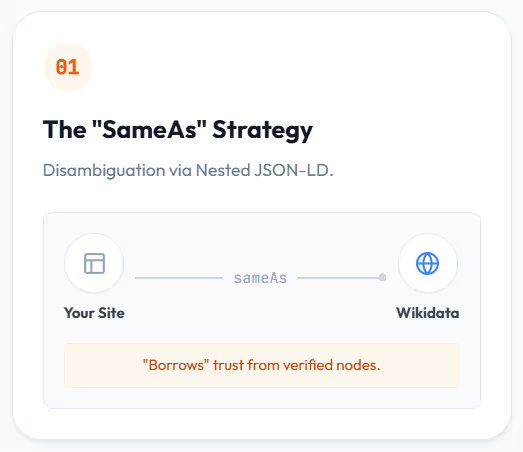
Standard Schema markup is no longer sufficient. You must use Nested JSON-LD to explicitly tell the AI where else your brand exists on the web. This process is called “Disambiguation”.
By linking your site to high-authority nodes like Wikidata or Crunchbase using the “sameAs” tag, you effectively “borrow” their trust score.
Why it works: It prevents the AI from guessing who you are by providing a direct link to trusted, verified profiles.
2. Fact Density Injection
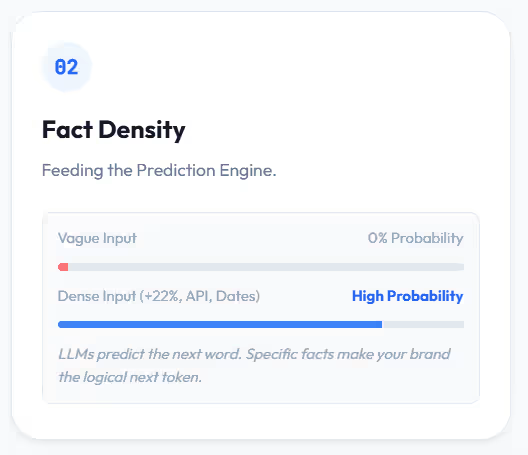
LLMs are essentially “prediction engines”, they predict the next word in a sentence based on probability. Content that is dense with specific facts, dates, and numbers is easier for these models to latch onto.
- Low Density (SEO Style): “We offer great software that helps you sell more.” (This is vague and hard for AI to cite) .
- High Density (GEO Style): “Our platform increases lead velocity by 22% and integrates natively with Salesforce and HubSpot via API.” (This is specific and easy for AI to cite) .
3. Co-Citation Networks
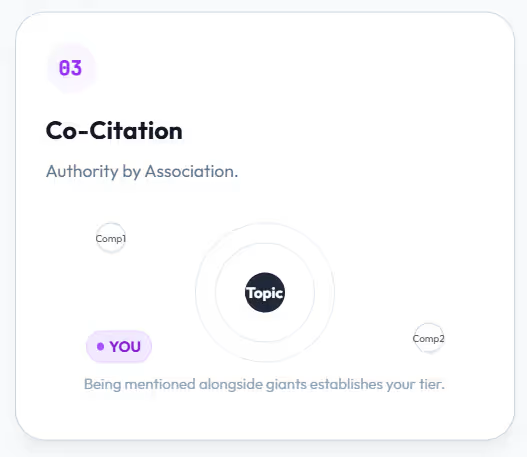
An AI judges your authority by the company you keep.
If your brand is frequently mentioned in the same paragraph as established industry leaders (e.g., “Competitors to Salesforce include HubSpot and [Your Brand]”), the AI learns to associate you with that tier of authority. This is known as establishing a co-citation network.
Technical Implementation: The JSON-LD Blueprint
For those ready to implement this immediately, here is the code structure that tells the AI exactly who wrote the content, what concepts are discussed, and what evidence is used.
Why This Matters for Your Survival
Implementing these strategies isn’t just about having “clean code”, it is about survival in the new search landscape.
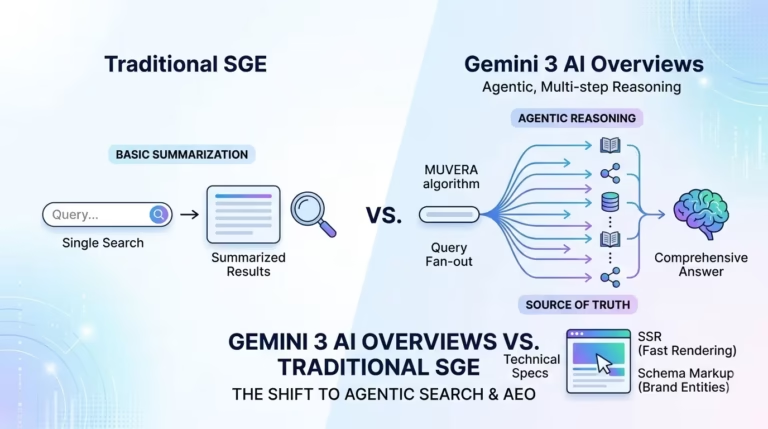
- Google SGE relies on the Knowledge Graph to generate its snapshots.
- Perplexity AI relies on citation authority to choose its sources.
If you ignore Entity Optimization, you remain invisible to the engines that are taking over search. It is time to stop guessing and start engineering your Knowledge Graph presence.