

The trajectory of the World Wide Web has historically been defined by distinct epochs: the static web of the 90s, the interactive Web 2.0 of the 2000s, and the mobile-first algorithmic era of the 2010s. As we navigate 2025, we have entered a fourth, more volatile epoch: the age of Generative Synthesis. The fundamental contract between content creator and search engine, where content was indexed and ranked as a list of blue links, has been irrevocably altered. Google and emerging competitors like Perplexity and OpenAI’s search prototypes no longer function merely as librarians; they act as synthesis engines, ingesting vast corpuses of data to generate singular, authoritative answers.
For web developers and digital strategists, this shift necessitates a radical departure from the “good enough” standards of the early 2020s. The new mandate is a convergence of three distinct disciplines: Generative Engine Optimization (GEO), Extreme Technical Performance, and Semantic Rigor. The barrier to entry for visibility has risen dramatically. Google’s algorithms, now heavily integrated with Large Language Models (LLMs), punish mediocrity not just with lower rankings, but with total invisibility.
This report serves as an exhaustive technical blueprint for the 2025 landscape. It synthesizes data from over 100 technical sources, analyzing the deprecation of legacy metrics like First Input Delay (FID) in favor of Interaction to Next Paint (INP), the architectural dominance of Server Components in Next.js 15, the “Islands Architecture” of Astro, and the critical importance of HTTP/3 and WCAG 2.2. We analyze why “Information Gain” has become the primary currency of the web, and how the technical structure of a website, down to the packet transport layer, determines its viability in an AI-first world.
1: The Paradigm Shift – From Search Engine Optimization to Generative Engine Optimization (GEO)
1.1 The Collapse of the “Ten Blue Links” Model
For two decades, the primary objective of web development, in relation to discovery, was to secure a position on the first page of Google’s search results. This “Ten Blue Links” model assumed a user journey where the search engine acted as a gateway, passing the user through to a destination website. In 2025, this model is rapidly eroding. The rise of AI Overviews (formerly Search Generative Experience or SGE) and direct-answer engines means that for a growing percentage of queries, particularly informational and complex queries, the search engine is the destination.
This phenomenon, termed the “Zero-Click” future, fundamentally changes the reward mechanism. If a website’s content is not structured to be ingested, synthesized, and cited by a Generative AI, it effectively does not exist for that query. This has given rise to Generative Engine Optimization (GEO), a discipline that transcends traditional SEO.1 While SEO focused on keywords and backlinks, GEO focuses on LLM legibility, citation authority, and structural clarity.
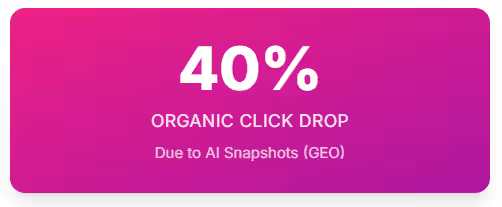
The stakes are quantified by the dramatic shift in click-through rates (CTR). Studies indicate that AI Overviews now appear on over 50% of high-traffic queries, causing CTR on traditional organic results to drop by approximately 34.5% to 50%.2 The implication is clear: the “winner-take-all” dynamic of generative search means that being ranked #3 or #4 is no longer a viable traffic strategy. One must either be the primary source cited in the AI snapshot or occupy the “Information Gain” slots that the AI cannot hallucinate.
1.2 The Mechanics of AI Overviews and “Query Fan-Out”
To optimize for this new environment, one must understand how Google’s AI features actually work. Unlike a traditional crawler that matches keywords in an inverted index, AI Overviews utilize a process known as “Query Fan-Out”.4 When a user asks a complex question, the AI breaks this query down into multiple sub-questions, runs simultaneous searches for these components, and then synthesizes the results.
For example, if a user searches “Best web framework for SEO in 2025,” the system essentially “fans out” to ask:
- “What are the SEO features of Next.js 15?”
- “How does Astro’s Islands Architecture affect Core Web Vitals?”
- “What is the impact of React Server Components on LCP?”
It then retrieves answers for these sub-queries and combines them. This mechanism rewards content that is structurally aligned with this logic. Websites that utilize Topic Clusters, where a core “pillar page” is supported by detailed sub-pages linked via a logical internal graph, are far more likely to be retrieved during this fan-out process.3 The AI can easily map the pillar page to the main query and the cluster pages to the sub-queries.
1.3 The “Reverse Pyramid” and Structured Content Strategy
The way content is formatted determines its ingestibility by LLMs. Generative engines struggle with “wall of text” content where the answer is buried in the fifth paragraph. The most effective strategy in 2025 is the “Reverse Pyramid” structure, heavily borrowing from journalistic principles but adapted for machine reading.6
In this model, the direct answer to the user’s intent must appear immediately following the heading. If the heading is “How to optimize INP?”, the very next sentence should define the solution concisely. This “answer block” increases the probability of extraction for the AI summary. Following the direct answer, the content should expand into supporting details, structured rigorously with HTML lists and tables.
Table 1: The GEO Optimization Hierarchy
| Hierarchy Level | GEO Requirement | Implementation Strategy |
| Level 1: Legibility | Machine-Readable Structure | Use semantic HTML5 (<article>, <section>, <aside>), clear H1-H6 hierarchy, and avoiding text-in-images. |
| Level 2: Synthesis | Direct Answers & Lists | Format key data in <ul>/<ol> lists and <table> elements. Place the “TL;DR” answer immediately after headings. |
| Level 3: Authority | Entity Association | Use Schema.org markup to explicitly link content to known Entities (Authors, Organizations) in the Knowledge Graph. |
| Level 4: Value | Information Gain | Provide unique data, original research, or contrarian expert analysis that differs from the consensus training data. |
1.4 Information Gain vs. Consensus Content
A critical concept in GEO is Information Gain. LLMs are trained on vast datasets and are excellent at generating “consensus” content, standard advice that appears on thousands of websites. If a website publishes content that merely repeats the consensus (e.g., “React is a JavaScript library for building user interfaces”), it offers zero information gain. The AI already “knows” this and has no reason to cite the new source.3
Google’s ranking systems have been updated to explicitly reward Information Gain. To be cited, content must provide something the LLM cannot generate on its own. This includes:
- Original Data and Research: Proprietary statistics, survey results, or benchmarks.
- Human Experience: First-hand accounts, case studies, and physical evidence of product testing (photos/videos).
- Novel Frameworks: Unique mental models or methodologies for solving problems.
- Expert Opinion: High-authority analysis that contradicts or nuances the general consensus.
This shift marks the death of “commodity content.” The strategy of spinning existing top-ranking articles is now functionally obsolete because the AI can perform that synthesis instantly and essentially “free of charge” to the user.
2. Core Web Vitals 2025 – The Performance Imperative
2.1 The Elevation of Interaction to Next Paint (INP)
The most significant technical development in the 2025 search landscape is the full maturation of Interaction to Next Paint (INP) as a Core Web Vital, replacing First Input Delay (FID).9 This is not merely a metric swap; it represents a philosophical change in how Google defines “performance.” While FID only measured the first interaction, INP measures the latency of all interactions throughout the lifespan of the page, reporting the worst-case scenario (specifically, the 75th percentile of worst latencies).
INP addresses the “frozen page” phenomenon common in heavy JavaScript applications. A site might load visually (good LCP), but when a user clicks a “Menu” button or an “Add to Cart” button, the interface freezes for 500ms because the main thread is blocked by hydration or third-party scripts. In 2025, this behavior is heavily penalized.9
The Three Components of INP:
To optimize INP, developers must dissect the interaction into three phases:
- Input Delay: The time between the user action and the browser beginning to process the event. High input delay is often caused by the main thread being busy with other tasks (e.g., third-party tracking scripts running on load).
- Processing Time: The time taken to run the event callbacks. This is directly controlled by the developer’s code efficiency.
- Presentation Delay: The time taken for the browser to calculate the new layout and paint the next frame. Complex DOM updates contribute to this.
Optimization Strategies for Sub-200ms INP:
The target is an INP of ≤ 200 milliseconds.12 Achieving this requires aggressive main-thread management:
- Yielding to the Main Thread: Long tasks (anything taking >50ms) must be broken up. The modern scheduler.yield() API is the preferred method, allowing the browser to pause execution, handle user input, and then resume the task. Fallbacks like setTimeout or requestIdleCallback remain relevant.13
- Web Workers: Heavy logic, such as data parsing, image manipulation, or complex state calculations, should be offloaded to Web Workers. This runs the code on a separate background thread, keeping the main UI thread responsive.14
- Debouncing and Throttling: For interactions that fire rapidly (like scroll or window resize), event handlers must be debounced to prevent flooding the main thread.13
2.2 Largest Contentful Paint (LCP) in the Era of Rich Media
Largest Contentful Paint (LCP) remains the primary metric for perceived load speed. The standard for “Good” is ≤ 2.5 seconds.12 However, the bar for visual fidelity has risen; users expect high-resolution imagery and video backgrounds, which compete directly with LCP.
The 2025 approach to LCP optimization relies on precise resource orchestration:
- Fetch Priority: The fetchpriority=”high” attribute is now standard practice for the LCP element (usually the hero image). This signals to the browser to deprioritize other requests (like CSS or scripts) in favor of the critical image.15
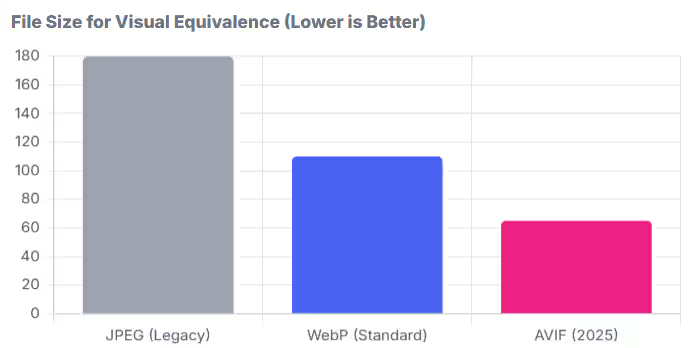
- AVIF over WebP: While WebP was the standard, AVIF has emerged as the superior format for 2025, offering better compression ratios and visual quality. It is supported across all major browsers and significantly reduces the byte size of LCP candidates.
- Server-Side Rendering (SSR): Client-side rendering (CSR) is detrimental to LCP because the browser must download JS, execute it, and then fetch the image. SSR or SSG (Static Site Generation) ensures the image URL is present in the initial HTML document response, allowing the browser to discover and download it immediately.16
2.3 Cumulative Layout Shift (CLS) and Visual Stability
Visual stability, measured by CLS (Target: ≤ 0.1), continues to be a quality signal. In 2025, the most common sources of CLS are dynamic ad injections and late-loading web fonts.12
- Font Loading Strategies: To prevent layout shifts caused by fonts swapping (FOUT/FOIT), developers must use font-display: optional or font-display: swap combined with robust font metric overrides (using CSS size-adjust) to ensure the fallback font takes up the exact same space as the web font.
- Aspect Ratio: All images and video elements must have explicit width and height attributes or CSS aspect-ratio properties to reserve space in the layout before the asset loads.10
Table 2: Core Web Vitals Thresholds (Late 2025)
| Metric | Focus | Good (Reward) | Needs Improvement | Poor (Penalty) |
| LCP | Load Speed | ≤ 2.5s | 2.5s – 4.0s | > 4.0s |
| INP | Responsiveness | ≤ 200ms | 200ms – 500ms | > 500ms |
| CLS | Stability | ≤ 0.1 | 0.1 – 0.25 | > 0.25 |
2.4 Mobile Performance Realities
While 5G is widespread, mobile network stability remains inconsistent. Real-world data shows a massive discrepancy between desktop and mobile performance. The average mobile page load time hovers around 8.6 seconds, compared to 2.5 seconds on desktop.17 Yet, Google evaluates sites based on mobile-first indexing.
This discrepancy has severe business implications. Data indicates that a one-second delay in mobile load times can reduce conversion rates by up to 20%.19 Furthermore, bounce rates spike to 53% if a mobile page takes longer than 3 seconds to load.21
Best Practice: Developers must stop testing on high-end iPhones on Wi-Fi. Performance testing should be conducted using Network Throttling (simulating 4G/LTE) and CPU Throttling (simulating mid-tier Android devices like the Moto G Power) to reflect the reality of the median user.22
3. Next-Generation Web Architecture
3.1 Next.js 15: The Server Component Revolution
The release of Next.js 15 marks a definitive shift in the React ecosystem towards React Server Components (RSC). This architecture is not just a developer convenience; it is a direct response to the performance demands of Google’s algorithms.23
The End of Client-Side Bloat
In previous iterations of React (and Single Page Applications in general), the entire application bundle was sent to the client. The browser had to download, parse, and execute megabytes of JavaScript before the user could interact. Next.js 15 flips this model. Components are Server Components by default. They render on the server and stream pure HTML to the client. The JavaScript code for these components is never sent to the browser.25
This has two profound impacts on SEO and Performance:
- LCP Improvement: Because the HTML is generated on the server, the browser receives meaningful content immediately (improving LCP).
- INP Improvement: By removing the JavaScript payload for static parts of the page (headers, footers, text blocks), the main thread is freed up to handle interactions for the parts that do need to be interactive (improving INP).26
Partial Prerendering (PPR)
Next.js 15 introduces Partial Prerendering (PPR). This hybrid rendering model allows a page to have a static shell (served instantly from the edge) with dynamic “holes” that are streamed in asynchronously.27
- Scenario: An e-commerce product page. The navigation, footer, and product description are static and cached at the edge (Global CDN). The “Add to Cart” button and “Personalized Recommendations” are dynamic.
- Mechanism: The browser receives the static shell immediately (fast TTFB/FCP). The dynamic parts stream in parallel. This solves the historic trade-off between “Static but boring” and “Dynamic but slow”.27
Turbopack and Tooling
The inclusion of Turbopack (now stable in dev) significantly speeds up local development, but more importantly, the new instrumentation.js API allows developers to monitor performance bottlenecks in the server lifecycle, enabling proactive optimization of server response times.24
3.2 Astro and the “Islands Architecture”
For content-driven websites, blogs, news portals, marketing sites, and documentation, Astro has established itself as the performance leader, often outperforming Next.js in raw Core Web Vitals scores.28
The Architecture of Zero-JS
Astro’s fundamental philosophy is “HTML-first.” By default, it ships zero JavaScript to the client. The page is treated as a static canvas. If a specific component needs interactivity (e.g., a search bar or a carousel), it is designated as an “Island”.30
Selective Hydration
This is achieved through granular directives that give developers precise control over the main thread cost:
- client:load: Hydrate immediately (for high-priority critical UI).
- client:idle: Hydrate when the browser is idle (excellent for non-critical interactivity).
- client:visible: Hydrate only when the user scrolls the component into view (ideal for heavy footer widgets or comments sections).31
Table 3: Framework Selection Guide for SEO 2025
| Feature | Next.js 15 (App Router) | Astro (Islands) | Best Use Case |
| Rendering Model | Server Components + Streaming | Static HTML + Selective Hydration | Next.js: Complex Web Apps (SaaS, Social) Astro: Content Sites (Blogs, Marketing) |
| JS Bundle Size | Moderate (React runtime included) | Minimal (Zero JS by default) | Astro wins on raw load speed. |
| State Management | Global Context / Redux / Zustand | Local (Nano Stores) / Framework Agnostic | Next.js handles complex app state better. |
| SEO Defaults | Excellent (Metadata API) | Excellent (Content Collections) | Tie. Both prioritize server-rendered HTML. |
| Developer Exp. | React-exclusive ecosystem | Framework agnostic (React, Vue, Svelte) | Astro offers flexibility; Next.js offers integration. |
Website Audit Checklist (Printable)
3.3 Node.js vs. Edge Rendering: The Latency War
The location of rendering is as important as the method. The debate between Node.js (Origin Server) and Edge Runtimes (Cloudflare Workers, Vercel Edge) centers on the trade-off between latency and computational power.33
- Edge Rendering: Code executes on servers physically close to the user. This reduces network latency (TTFB). It is ideal for simple personalization (geo-targeting, A/B testing) and routing.
- Node.js Rendering: Code executes on a centralized server. While latency is higher, Node.js runtimes support the full spectrum of NPM packages and maintain persistent database connections (e.g., via Prisma or TypeORM) more effectively than the stateless Edge.35
2025 Consensus: The industry has moved toward a Hybrid Model. Middleware runs at the Edge for routing and caching headers, while complex data fetching and page generation occur on Node.js/Serverless functions to leverage the robust backend ecosystem.
4. The Infrastructure Layer – Protocols and Security
4.1 HTTP/3 and QUIC: The Transport Upgrade
The underlying plumbing of the web has been upgraded. HTTP/3, built upon the QUIC protocol (over UDP), has largely superseded HTTP/2 (over TCP) for high-performance delivery. As of late 2025, adoption is critical for mobile optimization.37
The Head-of-Line Blocking Solution
The fatal flaw of HTTP/2 was “Head-of-Line Blocking” at the TCP level. If a single packet was lost during transmission, the entire TCP connection (and all streams within it) paused until that packet was recovered. On unreliable mobile networks, this caused significant jitter and stalling.
HTTP/3 solves this by using independent streams over UDP. If a packet is lost, only the stream containing that packet is affected; all other resources (images, scripts, CSS) continue to load without interruption.39
Connection Migration and 0-RTT
QUIC introduces Connection Migration, allowing a user to switch networks (e.g., from Wi-Fi to 5G) without severing the connection. This is vital for mobile UX. Additionally, HTTP/3 supports 0-RTT (Zero Round Trip Time) handshakes for returning visitors, effectively eliminating the latency of the TLS negotiation phase.41
Benchmark Data: Studies show that HTTP/3 reduces LCP by an average of 20-30% on high-latency networks compared to HTTP/2.39
4.2 Content Security Policy (CSP) and SEO
Security is often viewed as separate from SEO, but in 2025, they are inextricably linked. A hacked site is an invisible site. Furthermore, cross-site scripting (XSS) attacks can be used to inject spam links (SEO injection), destroying a domain’s reputation.
Implementing a strict Content Security Policy (CSP) is a best practice.
- Header: Content-Security-Policy: script-src ‘self’ https://trusted-analytics.com; object-src ‘none’;
- SEO Benefit: While not a direct ranking factor, CSP protects the site’s integrity. It ensures that the content Google indexes is the content the developer intended.
- Performance: A well-tuned CSP can also prevent the accidental loading of heavy, unauthorized third-party scripts that degrade INP.42
5. Semantic Engineering – Speaking to Machines
5.1 Structured Data: The API of the Web
If HTML is the visual presentation layer, Schema Markup (JSON-LD) is the semantic data layer. In the age of AI, Schema is the API through which search engines ingest data. It is no longer optional.
Critical Schema Types for AI Optimization
To maximize presence in AI Overviews, developers must implement specific Schema types 44:
- FAQPage Schema: Despite the decline of traditional FAQ snippets, this remains the most effective way to feed Q&A pairs directly into AI summaries.
- Organization Schema: Critical for building the Knowledge Graph. It must include sameAs properties linking to all social profiles, Crunchbase, and Wikipedia entries to establish Entity Authority.46
- Product Schema: For e-commerce, this must be exhaustive. Properties like shippingDetails, hasMerchantReturnPolicy, and priceValidUntil are required for inclusion in the “AI Shopping Graph”.47
- Article / TechArticle Schema: Must explicitly identify the author (Person) and publisher (Organization) to validate E-E-A-T signals.
5.2 The Knowledge Graph and Entity SEO
Google’s understanding of the web is based on Entities (nodes in a graph) and Relationships (edges). Keywords are merely the labels we use to describe them. SEO in 2025 is about establishing “Entity Identity”.48
Developers must use semantic HTML and Schema to disambiguate entities. If a page is about “Jaguar,” the markup must clarify whether it refers to the Animal entity or the Automobile Brand entity. Building a strong Entity Identity helps the AI connect the brand to specific topics, increasing the likelihood of citation when those topics are queried.46
6. Accessibility as a Ranking Signal (WCAG 2.2)
6.1 WCAG 2.2: The New Baseline
Web Content Accessibility Guidelines (WCAG) 2.2 are now the official recommendation and a proxy for site quality. Google’s internal systems increasingly correlate accessibility with overall user experience. An inaccessible site is fundamentally a “broken” site for a segment of users, and often for the bots themselves.49
Key WCAG 2.2 Success Criteria for Developers:
- Focus Not Obscured (2.4.11 & 2.4.12): When a user navigates via keyboard, the item receiving focus (e.g., a button or link) must not be hidden behind other content (like a sticky header or cookie banner). This is a common failure point in modern SPAs.51
- Target Size (2.5.8): Interactive targets must be at least 24×24 CSS pixels. This is crucial for mobile users with motor impairments and directly impacts Google’s “Mobile Friendly” assessment.52
- Redundant Entry (3.3.7): Users should not be asked to re-enter information they have already provided in the same session (e.g., shipping address vs. billing address forms).
- Dragging Movements (2.5.7): Any functionality that requires dragging (like a map or a slider) must have a single-pointer alternative (e.g., clicking buttons to move the map).52
6.2 The SEO-Accessibility Convergence
There is a near-perfect overlap between SEO best practices and Accessibility best practices.
- Alt Text: Essential for screen readers; essential for Google Image Search and AI visual understanding.
- Heading Structure (H1-H6): Essential for screen reader navigation; essential for AI to understand document structure.
- Link Text: “Click here” is bad for accessibility (no context) and bad for SEO (no anchor text relevance).
- Semantic HTML: Using <button> for actions and <a> for navigation helps assistive technology and search bots understand the purpose of the element.53
7. Strategic Content Engineering & E-E-A-T
7.1 “Experience” and Authorship
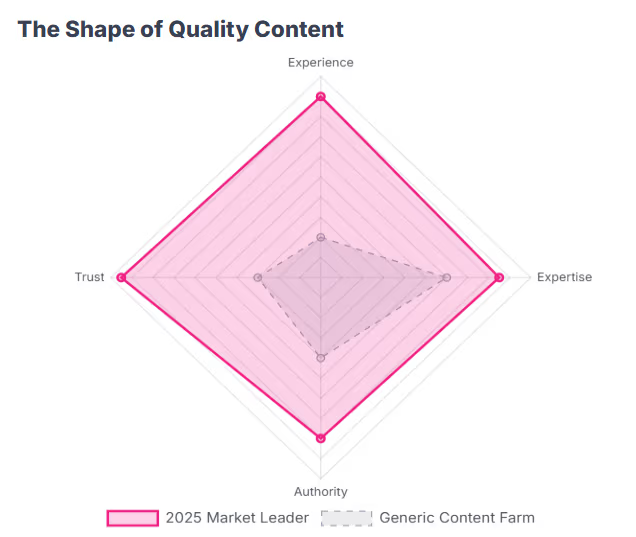
As AI-generated content floods the web, Google has doubled down on E-E-A-T (Experience, Expertise, Authoritativeness, Trustworthiness). The extra “E” (Experience) is the discriminator. AI can possess “Expertise” (data knowledge), but it cannot possess “Experience” (lived reality).54
Demonstrating Experience in Code and Content:
- Author Bios: Every piece of content must be linked to a robust Author Bio page. This page should use Person schema to detail the author’s credentials, past work, and social proof.
- Evidence: Content must include proof of experience. For a product review, this means unique photos of the product being used (not stock photos). For a coding tutorial, it means a GitHub repo link or a live CodeSandbox demo.
- First-Person Narrative: Writing in the first person (“I tested this…”) signals human authorship, provided it is backed by evidence.
7.2 Optimizing for Query Fan-Out with Topic Clusters
To align with the “Query Fan-Out” mechanism of AI Overviews, content strategy must move from isolated keywords to Topic Clusters.
- Pillar Page: A comprehensive overview of a broad topic (e.g., “Web Performance”).
- Cluster Pages: Detailed deep-dives into specific sub-topics (e.g., “How to optimize LCP,” “What is INP,” “HTTP/3 benefits”).
- Internal Linking: A rigorous internal linking structure connecting the pillar to the clusters and the clusters to each other.
This structure mimics the AI’s knowledge graph. When the AI “fans out” the query “How to improve web performance?”, it finds your cluster of content covering every angle, making your domain the most authoritative source to synthesize.3
FAQs
Q1: Should I block AI bots from crawling my site?
Answer: Generally, no. While blocking GPTBot or Google-Extended prevents your content from training their models, it may also prevent your content from being cited in their real-time answers (like ChatGPT Search or Google AI Overviews). If you rely on organic traffic, you must participate in the ecosystem. The goal is to be cited, not ignored.
Q2: How do I measure GEO success?
Answer: Traditional rank tracking is less effective. You must track Share of Voice in AI answers. Tools are emerging that monitor how often your brand is cited in generated responses for specific prompts. Additionally, monitor referral traffic from “AI Engines” (e.g., referrals from perplexity.ai or chatgpt.com) in your analytics.
Q3: Is Next.js the only option for modern SEO?
Answer: No. While Next.js 15 is excellent for applications, Astro is arguably better for pure content sites due to its lower JS overhead. Even WordPress can perform well if running “Headless” or if utilizing modern caching and image optimization plugins (like NitroPack). The architecture matters less than the output: fast HTML, low INP, and valid Schema.
Q4: Why is my LCP score poor despite optimizing images?
Answer: LCP is often delayed by “Resource Load Delay.” Even if the image is small, if the browser doesn’t discover the URL until after it has executed a JavaScript bundle (Client-Side Rendering), LCP will be slow. You must ensure the LCP image URL is in the initial HTML source, use fetchpriority=”high”, and ensure your server Time to First Byte (TTFB) is fast.
Q5: What is the single most impactful change I can make for 2025?
Answer: Optimize Interaction to Next Paint (INP). A site that frustrates users with unresponsive clicks will be penalized by Google’s algorithms and abandoned by users. Audit your main thread, remove heavy third-party tags, and transition to a framework that supports Server Components or Partial Hydration to minimize client-side JavaScript.
Conclusion
The web development landscape of 2025 is defined by a return to engineering rigor. The era of “bloated but functional” is over. Google’s alignment with AI-driven synthesis and user-centric performance metrics has raised the floor for what constitutes a viable web property.
Success in this new environment requires a holistic approach:
- Architecture: Adopting Server Components (Next.js) or Islands (Astro) to minimize JavaScript and solve INP.
- Infrastructure: Upgrading to HTTP/3 and utilizing Edge rendering for speed.
- Semantics: Speaking the language of AI through rigorous Schema markup and semantic HTML.
- Content: moving beyond consensus to provide genuine Information Gain and Experience.
The developers and strategists who master this “Unified Field” of performance, semantics, and generative optimization will not only rank higher, they will define the answers provided by the intelligent web of the future. The “Single Answer” economy is here; the only question is whether your site will be the source.
Reference/ Works cited
- How to Rank on AI Engines Part-7 | Future of GEO (AI-SEO), accessed on November 25, 2025
- Generative Engine Optimization (GEO): The New SEO Frontier | by Vivek Malhan | Nov, 2025, accessed on November 25, 2025
- Beat Google’s Algorithm in 2025 | Rank #1 on Google & AI Overviews (ChatGPT, Perplexity, Gemini), accessed on November 25, 2025
- AI Features and Your Website | Google Search Central | Documentation, accessed on November 25, 2025
- Google AI Overviews: The Ultimate Guide to Ranking in 2025 – Single Grain, accessed on November 25, 2025
- Everything You Should Know About Optimizing for GEO in 2025 | Oomph, Inc, accessed on November 25, 2025
- SEO Tips to Optimize for Google’s AI Overviews – yellowHEAD, accessed on November 25, 2025
- How to Create an Effective SEO Strategy in 2025 – Backlinko, accessed on November 25, 2025
- Core Web Vitals: Everything You Need to Know (2025 Guide) – NitroPack, accessed on November 25, 2025
- Understanding Core Web Vitals and Google search results, accessed on November 25, 2025
- Everything You Need to Know About Interaction to Next Paint (INP) – Nostra AI, accessed on November 25, 2025
- How the Core Web Vitals metrics thresholds were defined | Articles – web.dev, accessed on November 25, 2025
- How to optimize for Interaction to Next Paint (INP) | Yossi Fest | Wix SEO Hub, accessed on November 25, 2025
- INP: Understanding the New Core Web Vitals Metric and How to Optimize for It – Hostinger, accessed on November 25, 2025
- SEO in Next.js 15: Best Practices for Faster Ranking | by Sparkle Web | Nov, 2025 | Medium, accessed on November 25, 2025
- Next.js Rendering Strategies and how they affect core web vitals – This Dot Labs, accessed on November 25, 2025
- Website Load Time & Speed Statistics: Is Your Site Fast Enough? – WP Rocket, accessed on November 25, 2025
- Mobile vs Desktop Usage Statistics for 2025 – Research.com, accessed on November 25, 2025
- 20+ Interesting Website Speed Statistics (2025) – Site Builder Report, accessed on November 25, 2025
- Load time to conversion statistics – Think with Google, accessed on November 25, 2025
- Mobile Device Website Traffic Statistics (2025 Trends) – TekRevol, accessed on November 25, 2025
- Website Load Time Statistics: Page Speed In 2025 – DebugBear, accessed on November 25, 2025
- The Complete Next.js SEO Guide for Building Fast and Crawlable Apps – Strapi, accessed on November 25, 2025
- Next.js 15, accessed on November 25, 2025
- The Future of React: Top Trends Shaping Frontend Development in 2025 – Netguru, accessed on November 25, 2025
- Next.js 15 SEO: Complete Guide to Metadata & Optimization – Digital Marketing Agency, accessed on November 25, 2025
- Next.js by Vercel – The React Framework, accessed on November 25, 2025
- Island Architecture SEO Benefits: 11 Ranking Advantages – Brand Nexus Studios, accessed on November 25, 2025
- Astro, accessed on November 25, 2025
- Islands architecture – Astro Docs, accessed on November 25, 2025
- SEO for Astro: How to Make the Fastest Framework Also the Smartest – DEV Community, accessed on November 25, 2025
- Astro Islands Architecture Explained | AstroJS.dev, accessed on November 25, 2025
- Is JavaScript Rendering a Game-Changing SEO Risk or Boost in 2026? – ClickRank, accessed on November 25, 2025
- Do you use Node.js more for SSR or as a Server API? – Reddit, accessed on November 25, 2025
- Top Frameworks for JavaScript App Development in 2025 – Strapi, accessed on November 25, 2025
- Operationalizing Node.js for Server-Side Rendering (SSR) | by Arunangshu Das – Medium, accessed on November 25, 2025
- HTTP/3 vs HTTP/2 Performance: Is the Upgrade Worth It? – DebugBear, accessed on November 25, 2025
- HTTP/3 vs. HTTP/2 , A detailed comparison – Catchpoint, accessed on November 25, 2025
- [2409.16267] Performance Comparison of HTTP/3 and HTTP/2 with Proxy Integration – arXiv, accessed on November 25, 2025
- HTTP/3 – Glossary – MDN Web Docs, accessed on November 25, 2025
- WebTransport API – MDN Web Docs – Mozilla, accessed on November 25, 2025
- Website Security in 2025: 10 Threats + 10 Critical Best Practices, accessed on November 25, 2025
- Content Security Policy (CSP) Impact on SEO – Watsspace, accessed on November 25, 2025
- Best Schema Types That Help AI Understand Pages in 2025 | Brimar Online Marketing, accessed on November 25, 2025
- How to Rank in Google AI Overviews with Schema Markup – AIO Web Designs, accessed on November 25, 2025
- The Complete Guide to Schema Markup for AI Search Optimization – Geostar, accessed on November 25, 2025
- Schema Markup for AI Search: Complete Guide – SEOptimer, accessed on November 25, 2025
- Google SEO Ranking Factors Tier List (2026), accessed on November 25, 2025
- WCAG 2.2 AA: Summary and Checklist for Website Owners – Level Access, accessed on November 25, 2025
- WCAG 2 Overview | Web Accessibility Initiative (WAI) – W3C, accessed on November 25, 2025
- WCAG 2.2: What You Need to Know in 2025 – accessiBe, accessed on November 25, 2025
- What’s New in WCAG 2.2 | Web Accessibility Initiative (WAI) – W3C, accessed on November 25, 2025
- WCAG Checklist: A Simplified Guide to WCAG 2.2 AA – DigitalA11Y, accessed on November 25, 2025
- Creating Helpful, Reliable, People-First Content | Google Search Central | Documentation, accessed on November 25, 2025
- Strategies to Master Google AI Overview Optimization 2025 – AWISEE.com, accessed on November 25, 2025