
1. Introduction: The Transition from Search to Synthesis
The commercial internet stands at its most significant inflection point since the introduction of the smartphone. For two decades, the primary objective of corporate web development was to satisfy the indexing algorithms of traditional search engines—a practice known as Search Engine Optimization (SEO). The paradigm was straightforward: structure information so that a crawler could index it, and a human could find it among ten blue links. However, the operational landscape of 2025 and 2026 has been radically reshaped by the ascendance of Generative Artificial Intelligence (GenAI) and Large Language Models (LLMs). We have transitioned from the era of “search”—where users hunt for information—to the era of “synthesis,” where AI agents retrieve, analyze, and construct answers, often rendering the traditional click-through obsolete.
In this volatile environment, the role of a proprietary website has shifted from a static digital brochure to a dynamic, machine-readable infrastructure that serves as the single source of truth for both human consumers and autonomous AI agents. This report provides an exhaustive analysis of why website development remains the cornerstone of modern business strategy, arguing that in an age of algorithmic volatility and “rented land” on social platforms, a robust, technically optimized web presence is the only guarantor of digital sovereignty.
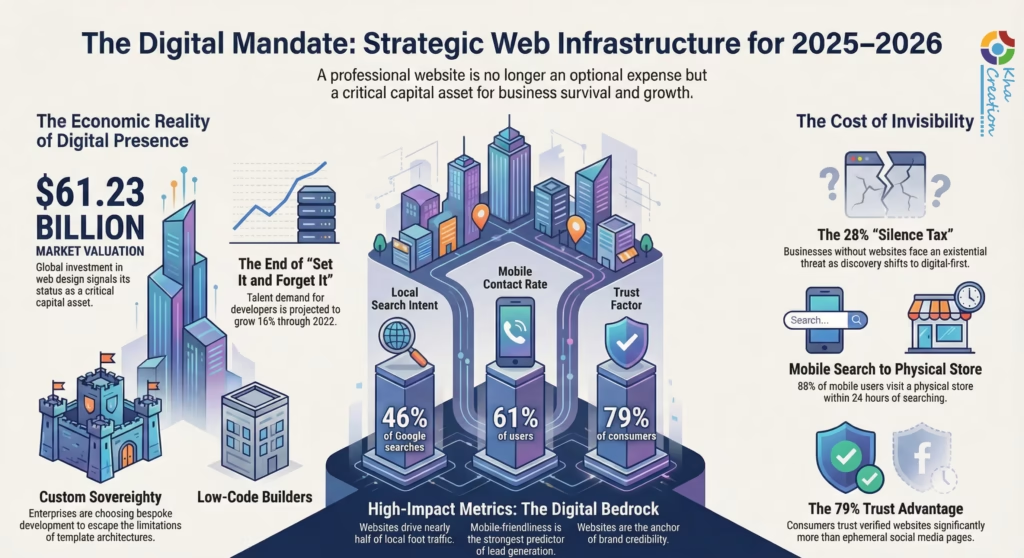
The stakes are quantified by the sheer scale of the digital economy. As we move through 2025, the web design services industry has swollen to a market size of $61.23 billion 1, driven not merely by new business formation but by a massive wave of re-platforming as legacy infrastructure fails to meet the technical demands of the “Agentic Web.” Yet, a dangerous digital divide persists: 28% of small businesses remain without a website, effectively rendering them invisible to the modern economy.1 This report explores the emerging discipline of Generative Engine Optimization (GEO), the critical revenue implications of Core Web Vitals, and the strategic necessity of owning one’s digital destiny.
2. The Economic Landscape of 2025–2026
The digital economy of the mid-2020s is characterized by a hyper-competitive ecosystem where the distinction between “online” and “offline” commerce has effectively evaporated. The internet of 2025 comprises over 1.2 billion websites, a sprawling digital metropolis where visibility is the primary currency.2 However, the distribution of value within this network is starkly uneven. While 72% of businesses have established a web presence, the remaining 28% face an existential threat of obsolescence as consumer behavior shifts decisively toward digital-first discovery.1
2.1 The Market Dynamics of Web Services
The valuation of the web design services industry at $61.23 billion in 2025 signals a robust recognition of digital infrastructure as a capital asset rather than an operational expense.1 This valuation reflects a compound growth driven by the increasing complexity of web technologies. As businesses scramble to integrate AI chatbots, personalized experiences, and e-commerce capabilities, the demand for specialized web developers has surged. Employment in this sector is projected to grow by 16% from 2022 to 2032, a rate significantly outpacing the national average for all occupations.1 This talent demand suggests that the “set it and forget it” mentality of the early 2000s is dead; modern websites require continuous development and optimization to remain viable.
The market is also witnessing a bifurcation. On one end, the global website builder market—tools like Wix and Squarespace—is projected to reach $2.3 billion in 2025, catering to the entry-level segment.3 On the other, enterprise-grade custom development is exploding as companies seek to escape the limitations of template-based architectures to build bespoke, high-performance environments capable of supporting the next generation of AI interactions. This schism underscores a critical strategic choice for business owners: the trade-off between the convenience of low-code platforms and the sovereignty and scalability of custom development.
2.2 The High Cost of Digital Invisibility
The absence of a website in 2025 incurs a “silence tax”—a pervasive, often unmeasured loss of revenue and brand equity. Data indicates that 97% of users now search online to find local businesses.4 This near-universal behavior means that a business without a digital footprint effectively opts out of the market before the consumer journey even begins. The implications are particularly acute for brick-and-mortar establishments. The “Research Online, Purchase Offline” (ROPO) phenomenon is stronger than ever, with 56% of people globally shopping both online and in local stores.4
Furthermore, the immediacy of mobile commerce drives local economic activity. A staggering 88% of mobile users who search for a local business visit a physical store within 24 hours.4 This causal link between digital discovery and physical foot traffic is the lifeline of local economies. When a business lacks a website, it does not merely lose online sales; it loses physical traffic, as it fails to appear in the 46% of Google searches that possess local intent.4 In an environment where consumers expect instant gratification—hours of operation, inventory availability, and pricing at their fingertips—opacity is interpreted as non-existence.
2.3 The Mobile-First Reality
The device landscape has settled into a mobile-dominant reality. By 2025, mobile devices are the primary interface for digital interaction. Consequently, the standard for “mobile-friendliness” has elevated from simple responsiveness to app-like performance. Statistics show that 61% of mobile users are more likely to contact a local business if its website is mobile-friendly.4 Conversely, friction on mobile is fatal to conversion. The user’s tolerance for poor mobile experiences has effectively vanished; they do not simply struggle through a bad site—they abandon it for a competitor. This behavior underscores that web development is not a purely aesthetic exercise but a functional imperative for lead generation.
2.4 Digital Trust and Credibility
In an era rampant with misinformation, deepfakes, and algorithmic manipulation, a proprietary website remains the gold standard of legitimacy. While social media allows for rapid dissemination of content, it suffers from a “trust deficit.” Consumers are increasingly wary of the ephemeral and often unverified nature of social content. In contrast, 79% of consumers trust websites more than social media pages.5 A website serves as the digital headquarters, a verified registry of a business’s identity, policies, and offerings. It is the only platform where the business controls the narrative completely, free from the contextual noise of ads, competitor content, and algorithmically suggested distractions that plague social media feeds.
| Metric | Statistic | Strategic Implication | Source |
| Web Design Market Value | $61.23 Billion (2025) | Investment in digital infrastructure is rising, signaling higher competition. | 1 |
| Unwebsite Business Rate | 28% | Nearly one-third of businesses are economically invisible to digital-first consumers. | 1 |
| Local Search Intent | 46% of all searches | A website is the primary driver of local foot traffic. | 4 |
| Mobile Conversion Link | 61% contact rate | Mobile optimization is the strongest predictor of lead generation. | 4 |
| Trust Factor | 79% trust websites > social | Websites are the anchor of brand credibility in a low-trust internet. | 5 |
3. The Generative Engine Optimization (GEO) Revolution
The most profound shift in the digital landscape of 2025–2026 is the emergence of Generative Engine Optimization (GEO). This discipline represents the evolution of SEO, adapted for a world where answers are synthesized by AI rather than retrieved from a list. As Generative AI engines like ChatGPT, Google Gemini, Claude, and Perplexity AI gain market share, they are fundamentally altering how information is discovered and consumed.
3.1 Defining GEO and the Synthesis Era
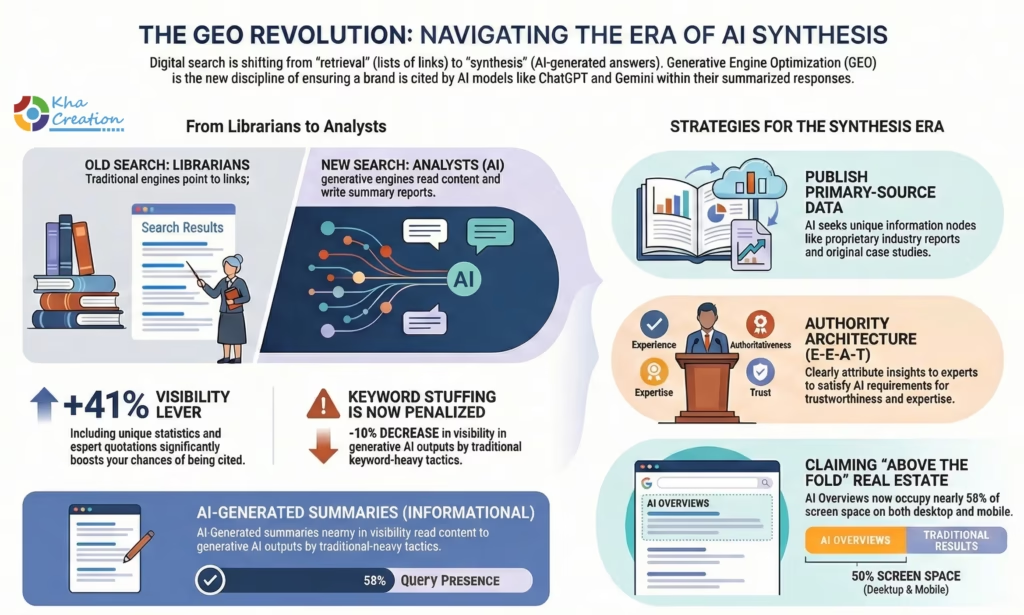
Generative Engine Optimization (GEO) is defined as the practice of optimizing content and website structure for AI-driven generative models to ensure that a brand’s message is accurately represented, synthesized, and cited.6 Unlike traditional search engines, which function as librarians pointing to books, generative engines function as analysts—reading the books and writing a summary report.
This shift utilizes Retrieval-Augmented Generation (RAG) architectures.7 In this model, the AI retrieves relevant documents from its index, “reads” them to understand context, and then generates a new, original response based on that information. For a business, the goal is no longer just to rank on the first page of results but to be included in the synthesized answer as a primary source of truth. If an AI summarizes the “best project management tools for 2026,” and a business is not cited in that paragraph, it effectively does not exist for the user, regardless of where its link might sit in the traditional footnotes.
3.2 The Princeton University Findings on Visibility
The academic foundation for GEO was solidified by a landmark study from Princeton University, which quantified the mechanics of visibility in generative engines. The researchers discovered that unlike traditional SEO—where keywords and backlinks were paramount—generative engines prioritize different signals. The study found that implementing specific GEO strategies could boost a website’s visibility in generative responses by up to 40%.7
Crucially, the study highlighted what doesn’t work. Traditional “keyword stuffing,” a staple of early SEO, was found to reduce visibility by 10% in generative outputs.8 AI models, trained on vast corpora of high-quality literature, are highly sensitive to unnatural language patterns and penalize content that feels manufactured for algorithms rather than written for humans.
Instead, the study identified “Statistics Addition” and “Quotation Addition” as powerful levers. Including quantitative data and direct quotes from authoritative sources improved visibility by 41%.8 Generative models are designed to be factual and authoritative; therefore, they gravitate toward content that provides hard data (numbers, percentages, dates) to substantiate its claims. A website that publishes “We are leading experts” is less likely to be cited than one that publishes “We served 15,000 clients in 2025 with a 98% satisfaction rate.”
3.3 Strategies for the GEO Era
To capitalize on this shift, web development strategies must pivot toward “Machine Readability” and “Authority Architecture.”
3.3.1 The Citation-Worthy Content Framework
Content must be engineered to be cited. This requires a shift from generic “how-to” guides to authoritative, primary-source content.
- Unique Data Publishing: Businesses should use their websites to publish proprietary data, case studies, and industry reports. AI agents seek unique information nodes to build their answers.
- Expert Attribution: Content should clearly attribute insights to specific experts within the organization, leveraging the E-E-A-T (Expertise, Experience, Authoritativeness, Trustworthiness) framework that Google and other AI developers emphasize.9
- Semantic Structure: Content should be structured logically with clear headings (H1, H2, H3) that mimic a well-organized textbook. This helps the RAG systems parse the relationship between concepts and retrieve the correct snippet for the answer.11
3.3.2 Technical Optimization for AI Crawlers
The “Technical SEO” of the past is now “Technical GEO.”
- Schema Markup as a Language: Schema markup (structured data) is the lingua franca of the Agentic Web. It provides explicit clues to the AI about the meaning of the content.
- LocalBusiness Schema: Critical for ensuring AI models know a business’s exact location, hours, and service area, preventing “hallucinations” where the AI invents incorrect details.12
- FAQ Schema: AI models frequently handle question-based queries. Marking up content with FAQ schema directly feeds the Q&A format of the generative output.12
- Organization Schema: Connects a website to its social profiles, founders, and subsidiaries, helping the AI construct a comprehensive “Knowledge Graph” of the brand entity.14
- Contextual Context: Unlike keyword matching, GEO requires “Contextualism.” This involves optimizing foundational technical elements to allow AI engines to discover and understand the broader context of the brand.6
3.4 The Cost of Ignoring GEO
The transition to AI search is not a future theoretical; it is a current reality. By May 2025, AI-generated summaries were appearing in 13% of all search queries, and for informational searches, that number jumped to 58%.15 Furthermore, AI Overviews were occupying 42% of the screen on desktop and 48% on mobile.15
This “real estate” takeover means that organic traffic from traditional blue links is being pushed “below the fold.” A business that ignores GEO is effectively invisible to the majority of users who are satisfied by the AI’s summary. The “zero-click” future, where users get their answer without leaving the search page, demands that businesses optimize to be the source of that answer, ensuring brand attribution even if the click never happens.
4. The Technical Revenue Engine: Core Web Vitals and Performance
In the ecosystem of 2025, website performance has transcended its status as a technical metric to become a primary driver of revenue and business viability. The correlation between site speed, user experience, and financial outcomes is linear and unforgiving. Google’s Core Web Vitals (CWV) initiative has standardized how performance is measured, and these metrics now act as gatekeepers for both search visibility and customer retention.
4.1 The Metrics of Modern Performance
Core Web Vitals quantify the distinct aspects of user experience that determine whether a user stays or leaves.
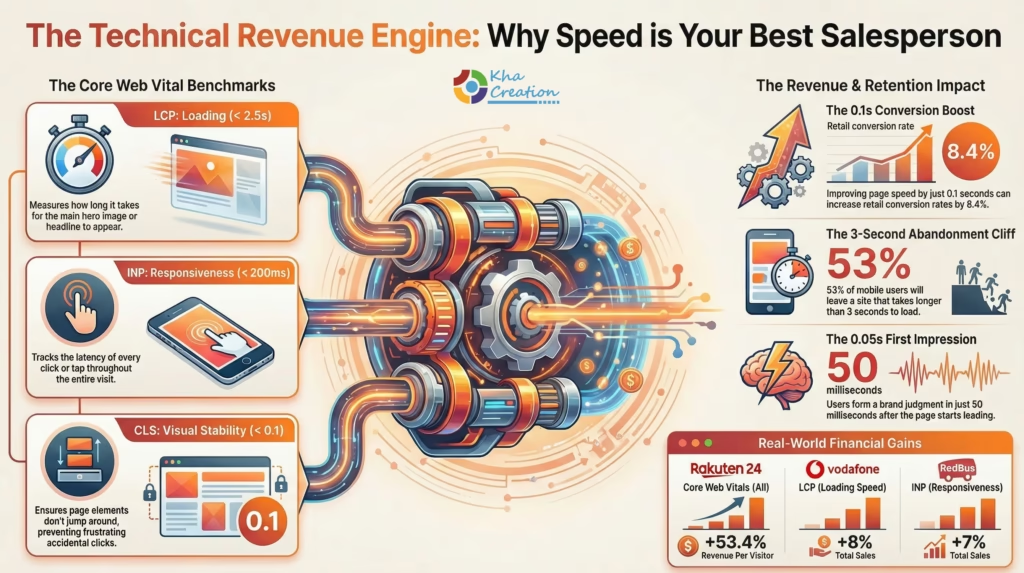
- Largest Contentful Paint (LCP): This measures perceived load speed—specifically, how long it takes for the main content (hero image or headline) to appear. The benchmark for 2025 remains strict: 2.5 seconds or less.16
- Interaction to Next Paint (INP): Replacing the older First Input Delay (FID) metric, INP measures responsiveness. It tracks the latency of every interaction (click, tap, key press) throughout the entire lifespan of the page visit. A good score is under 200 milliseconds.16 This metric is crucial because it captures the “rage click” moments where a user taps a button and nothing happens.
- Cumulative Layout Shift (CLS): This measures visual stability. A score of less than 0.1 ensures that text and buttons do not jump around as the page loads, a common source of user frustration and accidental clicks.16
4.2 The Revenue Correlation: Speed is Money
The business impact of these technical metrics is profound. Research from Deloitte and Google indicates that improving page speed by just 0.1 seconds can boost retail conversion rates by 8.4% and increase average order value by 9.2%.17 This sensitivity to speed highlights that modern consumers operate with a micro-tolerance for delay.
Case studies from 2024–2025 reinforce this revenue link:
- Rakuten 24: By optimizing all three Core Web Vitals, the e-commerce giant achieved a 53.4% increase in revenue per visitor and a 33.1% rise in conversion rates.18
- Vodafone: A 31% improvement in LCP (loading speed) resulted in an 8% increase in total sales.17
- RedBus: Focusing on the new INP metric and improving it by 72% led to a 7% increase in sales.17
Conversely, poor performance is a revenue leak. 53% of mobile users abandon a site that takes longer than three seconds to load.19 In the competitive landscape of 2025, a slow website is not merely an annoyance; it is a business repellent. With 60% of shoppers abandoning purchases due to poor user experience, the cumulative cost of technical debt runs into the billions for the e-commerce sector.20
4.3 The Psychological Thresholds of UX
User behavior statistics from 2025 reveal the extreme cognitive speed at which consumers judge digital properties. An average user forms an impression of a website in just 0.05 seconds (50 milliseconds).20 This “blink” judgment determines whether they trust the brand or navigate away. Furthermore, 94% of these first impressions are design-related.20
Once the user decides to stay, the window for engagement remains narrow. Users spend an average of only 5.59 seconds reading a website’s written content.20 This necessitates a design philosophy that prioritizes scannability, visual hierarchy, and immediate value delivery. “Wall of text” layouts fail because they do not respect the user’s cognitive load limits.
4.4 Mobile-First Indexing and the “Thumb Economy”
With Google’s index being mobile-first, the mobile version of a website is the only version that matters for ranking. This aligns with user behavior, where 61% of mobile users are more likely to contact a local business if the site is mobile-friendly.4
The “Thumb Economy” demands specific design considerations. Navigation must be accessible with one hand; buttons must be large enough to prevent miss-taps (a factor in CLS scores); and content must be legible without zooming. The friction of a non-optimized mobile site is the single fastest way to drive a potential customer to a competitor. As of 2025, 88% of online shoppers say they are unlikely to return to a site after a bad experience, and 89% will actively switch to a competitor.20
| Metric | Business Impact | Source |
| 0.1s Speed Improvement | +8.4% Conversion Rate | 17 |
| LCP < 2.5s | Critical threshold for user retention | 16 |
| Bad UX Abandonment | 88% of users won’t return | 20 |
| First Impression Time | 0.05 seconds | 20 |
| Rakuten Case Study | +53% Revenue per Visitor via CWV opt. | 18 |
5. The “Rented Land” Trap: Risks of Social Media Dependence
A pervasive myth in small business strategy is that a social media presence can substitute for a proprietary website. This “rented land” strategy is fraught with existential risks in the regulatory and algorithmic climate of 2025–2026. While social media is a powerful channel for distribution, it is a perilous foundation for a business.
5.1 The Volatility of Algorithms
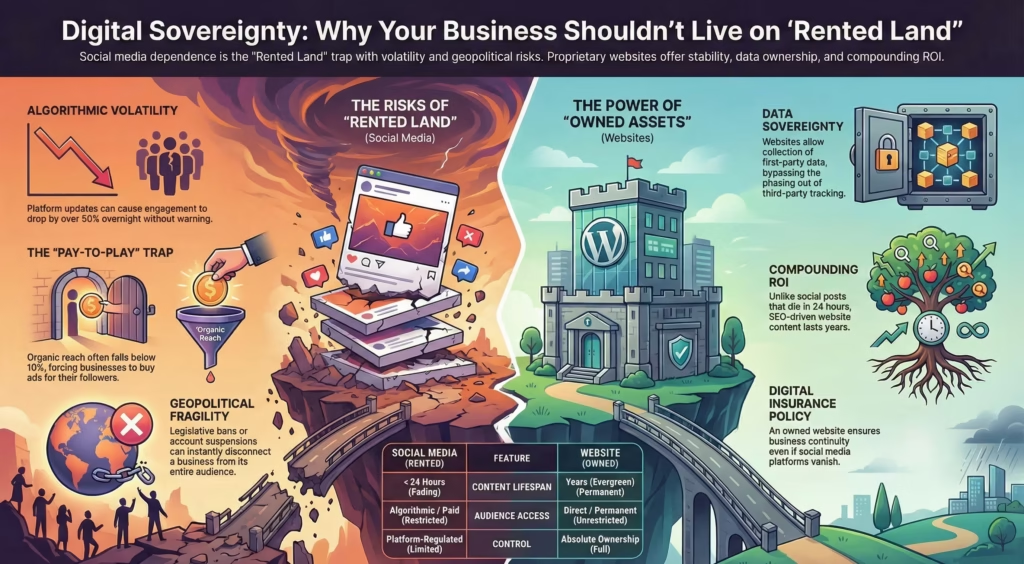
Social media platforms are notoriously unstable partners. Business owners who rely on them are subject to “algorithmic volatility,” where a platform update can eviscerate organic reach overnight. Reports from late 2024 and 2025 highlight a significant shift in Instagram’s algorithm, where static image posts were deprioritized in favor of Reels, causing many businesses to lose over 50% of their usual engagement without warning.21
This volatility forces businesses into a “pay-to-play” model. As organic reach declines (often to less than 5-10% of followers), businesses must purchase ads simply to reach the audience they spent years building.23 A website, by contrast, is an “owned asset.” The traffic it generates, the email list it captures, and the domain authority it builds are the permanent property of the business, immune to the whims of a third-party CEO or algorithm update.24
5.2 The Geopolitical Risk: The TikTok Scenario
The risks of platform dependence are not just algorithmic but geopolitical. The legislative landscape of 2025 has introduced the very real threat of platform bans. With the U.S. government moving to force the divestiture of TikTok under threat of a ban, businesses that built their entire marketing funnel on this single platform face a catastrophic loss of access to their customer base.25
This scenario illustrates the fragility of building a business on rented land. If a platform is banned, or if a user’s account is suspended (a common occurrence with automated moderation bots), the business disappears instantly. A website acts as a digital insurance policy. Even if TikTok, Instagram, or X (formerly Twitter) were to vanish, the website remains accessible, ensuring business continuity.27
5.3 Ownership vs. Leasing: The Asset Class Argument
Analysts compare a website to real estate ownership and social media to renting an apartment.
- Asset Control: On a website, the business controls every pixel, policy, and pathway. There are no competing ads next to your product, and no character limits on your message.27
- Data Sovereignty: Social platforms hoard user data. A website allows for the collection of “first-party data” (direct customer emails, purchasing behavior). In a “cookieless” world where third-party tracking is being phased out, owning your own data is the only way to secure long-term marketing viability.24
- Long-Term ROI: Social media content has a short half-life; a post is often irrelevant within 24 hours. Website content is evergreen. A high-quality article or product page can attract traffic via SEO and GEO for years, providing a compounding return on investment that social media cannot match.5
6. The Agentic Web: Future-Proofing for 2026–2030
As we look toward the latter half of the decade, the function of a website is expanding beyond human interaction. We are entering the age of the “Agentic Web,” where autonomous AI agents perform tasks on behalf of users.
6.1 Websites as APIs for Agents
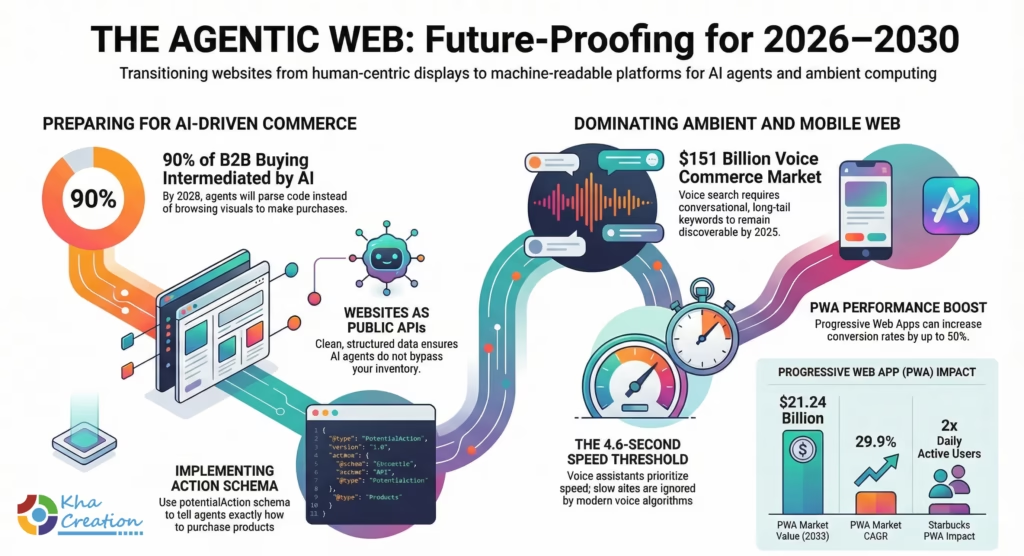
Gartner predicts that by 2028, 90% of B2B buying will be intermediated by AI agents.28 These agents will not “browse” a website visually; they will parse its code to extract pricing, availability, and specifications to make purchasing decisions.
For a website to survive in this economy, it must function as a public API (Application Programming Interface). This means the underlying code must be as clean and structured as the visible design. If an AI agent cannot easily determine the price of a product or its stock status because the data is trapped in an image or a complex script, the agent will bypass that vendor in favor of one with machine-readable data.
6.2 Action Schema: From Passive to Active
The key to unlocking the Agentic Web is Action Schema. Current schema markup is largely passive—it describes what an object is (e.g., “This is a pair of shoes”). The next evolution is potentialAction schema, which tells an agent how to interact with the object (e.g., “Use this API endpoint to purchase these shoes”).29
Implementing Action Schema transforms a website from a catalog into a tool that AI agents can wield. This moves the question from “Is my site discoverable?” to “Is my site actionable?” Businesses that adopt this “headless” approach to commerce—where the transaction can happen without a human ever visiting the site—will dominate the automated procurement markets of the future.
6.3 Voice Search and Ambient Computing
The rise of ambient computing (smart speakers, wearables, connected cars) relies entirely on web-based data. Voice search is projected to facilitate $151 billion in commerce by 2025.30 Voice queries are fundamentally different: they are conversational, long-tail, and hyper-local.
Optimizing for voice requires a specific content strategy:
- Conversational Keywords: Targeting natural language phrases like “Where can I find a 24-hour locksmith?” rather than just “locksmith”.31
- Speed is Critical: Voice assistants prioritize speed even more than screens. The average voice result loads in 4.6 seconds, significantly faster than the average web page.32 Slow sites are simply ignored by the voice algorithms.
6.4 Progressive Web Apps (PWAs)
The bridge between the web and the app ecosystem is the Progressive Web App (PWA). PWAs use modern web capabilities to deliver app-like experiences (offline access, push notifications) directly through the browser.
- Market Growth: The PWA market is exploding, projected to reach $21.24 billion by 2033 with a CAGR of 29.9%.33
- Performance: PWAs dramatically improve engagement. Starbucks reported a 2x increase in daily active users after launching their PWA, and other case studies show conversion rate boosts of up to 50%.34
- Cost Efficiency: Developing a PWA is significantly cheaper than building separate native apps for iOS and Android, offering a single codebase that works everywhere.36
7. Development Ecosystems: Custom vs. Builders vs. CMS
Choosing the right technological foundation is a critical business decision with long-term financial implications. The market offers a spectrum of choices, from low-code website builders to enterprise-grade custom development.
7.1 The CMS Landscape: WordPress Dominance
WordPress continues to power roughly 43% of the internet in 2025, maintaining its dominance due to its open-source nature and massive ecosystem of plugins.1 It remains the default choice for content-heavy sites. However, its popularity makes it a target for security threats, requiring diligent maintenance.
7.2 The Rise of Website Builders
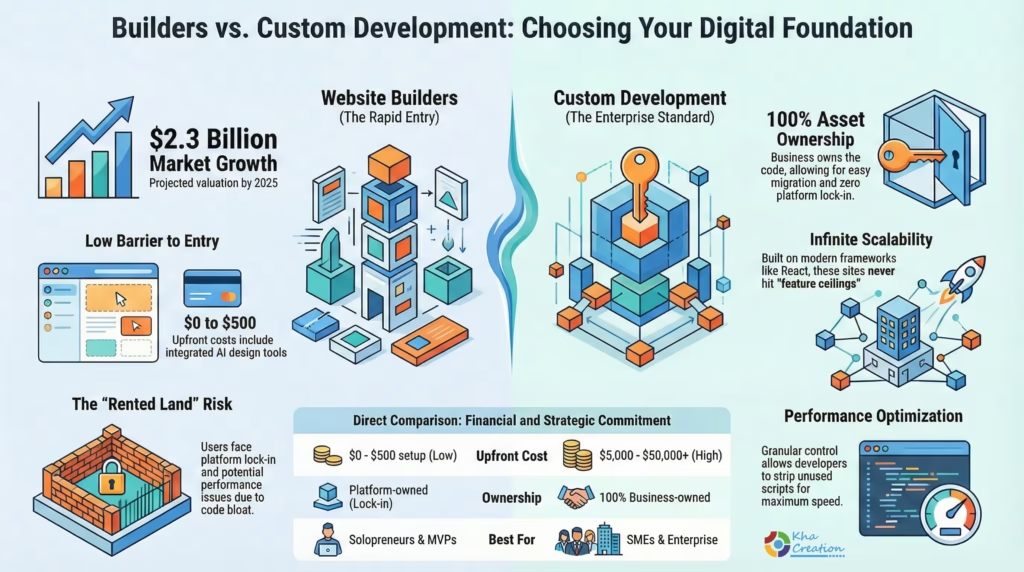
Platforms like Wix and Squarespace have matured, with the website builder market projected to reach $2.3 billion in 2025.3
- Pros: rapid deployment, low upfront cost ($0–$500/month), and integrated AI design tools.37
- Cons: “Rented land” risks (platform lock-in), limited SEO capabilities compared to custom stacks, and often poorer Core Web Vitals performance due to code bloat. Data shows that platforms like Wix often trail behind optimized custom solutions in pure performance metrics.38
7.3 Custom Development: The Enterprise Standard
For businesses anticipating scale, custom development remains the superior long-term investment.
- Scalability: Custom sites built on modern frameworks (React, Next.js) can scale infinitely. They do not hit the “feature ceilings” common with builders.39
- Performance: Custom code allows for granular optimization of Core Web Vitals. Developers can strip away unused scripts (“tree shaking”) to achieve speeds that generic builders cannot match.39
- Ownership: With a custom site, the business owns the code. If a hosting provider increases prices, the site can be migrated. There is no platform lock-in.39
Table: Cost-Benefit Analysis of Development Paths (2025 Estimates)
| Feature | Website Builders (Wix, Squarespace) | Custom Web Development |
| Upfront Cost | Low ($0 – $500 setup) | High ($5,000 – $50,000+) |
| Monthly Cost | $20 – $500/mo (subscription) | $50 – $200/mo (hosting/maintenance) |
| Ownership | Platform-owned (Lock-in risk) | 100% Business-owned |
| SEO/GEO Capabilities | Limited (Template constraints) | Unlimited (Full Schema/API control) |
| Scalability | Low (Hard ceilings on features) | High (Infinite extensibility) |
| Performance (CWV) | Variable (Code bloat common) | High (Optimized architecture) |
| Best For | Solopreneurs, MVP, Micro-biz | SMEs, Enterprise, E-commerce |
| Sources | 37 | 37 |
7.4 Hidden Costs
Business owners often overlook the total cost of ownership (TCO). While builders have low upfront costs, the long-term subscription fees and transaction fees can exceed the cost of a custom build over 3-5 years. Conversely, custom sites require a budget for ongoing maintenance (security patches, updates), which can range from $2,000 to $30,000 per year depending on complexity.37
8. Trust, Security, and Accessibility
8.1 Security as a Trust Signal
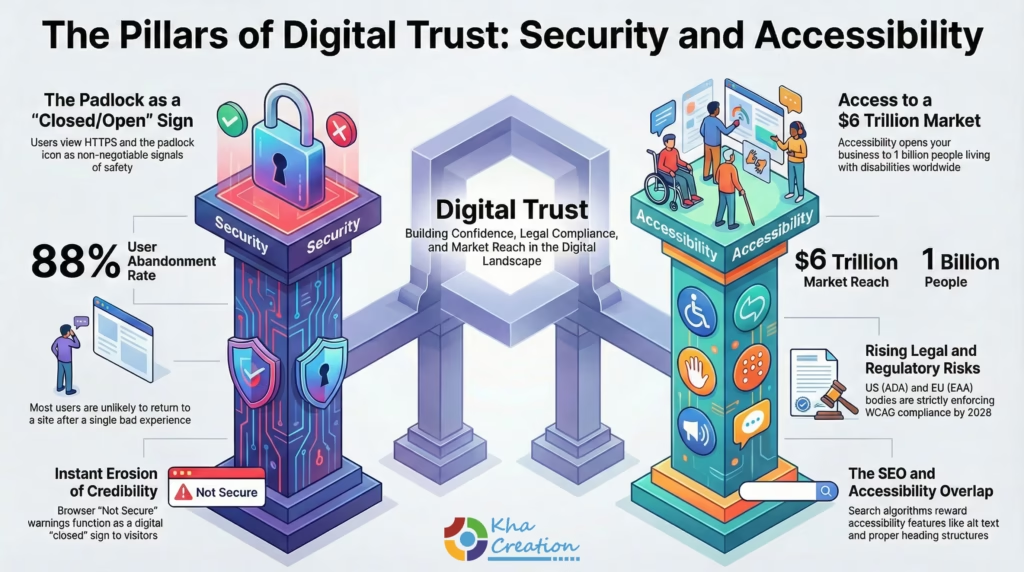
In the high-stakes environment of 2025, website security is a non-negotiable trust signal. Users are conditioned to look for the padlock icon (HTTPS). If a browser warns “Not Secure,” trust is instantly eroded. With 88% of users unlikely to return after a bad experience, a security warning is effectively a “closed” sign.20
8.2 The Legal Imperative of Accessibility
Web accessibility—ensuring a website is usable by people with disabilities—has moved from a moral obligation to a legal and economic one. The World Wide Web Consortium (W3C) guidelines (WCAG) are now the global standard.
- Legal Risk: In 2026, regulatory bodies in the US (ADA) and EU (European Accessibility Act) are strictly enforcing digital accessibility. Non-compliance can lead to significant fines and lawsuits.42
- Market Reach: Over 1 billion people globally live with some forhttps://khacreationusa.com/keyboard-navigation-for-wcag-ensuring-accessibility-for-all/m of disability. An accessible website opens the market to this demographic, which commands over $6 trillion in spending power.44
- SEO Benefit: Accessibility and SEO overlap significantly. Features like alt text for images, proper heading structures, and keyboard navigability are rewarded by both search algorithms and assistive technologies.43
9. Conclusion
In 2026 and beyond, website development is no longer a marketing activity; it is an infrastructure investment. The convergence of AI search (GEO), autonomous agents, and mobile-first consumer behavior demands a website that is fast, structured, and authoritative.
Businesses that rely solely on social media are building on sinking sand, exposed to algorithmic volatility and platform risk. In contrast, a robust, owned website serves as a sovereign digital territory—a secure hub for data, a training ground for brand-aligned AI, and a high-performance conversion engine.
The data is unequivocal: with 28% of small businesses still lacking a website, there is a massive arbitrage opportunity for those who invest in digital excellence.1 By prioritizing Technical SEO, adopting GEO strategies, and ensuring elite Core Web Vitals performance, businesses can future-proof their revenue streams against the disruptions of the AI era. The website of 2026 is not just a place for humans to visit; it is the digital nervous system of the modern enterprise.
Frequently Asked Questions (FAQ)
Q1: Why can’t I just use a Facebook Page or Instagram profile instead of a website?
A: Relying solely on social media is a “rented land” strategy. You do not own your audience or your data. Algorithms can cut your reach to zero overnight, and accounts can be banned without recourse.24 A website gives you 100% control, ownership of customer data, and immunity to platform changes. Additionally, 79% of consumers trust websites more than social media pages.5
Q2: What is Generative Engine Optimization (GEO) and do I really need it?
A: Yes. GEO is the new SEO for AI search engines like ChatGPT and Google Gemini. It involves optimizing your content with citations, statistics, and structured data so that AI models use your business as a source in their answers.6 With AI summaries appearing in over 50% of informational searches 15, ignoring GEO means becoming invisible to half your potential customers.
Q3: How much does a professional website cost in 2025?
A: Costs vary widely based on functionality. A DIY builder site might cost $20-$500/month in subscriptions. A professional custom website for a small business typically ranges from $5,000 to $10,000, while complex enterprise or e-commerce sites can range from $10,000 to $50,000+.37 The investment depends on your need for custom features, scalability, and performance.
Q4: My website looks fine, why do I need to worry about “Core Web Vitals”?
A: “Looking fine” isn’t enough. Core Web Vitals measure how fast and stable your site feels to a user. If your site takes longer than 3 seconds to load, you lose 53% of mobile visitors.19 Improving these metrics directly increases revenue—Rakuten saw a 53% revenue boost by optimizing them.17
Q5: Is voice search actually relevant for my local business?
A: Absolutely. By 2025, 50% of searches are expected to be voice-based.45 Many of these have local intent (e.g., “Find a plumber near me”). If your website isn’t optimized for conversational, question-based queries, voice assistants like Siri and Alexa won’t find or recommend you.31
Q6: What is the risk of using a website builder like Wix vs. hiring a developer?
A: Builders are excellent for starting out but can limit you as you scale. You often suffer from platform lock-in (you can’t move your site), and you have less control over the underlying code, which can hurt advanced SEO and speed.39 Custom development offers better long-term performance and total ownership but requires a higher initial investment.40
Q7: Will AI replace the need for websites?
A: No, AI will change how websites are used. Instead of just humans visiting your site, AI agents will visit your site to retrieve information for users.29 This makes having a well-structured website more important, as it becomes the trusted data source that feeds the AI answers.
References Works cited
- 40+ Website Statistics Every Marketer Should Know in 2026 – WebFX,
- Top Website Statistics for 2025 – Advisor – Forbes
- 50+ Small Business Website Statistics, 2026 – Wix.com
- 45 Digital Marketing Statistics That Will Impact Your 2026 Strategy – SEO.com
- Website vs Social Media: Which Is Better for Your Business? – Tilipman Digital
- Generative Engine Optimization (GEO): What to Know in 2025 | Walker Sands
- Generative engine optimization – Wikipedia
- GEO Targeted: Critiquing the Generative Engine Optimization Research – Sandbox SEO
- Google Search’s guidance about AI-generated content | Google
- SEO Techniques for AI-Generated Content – Overdrive Interactive
- What is generative engine optimization (GEO)?
- Schema Markup for Better Visibility in AI Search Results – Digital Analyst Team
- Why Should Local Businesses Embrace Schema Markup for SEO Success? – Outreach Digital Marketing
- Schema Markup for AI Search: Preparing Your Business for the Future – TheeDigital
- Generative Engine Optimization (GEO) Guide: AI Search Strategies – Digiligo
- Wix: Breaking Performance Myths – The Complete 2025 Guide to 90+ Mobile Speed Scores
- What Are Core Web Vitals & How to Improve Them for Better Rankings – MonsterInsights
- WPO Stats: Case studies on the business impact of web performance
- https://www.enfuse-solutions.com/core-web-vitals-optimizing-user-experience-for-better-seo-in-2025
- 75 Important Website Statistics of 2026 Everyone Should Know – DiviFlash
- Why your Instagram reach is dropping in 2025… : r/socialmedia – Reddit,
- Instagram engagement down March 2025 : r/InstagramMarketing – Reddit,
- The Decline of Organic Reach on Social Media in 2026 – ADdictive Digital,
- Small business website design vs social media: where to focus your energy – Marketeam
- Saving TikTok While Protecting National Security – The White House
- What the Potential TikTok Ban Could Mean for Your Business & How to Minimize Platform Risk – Quiet Light
- Website vs. Social Media: Why Your Business Needs Both – Webnode.com
- Strategic Predictions for 2026: How AI’s Underestimated Influence Is Reshaping Business – Gartner,
- Action Schema: Implementing Potential Action for AI Agents | Cubitrek
- How to Optimize for Voice Search in 2025 – circle S studio
- The Rise of Voice Search: Optimizing Your Content for 2025 – Evolved Marketing
- Voice Search Optimization 2025 for Local Biz | GreenBananaSEO,
- Progressive Web Apps Market Size | Industry Report, 2033 – Grand View Research
- Top 10 Benefits of Progressive Web Apps (PWAs) for Modern Businesses – The Tech Clouds
- Progressive Web Apps (PWA) Market Size, Growth & Trends by Forecast 2033 – Straits Research
- 8 Key Progressive Web App Benefits for Your Business in 2025,
- Website Cost in 2025: Full Guide to Design & Development Pricing – The Web Factory,
- 2025 Core Web Vitals Challenge: WordPress Versus Everyone – Search Engine Journal,
- The Hidden Costs of Using Website Builders (and Why Custom Development Pays Off) – Code Craft
- Website Builder VS. Custom Website: Complete 2025 Comparison Guide – Dorik
- Custom Web Design vs. DIY Website Builders: What’s Best for You? – Medium
- https://www.ada.gov/resources/web-rule-first-steps/
- Web Accessibility ➡️ 2025’s Laws & Standards Overview
- The Business Case for Digital Accessibility | Web Accessibility Initiative (WAI) – W3C,
- Voice Search Optimization in 2025 | Best Practices for UX & SEO – Design In DC