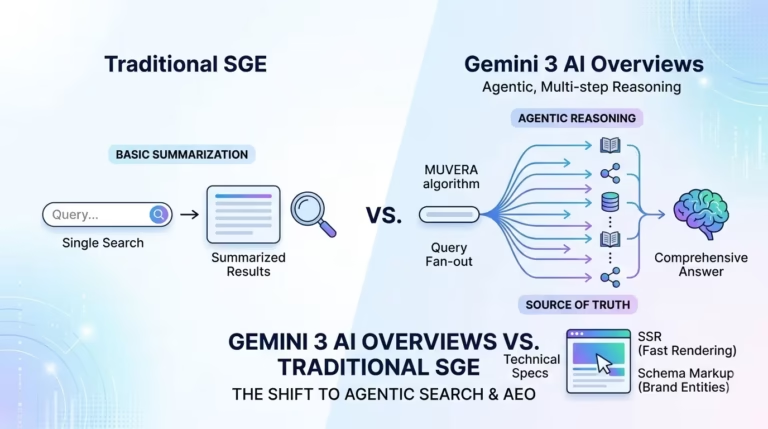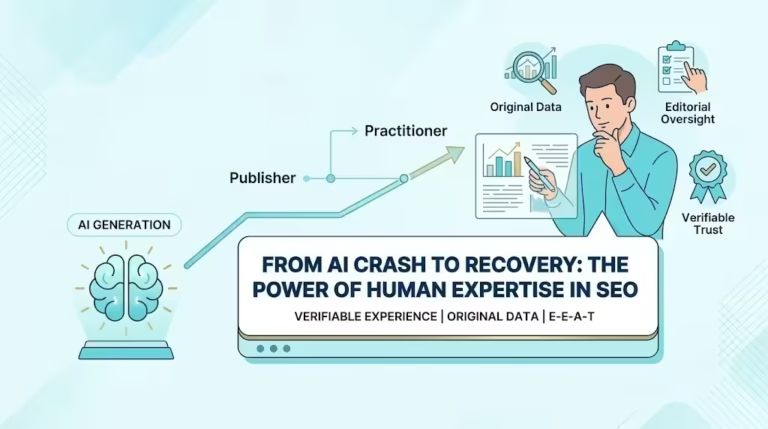

The search landscape is undergoing its biggest shift in two decades. We are moving from the “Search Economy”, where the goal was a click, to the “Citation Economy,” where the goal is to be the answer.
With over 60% of Google searches now ending without a click, traditional SEO strategies are no longer sufficient. To survive in 2026, you must optimize for the machines that build the answers: Generative Engines (GEs) like Google AI Overviews, Perplexity, and SearchGPT.
What is GEO?
Generative Engine Optimization (GEO) is the practice of optimizing content to maximize its visibility, citation, and synthesis within AI-powered answer engines.
Unlike traditional SEO, which focuses on ranking links, GEO focuses on ranking facts. It optimizes for Entity Recognition, Fact Density, and Structure to ensure Large Language Models (LLMs) select your content as the building block for their direct answers.
The Science of GEO: 3 Proven Tactics to Boost Visibility
Recent research from Princeton University and the Allen Institute for AI (utilizing the “GEO-Bench” framework) has quantified exactly what makes content attractive to AI models. Their findings reveal that specific adjustments can increase visibility by up to 40%.
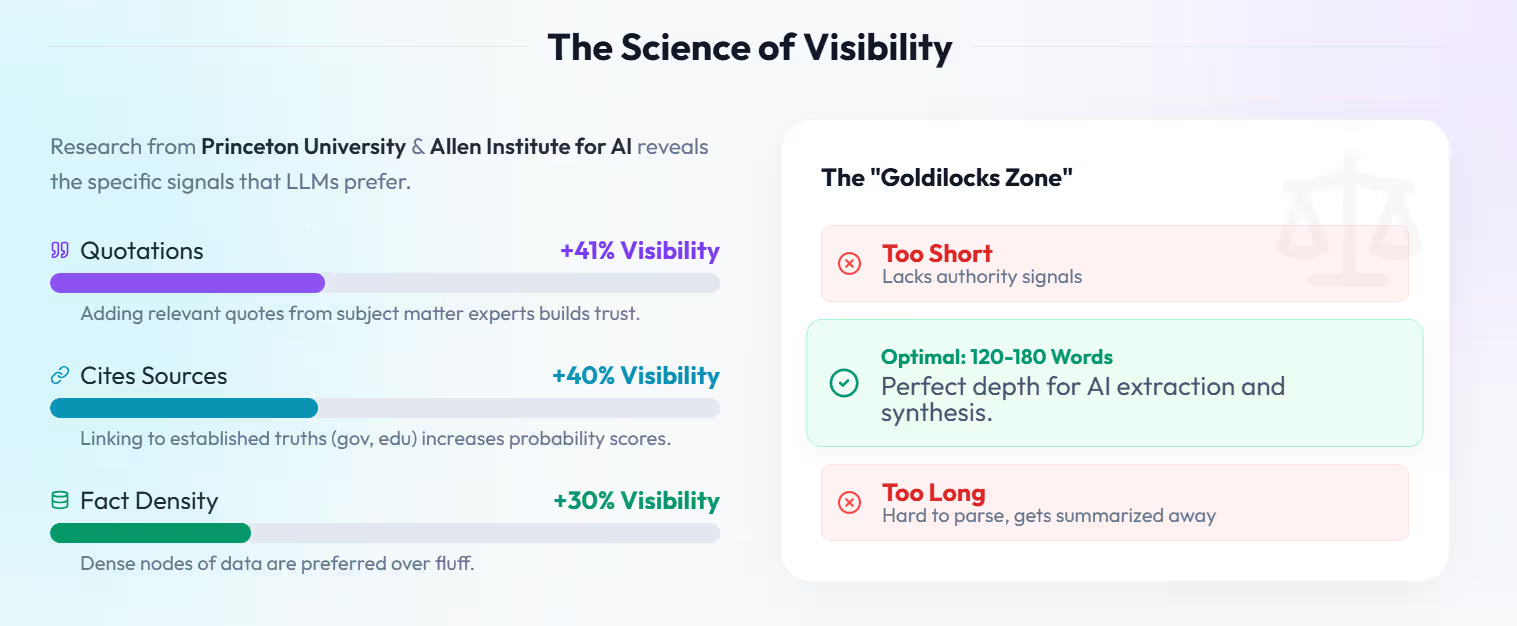
1. Leverage the Power of Quotations (+41% Visibility)
AI models are trained to trust authority. The single most effective tactic found in GEO research was adding relevant quotes from subject matter experts.
- Why it works: Quotes act as “Trust Signals” that verify accuracy.
- Action: Don’t just make a claim; support it. Instead of saying “GEO is important,” include a quote: “GEO allows website owners to optimize content specifically for generative engines… leading to large visibility enhancement,” notes the Princeton research team.
2. Cite Your Sources (+40% Visibility)
Generative engines function as “probability machines.” Content that links to established truths (government data, academic studies, white papers) is statistically scored as more likely to be true.
- Action: Aim for a “Citation Density” of at least one high-quality external link per 200 words for technical topics.
3. Increase Fact Density (+30% Visibility)
Vague content gets ignored; specific content gets cited. LLMs are “information compressors” that seek dense nodes of data.
- The “Goldilocks Zone”: Aim for section lengths of 120-180 words. This length provides enough depth to establish expertise while remaining digestible for AI extraction.
Pro Tip: Replace fluff with facts.
- Bad: “Many people use our software.”
- Good: “Over 12,000 companies across 47 countries use our software, processing 2.3 million transactions daily.”
Actionable Guide: How to Optimize Your Content for AI
To rank in 2026, you must speak the language of entities. Here is a practical framework to transform your content.
Strategy A: Entity Optimization (The “Before & After”)
Search engines no longer just match keywords; they map Entities (people, places, things, concepts). You must clearly define what you are to the AI.
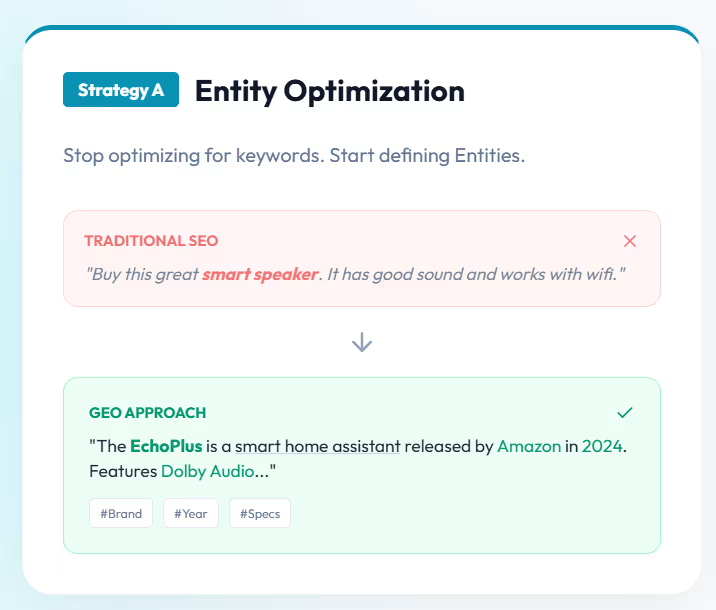
| Feature | Traditional SEO Approach | GEO / Entity Approach |
| Concept | “Smart Speaker” (Keyword focus) | “EchoPlus” (Product Entity) |
| Content | “Buy this great smart speaker. It has good sound and works with wifi.” | “The EchoPlus is a smart home assistant released by Amazon in 2024. It features Dolby Audio, Zigbee smart home hub integration, and voice control via Alexa.” |
| Why it Wins | Relies on keyword matching. | Defines the Brand, Year, Specs, and Tech, making it easy for AI to categorize and cite specifications. |
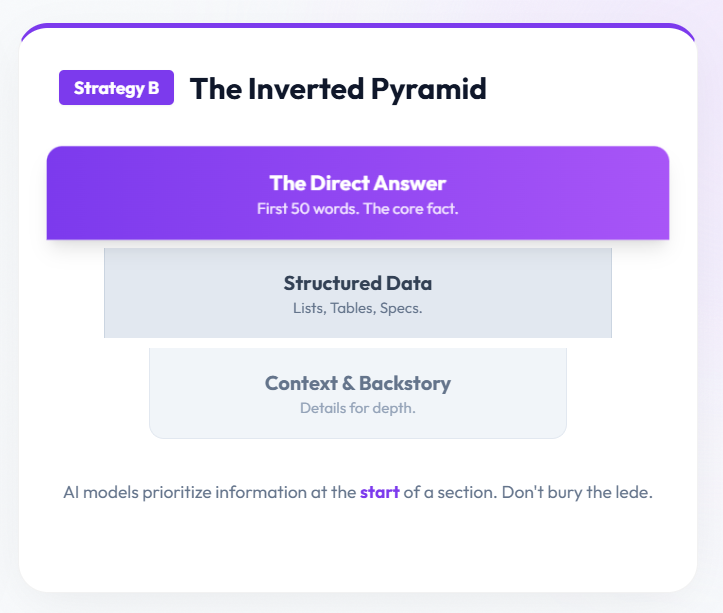
Strategy B: The “Inverted Pyramid” Structure
AI models read differently than humans. They prioritize information presented at the top of a section.
- The Answer First: Place your direct answer in the first 50 words of your article or section.
- Structured Data: Use HTML lists and tables. Google often scrapes these directly for “Snapshot” answers.
- Context Later: Save the backstory and fluff for the bottom of the page.
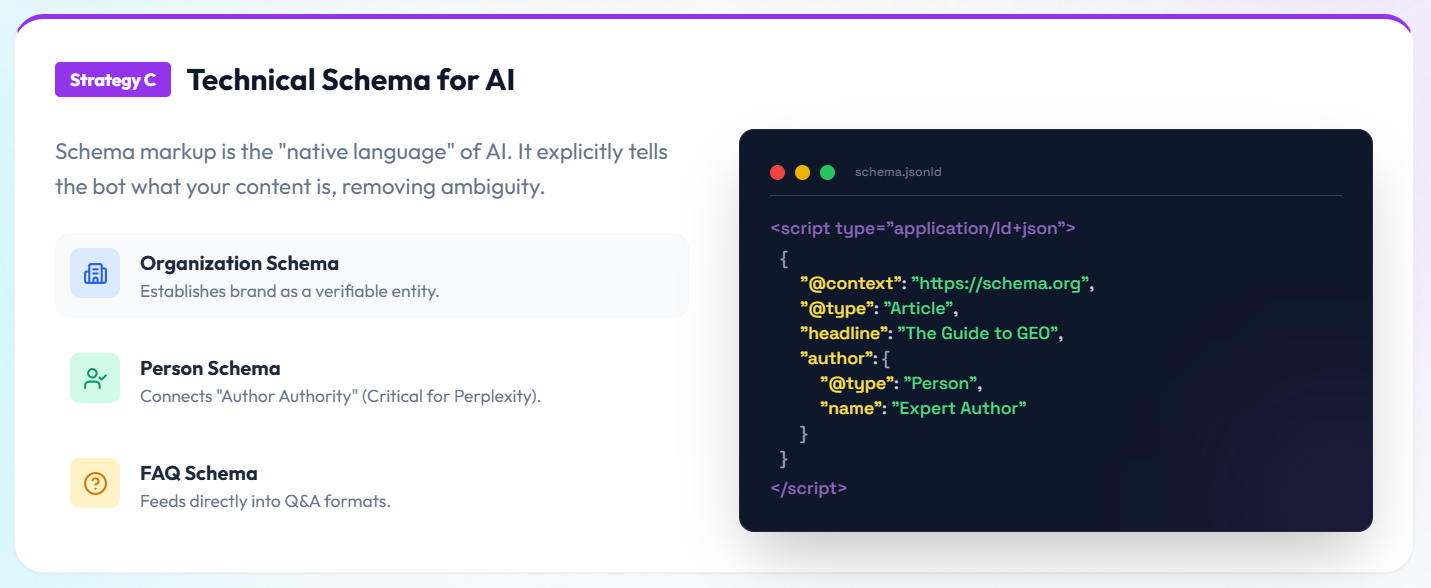
Strategy C: Technical Schema for AI
Schema markup is the “native language” of AI. It explicitly tells the bot what your content is, removing ambiguity.
- Organization Schema: Establishes your brand as a verifiable entity (not just a text string).
- Person Schema: critical for connecting “Author Authority” to the content, a key factor for Perplexity.
- FAQ Schema: Directly feeds into the Q&A format of chat-based search engines.
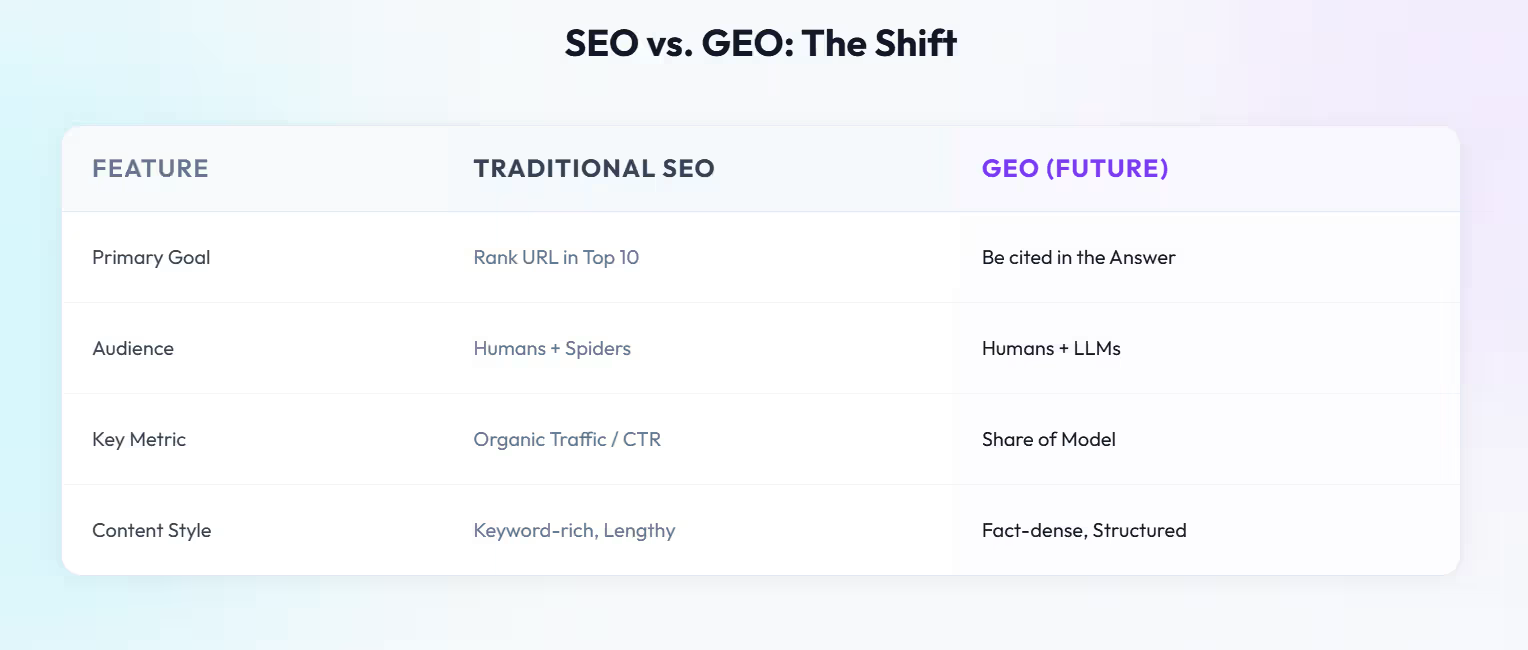
GEO vs. SEO: At a Glance
| Feature | SEO (Search Engine Optimization) | GEO (Generative Engine Optimization) |
| Primary Goal | Rank a URL in a list (Top 10). | Be cited in a synthesized answer. |
| Target Audience | Humans + Search Spiders. | Humans + LLMs (Large Language Models). |
| Key Metric | Organic Traffic / CTR. | Share of Model / Citation Frequency. |
| Content Style | Keyword-rich, lengthy. | Fact-dense, structured, authoritative. |
| Success Factor | Backlinks & Keywords. | Entities & Information Gain. |
Platform Playbook: Optimizing for Specific Engines
Different engines favor different signals. Here is your cheat sheet for 2026:
- Google AI Overviews (SGE): Focus on the Inverted Pyramid. Answer the user’s query immediately. Use distinct H2/H3 headers that mimic natural questions (e.g., “How much does X cost?”).
- Perplexity AI: Focus on Recency and Citations. Update your dateModified schema often. Perplexity heavily favors content that cites external authorities and frequently pulls from YouTube transcripts.
- SearchGPT: Focus on Conversational Flow. Structure your content with headers that mimic natural follow-up questions to keep the AI “interested” in the conversation thread.
The Verdict
The brands that win in 2026 will build a “Hybrid Strategy.” They will maintain their technical SEO foundation while re-engineering their content to be “machine-readable”, dense with facts, rich with entities, and endorsed by citations.